


AGN Dust Tori May Be Birthplaces of Millions of Planets, Study Suggests
Astronomers from New Mexico State University, the Nicolaus Copernicus Astronomical Center, and Manhattan Community College suggest that the dust-rich torus surrounding an active galactic nucleus (AGN)—the energetic center of a galaxy powered by material falling toward a supermassive black hole—could act much like a protoplanetary disk around a young star.
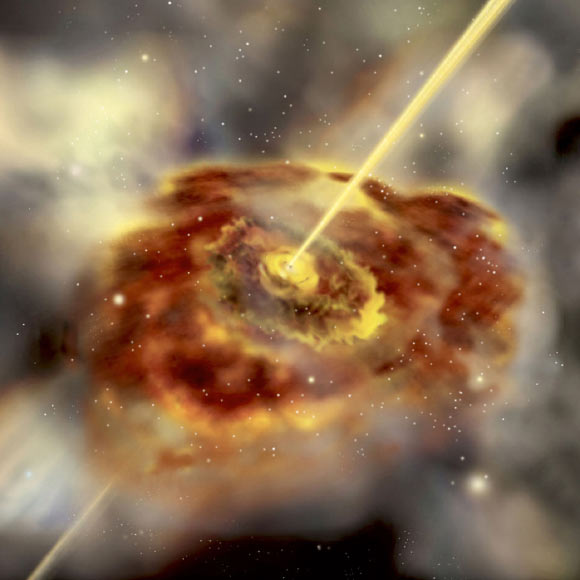
An artist’s impression of an AGN dust torus that could harbor millions of planets. Image credit: ESO.
“Planets form in disks of gas and dust surrounding young stars,” said New Mexico State University astrophysicist Vladimir Lyra and his colleagues.
“However, another promising environment for planet formation may exist in the disk surrounding an active galactic nucleus.”
“In recent years, researchers have identified important similarities between the physical processes occurring in circumstellar disks and those taking place in AGN disks.”
“These similarities suggest that mechanisms traditionally associated with planet formation could also operate in the extreme environment surrounding a supermassive black hole.”
Using computer simulations of strongly magnetized AGN disks, the researchers found that dust particles ranging from a few nanometers to several millimeters in diameter could drift inward from the interstellar medium and clump together through a process known as streaming instability.
Streaming instability concentrates dust into dense filaments. These structures can then collapse under their own gravity, potentially forming objects ranging from Earth-mass bodies to super-Jupiters. In some cases, the objects could grow beyond the hydrogen-burning limit—the mass threshold at which an object can ignite nuclear fusion and become a star.
The researchers estimate that an AGN disk could contain tens of millions of planetary-mass objects. Pebble accretion and gas accretion could drive their continued growth during the approximately 1 million to 10 million years that an AGN episode may remain active.
“We have identified objects that are 1,000 times more massive than Earth but are initially composed almost entirely of dust,” Dr. Lyra said.
“Some of these objects could eventually approach the mass of the Sun.”
“We hypothesized that a low-mass black hole orbiting within a disk around a supermassive black hole could behave much like planetary embryos and protoplanets orbiting the Sun.”
“These objects could migrate, change their orbits, collide with other protoplanets, and grow into increasingly massive bodies.”
“This may represent a completely different pathway for forming massive black holes.”
“We have developed this idea into a broader theory known as the ‘AGN channel’ and are continuing to gather observational evidence to test it.”
As some objects grow beyond the hydrogen-burning limit, the AGN disk could provide a previously unknown pathway for star formation.
“This is the first mechanism of star formation that we have identified that proceeds from the bottom up,” Dr. Lyra said.
“Stars typically form through gravitational collapse, which is a top-down process. A massive cloud of gas becomes dense enough to collapse under its own gravity, eventually forming a star.”
“Our proposed mechanism works in the opposite direction. First, small building blocks form. Gas then accumulates around them, followed by rapid growth and the birth of a star.”
These newly formed stars could eventually collapse into black holes. Some of those black holes might merge with the central supermassive black hole, producing gravitational-wave signals that could be detected by future observatories such as the European Space Agency’s Laser Interferometer Space Antenna (LISA), which is expected to launch in the mid-2030s.
“These black holes are enormous,” said Dr. Bhupendra Mishra of Santa Fe Preparatory School.
“They could be hundreds or thousands of times more massive than the Sun. As they migrate toward the center of the galaxy, they may produce gravitational-wave signals that LISA could detect.”
The study will appear in the Astrophysical Journal.
_____
Bhupendra Mishra et al. 2026. Active Galactic Nucleus Tori: Potential Birthplace of Millions of Planets. ApJ 1005, 99; doi: 10.3847/1538-4357/ae6f0b
Source: www.sci.news