


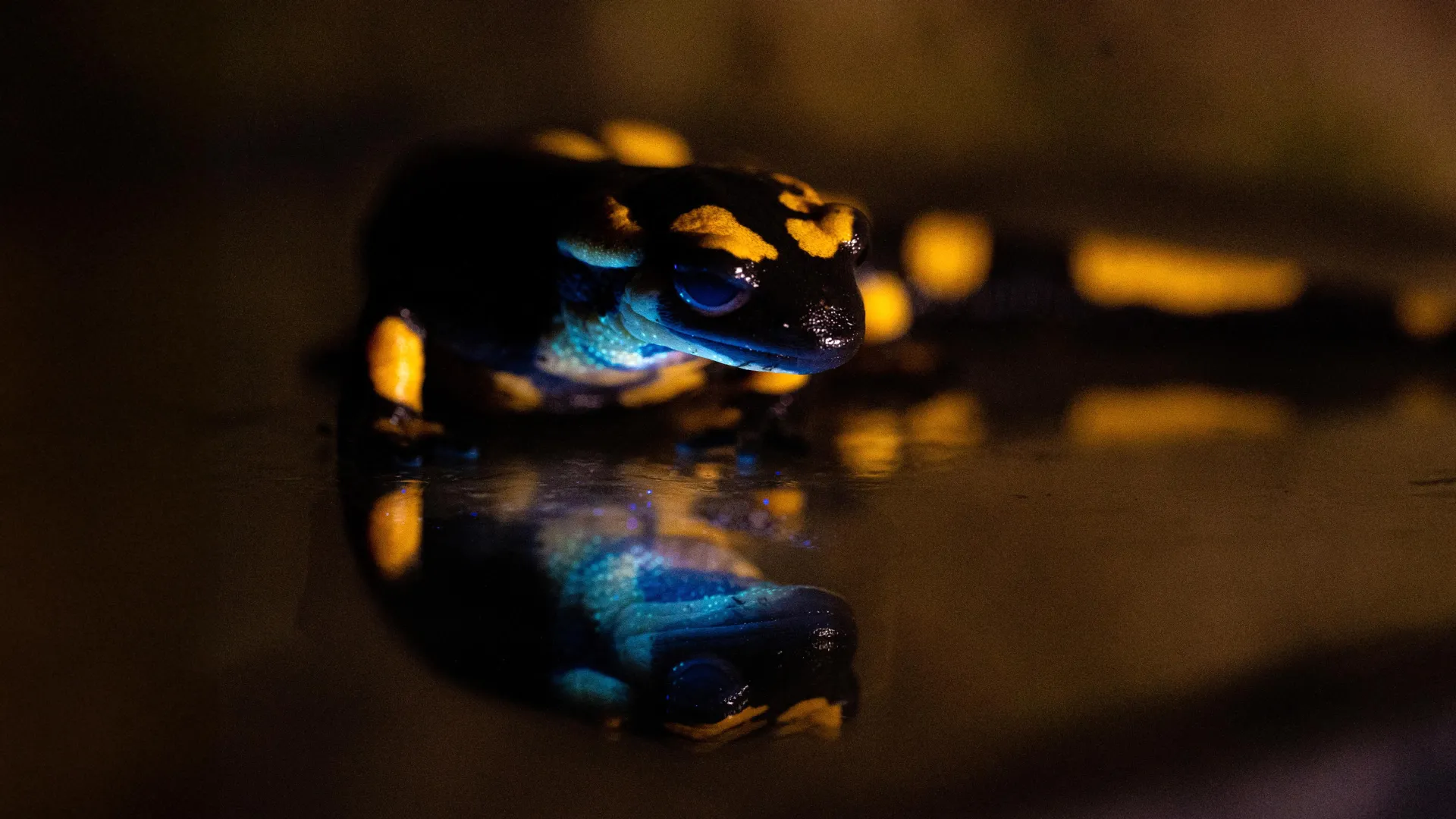
Fire salamanders, recognizable by their black-and-yellow coloring and toxic skin secretions, can fluoresce under ultraviolet light, according to new research. The glow is most visible on the yellow sides and underside of the body, and fluorescent secretions can remain active for more than 24 hours after they leave the animal. The discovery adds to scientists’ understanding of a species whose survival is increasingly threatened by habitat destruction and fragmentation and which the International Union for Conservation of Nature (IUCN) designates as endangered on its Red List of Endangered Species.
Fire salamanders typically live in moist forests, streams, and mountainous areas. Despite their familiar appearance, researchers continue to uncover unexpected details about their biology.
“It’s interesting that such a well-studied species still harbors such unknown phenomena. It’s a reminder that even the most familiar organisms can harbor secrets that are only revealed when observed using new tools,” said Bernat Briel, a researcher at Barcelona’s Natural Sciences Museum and lead author of the study.
Why do fire salamanders glow?
The fluorescence appears to come primarily from glands in the salamander’s skin and the substances they release. The phenomenon occurs when a compound absorbs ultraviolet light, which humans cannot see, and re-emits the energy as visible light. This produces bright green and cyan colors.
Known as biofluorescence, the process is different from bioluminescence because it requires an external source of illumination. Fireflies, for example, generate their own light through chemical reactions, while fluorescent organisms must first absorb light from their surroundings.
Scientists once believed that biofluorescence occurred almost exclusively in marine organisms, with scorpions standing out as a rare terrestrial example. More recent studies have challenged that assumption by identifying fluorescent signatures in a growing variety of land animals, including reptiles, birds, and amphibians.
Researchers have confirmed that fire salamanders fluoresce, but the biological purpose of the ability remains unclear. One possibility is that the light helps individuals recognize one another or evaluate potential mates. Another is that it makes the salamanders more visible to predators as part of a warning display.
“Fluorescence meets several criteria suggesting a communication function. Fluorescence could help salamanders detect each other in nocturnal or particularly crowded environments, or it could serve as an additional defense signal,” said Martin Kartempos, head of the Insect Symbiosis Division at the Max Planck Institute for Chemical Ecology and a co-author of the study.
The discovery that toxic skin secretions are also fluorescent raises further questions about how salamanders interact with predators and other animals in their environment.
For now, these proposed functions remain hypothetical. Animals with particularly sensitive vision may be able to detect green and cyan fluorescence even when it is very faint, but humans need a UV lamp to observe the effect.
In the forests where fire salamanders live, nighttime illumination comes mainly from moonlight and starlight. Researchers note that full moonlight contains more ultraviolet and violet wavelengths than sunlight, whose spectrum is more evenly distributed. Under these conditions, fluorescence could produce small green and cyan highlights against the salamander’s yellow markings, potentially making it easier for other salamanders to spot.
Could fluorescence warn predators?
Another possible explanation is aposematism, a defensive strategy in which an animal displays prominent colors to advertise that it is poisonous or dangerous. Fire salamanders already use their distinctive yellow-and-black markings as warning signals, and fluorescence may provide an additional visual cue.
When scientists identified samandarin more than a century ago, they established a link between the salamander’s warning coloration and its chemical defenses. These highly toxic steroidal alkaloids are produced from cholesterol precursors and contribute to the animals’ chemical protection.
Despite decades of research into salamander toxins and skin chemistry, the newly observed fluorescence came as a surprise.
“Although salamander skin secretions have been studied chemically for decades, we were unaware of any published reports on fluorescence, so the presence of this fluorescent compound was surprising,” said Andres Brunetti, a researcher at the Max Planck Institute for Chemical Ecology and co-lead author of the study.
The chemical substance behind the glow remains unknown
One of the biggest unanswered questions concerns the substances responsible for the fluorescence. Researchers have not yet determined their chemical identity, but the evidence suggests that they may include a previously unrecognized molecule in fire salamanders.
“We do not yet know what the compound responsible for this fluorescence is, but everything points to a previously unknown molecule in this species. Identifying it will be key to understanding its origin and function,” said Salvador Carranza, a researcher at IBE (CSIC-UPF) and another co-author of the study.
The research team is working to identify and chemically characterize the compounds that may be responsible for the effect. Determining which molecules emit light could help explain how fluorescence is generated and whether it plays a meaningful role in salamander behavior and survival.
What the discovery means for conservation
The findings reveal unexpected features of a well-known species and demonstrate how new research techniques can uncover biological properties that have escaped scientific attention for decades.
Understanding whether fluorescence influences communication, mating, and predator avoidance could also contribute to conservation efforts. Such information may help researchers better understand the behavior and ecological needs of fire salamanders, which already face significant threats from habitat loss and fragmentation.
Scientists from the Institute of Subtropical Biology and the Catalan Herpetological Society also participated in the study. The research forms part of a pioneering amphibian conservation project organized in Catalonia with support from the Barcelona Zoo Foundation.
Source: www.sciencedaily.com