


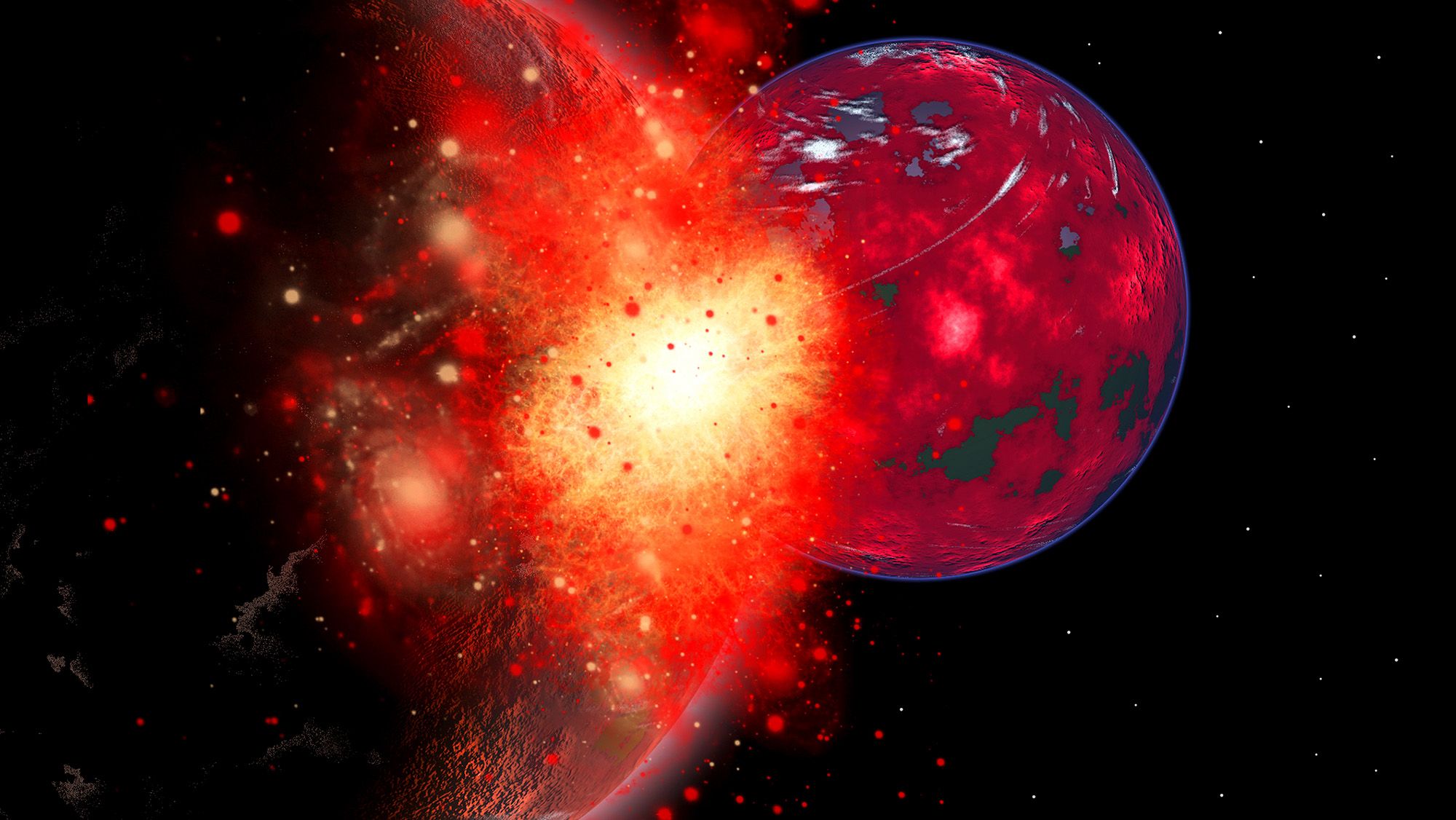
When the Sun eventually runs out of fuel, its transformation into a red giant could destabilize the outer solar system rather than leaving Jupiter, Saturn, Uranus and Neptune in orderly, expanded orbits. New research suggests that uneven bursts of mass loss from the aging Sun could give the star a recoil that changes its gravitational pull, sending the giant planets into eccentric orbits, ejecting them or causing them to collide within 3 billion years of the Sun’s transformation into a red giant.
The findings, published on September 21 in Astrophysics Journal Letter, could change scientists’ understanding of which kinds of exoplanets orbit white dwarf stars.
The Sun’s final transformation
In about 5 billion years, after exhausting the hydrogen in its core, the Sun will swell into a red giant. During this phase, it will expand to roughly 100 times its current size and engulf Mercury, Venus and possibly Earth. After this violent expansion, the Sun will shed its outer layers and leave behind a collapsed stellar core called a white dwarf.
Nathan Kaib, a planetary scientist at the University of Oklahoma who was not involved in the new study, told Live Science by email that the four giant planets were previously thought likely to emerge from this stage relatively unscathed.
That expectation was based on a 1998 study that used simulations in which gas gradually escaping from the Sun’s outer layers pushed the planets outward, roughly doubling the radius of each orbit. Only the gravitational influence of a passing star was thought likely to destabilize this new arrangement, and such encounters are believed to occur only once every billion years.
Uneven mass loss could give the Sun a kick
Those predictions assumed that the Sun would lose its outer layers smoothly. However, recent observations of stars suggest that mass loss may be more erratic, with clouds of gas expelled in bursts by plumes of plasma. The process may resemble a much larger version of a coronal mass ejection.
“They are similar [to] coronal mass ejection[s], except for something much bigger,” Jim Fuller, a professor of theoretical astrophysics at the California Institute of Technology and a co-author of the new study, told Live Science in an email. “We’re trying to figure out what’s going on.”
Each expelled “lump” of material pushes the Sun in the opposite direction, much as a fired bullet causes recoil in a gun. A single burst would move the Sun only a few feet per second, but many such events could eventually change its speed by hundreds of feet per second. Astronomers have already observed white dwarfs undergoing similar shocks in other star systems.
Image credit: Chartchai Sansaneeyashewin via Getty Images
Fuller studied these stellar kicks. Konstantin Batygin, a professor of planetary science at Caltech and the study’s lead author, “realized that this would have important consequences for the evolution of our own solar system,” Fuller said. The recoil changes the Sun’s motion and therefore its gravitational influence on the objects around it.
Chaos at the edge of the solar system
To investigate how the Sun’s mass loss could affect the giant planets, Batygin and his colleagues created computer simulations of the Sun and the outer solar system. They considered three possibilities: steady mass loss, the ejection of a distinct chunk of material during the Sun’s evolution as a red giant, and the ejection of a chunk only during the Sun’s final phase. The researchers also varied the mass of the material expelled in each scenario.
The first scenario produced results similar to those of earlier studies. The outer solar system retained nearly all of its major features over billions of years. The other two scenarios produced far more dramatic outcomes.
Across 672 simulations, the researchers found that losing mass in chunks could cause the giant planets to become disorganized, exchange positions, develop highly elliptical orbits or be ejected from the solar system entirely. In the most dramatic result, the planets collided with one another and were destroyed in 96% of the simulations involving the heaviest expelled mass packets.
These changes also occurred much sooner than in earlier models. They took place within hundreds of millions of years after the Sun became a white dwarf, or even during the red giant phase in the most extreme scenarios.
The findings suggest that modern-day analogues of the outer solar system orbiting white dwarf stars may be less common than previously thought. Kaib noted that the results instead point to a greater prevalence of planets with elliptical orbits.
Although habitable planets may exist around white dwarf stars, the new study suggests that scientists’ understanding of those distant systems may be incomplete. Some of those worlds could be unstable.
Batygin, K., Fuller, J., and Adams, F. C. (2026). “Terminal instability of the solar system caused by stochastic solar mass loss.” Astrophysics Journal Letter, 1009(2), L22.
Source: www.livescience.com