


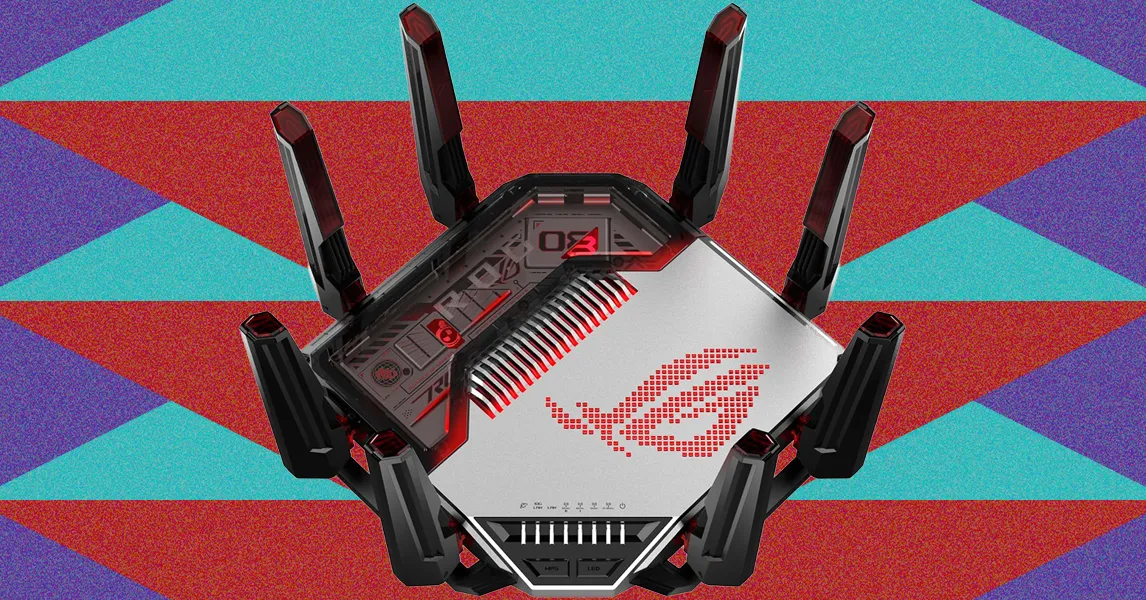
The Asus ROG Rapture GT-BN98 Pro combines a fanless thermal design, extensive wired connectivity and high-end quad-band wireless hardware. In testing, it remained quiet and cool while delivering speeds of up to 3 Gbps at close range, around 1 Gbps through a wall and 350 Mbps at the bottom of a garden surrounded by thick walls. Its additional 6 GHz band also makes it well suited to wireless backhaul in an Asus AiMesh network.
Fanless design and extensive connectivity
The router uses an advanced thermal design with multiple heat sinks and airflow channels to maintain peak performance over extended periods without loud fans. During a month of testing, it remained quiet and felt cool to the touch.
There is also room for a wide range of connections, including a 10 Gbps WAN/LAN port, a 10 Gbps LAN port, four 2.5 Gbps ports with one configurable as WAN/LAN, a 1 Gbps LAN port, USB 3.2 Gen 1 and USB 2.0. Link aggregation is supported through the two 10 Gbps ports, creating a potential 20 Gbps connection.
Quad-band Wi-Fi 7 hardware
Inside, the Asus ROG Rapture GT-BN98 Pro uses Broadcom’s BCM 6718 Wi-Fi chip alongside a 2.6 GHz quad-core processor, 256MB of flash memory and 2GB of DDR4 RAM.
As a quad-band router, it includes the standard 2.4 GHz and 5 GHz bands along with two 6 GHz bands. All four bands support 4×4 connectivity, OFDMA (orthogonal frequency division multiple access), 4096-QAM and maximum-width channels. The theoretical maximum speeds are 1.3 Gbps on 2.4 GHz, 5.6 Gbps on 5 GHz and 11.5 Gbps on each 6 GHz band.
These theoretical figures will not represent typical real-world performance, but they place the router at the high end of current wireless hardware.
Fast performance across long distances
In practical use, the Asus ROG Rapture GT-BN98 Pro delivered up to 3 Gbps in the same room and approximately 1 Gbps through a wall. Even at the bottom of a garden at an old house surrounded by thick walls, testing recorded 350 Mbps.
Compared with the tri-band Wi-Fi 7 Asus RT-BE96U, which was selected as an upgrade pick, the GT-BN98 Pro was slightly faster at every tested distance and maintained stronger performance across the bands overall. Its second 6 GHz band also makes it useful for wireless backhaul when building a mesh network with another Asus router through AiMesh, Asus’ mesh networking feature.
Multi-link operation
Multi-link operation (MLO), which allows compatible devices to connect across multiple bands simultaneously, appears to have matured since its problematic introduction with Wi-Fi 7. Testing achieved short-range speeds close to 5 Gbps when a second Asus ROG Rapture GT-BN98 Pro was used as the client, although most Wi-Fi 8 devices cannot support this when they first arrive.
Automatic Frequency Coordination (AFC) support could not yet be tested. The feature checks licensed services in a given area and can help increase the router’s output while extending the range and coverage of the 6 GHz band. AFC is available in the US and coming soon to the UK, but it is not licensed in every country, so performance will vary depending on local licensing conditions.
Features focused on stability and gaming
Wi-Fi 8 is not focused solely on higher speeds. It is intended to improve stability and reliability through features that compensate for local interference and reduce latency during demanding tasks such as gaming.
The Asus ROG Rapture GT-BN98 Pro includes adaptive quality of experience and device optimization features that automatically identify and prioritize gaming devices and streams.
Source: www.wired.com