


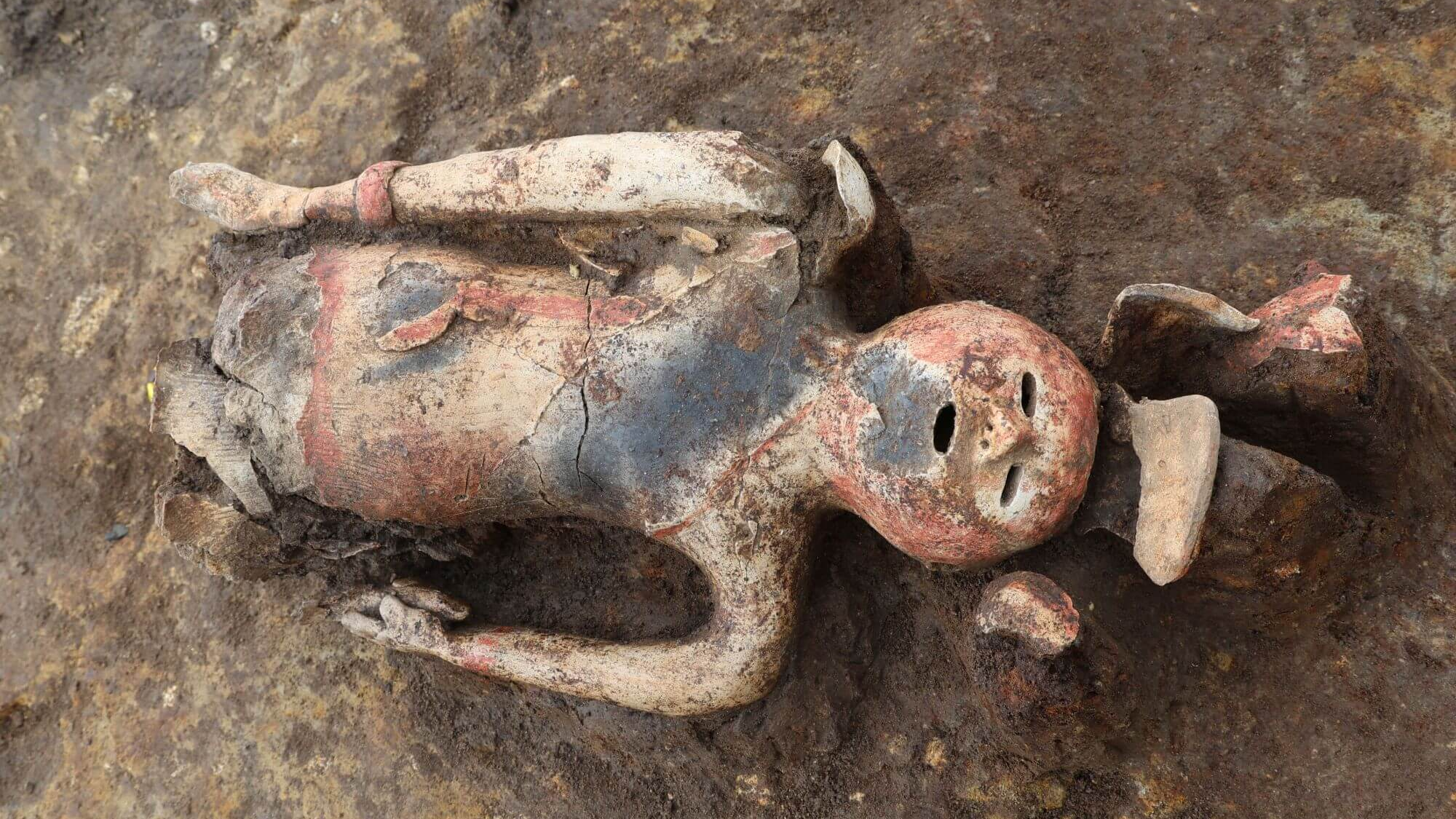
Archaeologists have discovered a roughly 40-centimeter-tall clay figure in a 5th-century tomb at the Nishijogu ruins in northwest Tokyo. The detailed haniwa appears to depict a female shaman, or miko, who may have served as a spiritual guardian of the burial site.
A figure from the Kofun period
According to a statement from the Gunma Prefectural Office, archaeologists have uncovered more than a dozen burial mounds, known as kofun, at the site. The tombs date from the fifth to sixth centuries.
The discoveries belong to the Kofun period, which lasted from about 300 to 710 AD. Many tombs from this period contained cylindrical clay sculptures called haniwa. These figures were placed as offerings to the dead and were sometimes thought to contain the souls of the deceased.
The newly excavated figure consists only of its head and torso, suggesting that it was originally much larger. Archaeologists found it in a moat surrounding a gigantic burial mound about 145 feet (45 meters) in diameter.
According to the statement, the figure was originally placed near a boat-shaped sarcophagus discovered inside the mound. It likely slipped down the slope and into the moat over time.
Clues to a shrine maiden
Experts believe the figure represents a miko, a female shaman who acted as a bridge between the human and spirit realms in the Shinto religion. During the Kofun period, shrine maidens may have performed important funeral ceremonies and provided spiritual guidance.
The haniwa has a traditional Japanese topknot hairstyle called Shimada. It also has clay bracelets on both wrists, traces of red pigment, carefully molded fingers and a distinct nose.
A red sash is painted across the figure’s torso, and the statue holds a stick-shaped ritual tool in its left hand. These details suggest that its makers took considerable care with the sculpture, even though many of its features would not have been visible from a distance.
“These details suggest that considerable care was taken in creating this map, even though the features may not be visible from a distance,” Gunma Prefectural Government officials said in a statement.
Excavations at Nishijomiya Tumulus
Archaeologists discovered the clay sculpture earlier this year during excavations at the main tomb of Nishijomiya Tumulus. Work at the site has been ongoing since 2020.
The haniwa is currently on display at the Gunma Prefectural Archaeological Research Center Excavation Museum in Shibukawa City.
Source: www.livescience.com