


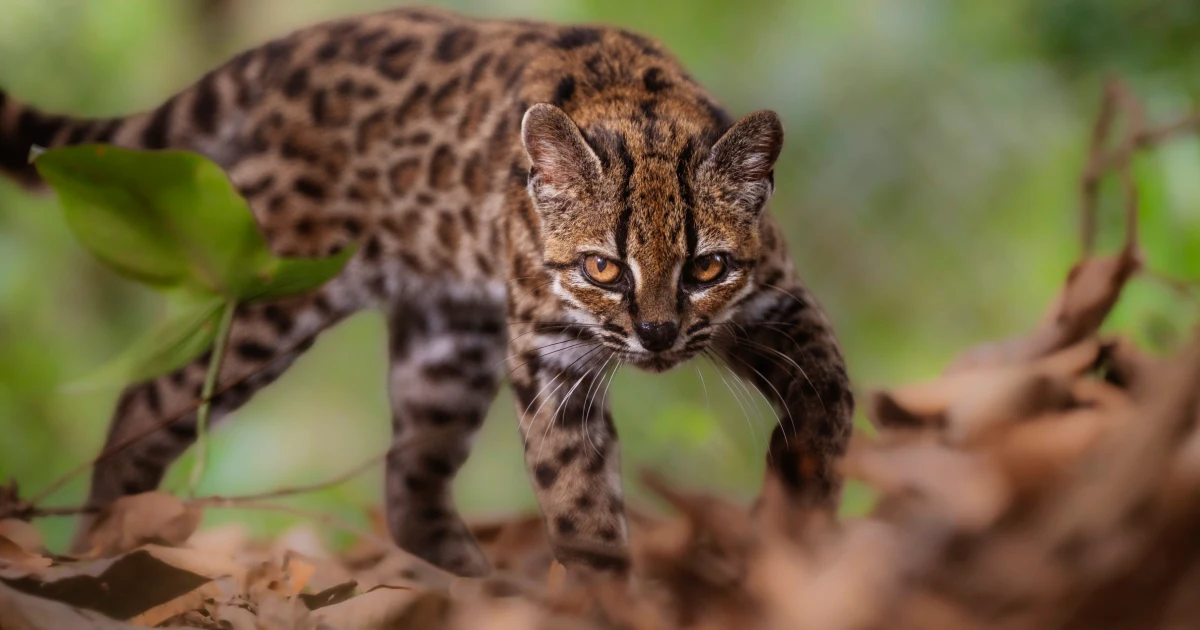
Scientists Identify a New Wild Cat Species in Bolivia’s Yungas Forest
A tiny wild cat discovered in Bolivia has been identified as a new species after genetic testing revealed that it diverged from other cat lineages about 1.4 million years ago.
The species, known locally as the Tilcayo and identified by scientists as Leopardus tilcayo, was found near La Paz in Bolivia’s Yungas region. Researchers say it may already be at risk as development and agriculture continue to shrink its habitat.
A Wild Cat Mistaken for a Kitten
Paola Nogales-Ascalunz first noticed the unusually small cat while volunteering at the Senda Verde Wildlife Refuge near La Paz.
“I saw this cat. It was really, really small and I couldn’t believe how small it was,” Nogales-Ascalunz said. “I thought it was a kitten.”
Fernando Faciore/National Geographic
According to records from the shelter, a man from a forest community near La Paz brought in the cat after mistaking it for a pet. He fed it noodles, rice and eggs before realizing that it was a wild animal that could not be kept at home.
Staff members initially thought the animal belonged to a known wild cat species from Brazil. Nogales-Ascalunz, however, noticed that its markings and tail did not match.
“When you look at the spots and the tails, they really don’t match,” she said.
Genetic Testing Revealed a New Species
Nogales-Ascalunz conducted genetic testing on tissue from the rescued cat and a second animal found at Senda Verde. The results showed that the two cats belonged to the same unique species.
The genetic evidence indicated that the cats had diverged from other wild cat lineages about 1.4 million years ago. The researchers considered that level of genetic difference sufficient to classify the animal as a new species.
Unlike many recently identified mammals, Leopardus tilcayo was not simply a genetically distinct population of a species already known to scientists. No museum specimens of the animal had previously been collected.
“The museum didn’t have any specimens,” said Tadeu de Oliveira, a co-author of the study and an ecologist at Brazil’s Maranhão State University. “It had never been collected before.”
Local Communities Already Knew the Tilcayo
Scientists may have only recently documented the Tilcayo, but communities in Bolivia have known about the cat for generations.
Local people call the animal “Tilcayo.” When researchers asked whether the name had a meaning in Quechua, Aymara or another Indigenous language, residents said they had inherited it from their grandparents.
“This is traditional knowledge that they have in their community,” Nogales-Ascalunz said. “We wanted to preserve that knowledge and didn’t want to give it another name.”

Fernando Faciore/National Geographic
Why the New Wild Cat May Be at Risk
Scientists add new mammal species to taxonomy about 65 times a year, according to a study published last year. Many of those discoveries result from genetic research that reveals previously unrecognized differences between populations.
One example is the Sunda leopard, Neofelis diardi, found on the island of Borneo. Scientists recognized it as distinct from its mainland counterpart in 2006 after comparing their genomes, although museum specimens of the animal already existed.
The Tilcayo is different because scientists had no prior specimens of it. Its discovery also highlights the conservation challenges facing wildlife in South America, where habitats are rapidly disappearing.
Nogales-Ascalunz believes the species is likely at risk. She is working to establish camera traps in Bolivia’s Yungas Forest to search for additional evidence of the cat’s presence.
“This is a new reason to protect the world,” she said.
Source: www.nbcnews.com