


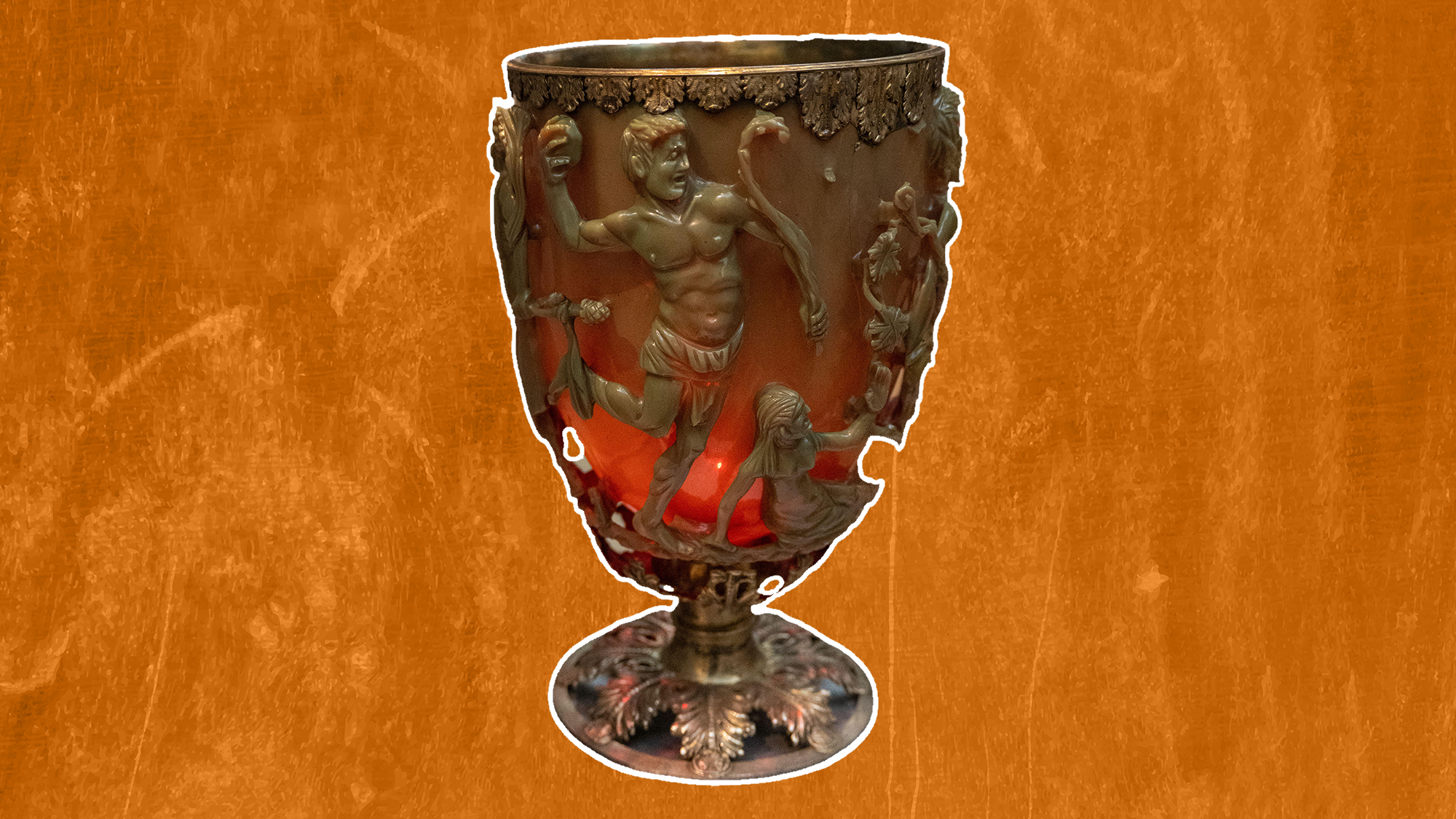
The Roman Lycurgus Cup is a rare example of dichroic glass: the approximately 5-inch-tall goblet appears jade green when light shines from the front and ruby red when it passes through from behind. Although scientists have linked the effect to nanoparticles of gold and silver in the glass, experts still do not know where the cup was made or whether its color-changing properties were deliberate.
Image credit: Lucas, ancientartpodcast.org (via Flickr) / CC BY 2.0
A Roman cup with an unusual optical effect
The Lycurgus Cup is a glass drinking vessel from the Roman Empire, probably created in the 4th century AD. It weighs about 1.6 pounds (700 grams) and is now held by the British Museum, which acquired it in 1958 from a Rothschild banker who had owned the artifact since the mid-19th century.
The cup is an especially well-preserved example of a Roman cage cup, or diatretum. In a 1959 examination, archaeologists D.B. Harden and Jocelyn Toynbee suggested that it was probably made in Italy during the 4th century. They also concluded that the bronze frame around the stem and rim was probably added in the 19th century.
Cage cups were made by cutting and polishing decorations into thick glass. Artisans left behind small bridges of glass so the openwork decoration remained attached to the vessel, creating the impression of a cage. Only a few examples survive.
The story of Lycurgus
The cup depicts the punishment of Lycurgus, a king of the Thracian tribe known as the Edoni, or Edonians. According to the myth, Lycurgus rejected the worship of Dionysus and drove the god into the sea with an axe.
Ambrosia, one of Dionysus’ priestesses, fought back by transforming into a vine and wrapping herself around Lycurgus. Other priestesses joined her and tormented the king. Because Dionysus was the god of wine and merrymaking, the scene was particularly appropriate for a drinking vessel. The cup’s shift from green to red may also have been intended to evoke ripening vines.
How the color change works
Color-changing vessels are also called dichroic cups, and ancient Roman records mention them. A 2nd-century letter, probably written by Hadrian to his brother-in-law, refers to a “gift of 2 dichroic cups” used at parties. However, very few examples of this type of glass survive today, according to a 2007 survey.
Researchers have spent decades investigating how Roman glassmakers produced the effect. A 1963 study found that adding tiny nanoparticles of gold and silver during glassmaking could create a milky green appearance when the glass was illuminated from the front and an almost translucent red appearance when light passed through it from behind.
These metal nanoparticles are smaller than grains of sand. They interact with light in ways that alter the color perceived by an observer, producing the Lycurgus Cup’s striking transformation.
A 2007 study reported that dichroic-glass replicas made by Corning Glassworks in the 1960s changed from green to amethyst under illumination. In 2020, researchers added silver and gold nanoparticles to 3D-printed objects to mimic the color-changing properties of the ancient glass.
Accident or deliberate design?
Researchers from the University of Sheffield in the UK recently worked on reproducing dichroic glass by reverse-engineering the original Lycurgus Cup’s “recipe.” The team then commissioned a glass artist to create a Lycurgus-inspired design from the replica.
Even so, experts remain uncertain whether Roman craftsmen intentionally created the color-changing effect. Gold was available in ancient craft workshops, and traces of it may have accidentally entered the molten glass. The resulting material could have produced a rare and unusual optical effect that surprised even highly skilled glassblowers.
Experts are also unsure where the cup was found or exactly where it was made. Its construction, decoration and optical properties provide clues about Roman glassmaking, but the surviving evidence does not establish whether the remarkable color change was an intentional feature.
Source: www.livescience.com