NASA Reveals First Images of Crater Created by SpaceX Falcon 9 Rocket on the Moon
NASA has released the first images of the crater formed when the upper stage of SpaceX’s Falcon 9 rocket struck the Moon on August 5, 2025.
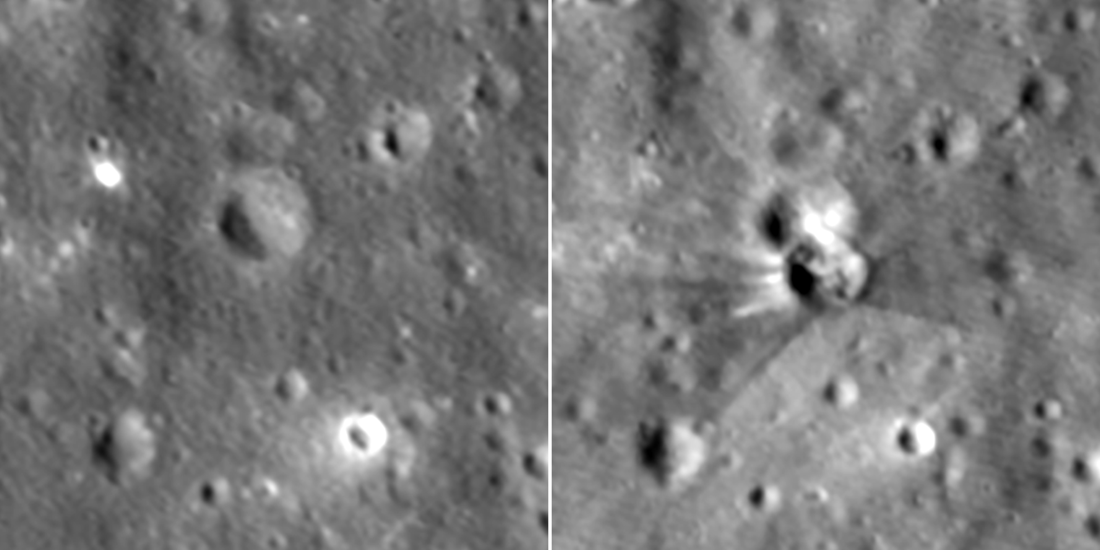
Images captured by NASA’s Lunar Reconnaissance Orbiter (LRO) on August 11 and 12 reveal an impact crater approximately 60 feet (18 meters) wide. The crater is surrounded by bright and dark streaks of lunar dust and rock blasted across the surface by the rocket impact.
The new lunar crater was created by the upper stage of a SpaceX Falcon 9 rocket launched on January 15, 2025. The mission carried two lunar landers toward the Moon. While Falcon 9’s first stage is designed to return to Earth and be reused, its upper stage is typically discarded after launch. In this case, the 4.4-ton (4-metric-ton) rocket stage remained in space for nearly a year before solar radiation and the Moon’s gravity pushed it onto a collision course with the lunar surface, according to Space.com.
from the latest videolive science
Locating the Falcon 9 impact crater was a major challenge that required cooperation between NASA scientists, lunar mission teams and amateur astronomers. NASA shared details about the discovery in a statement on Tuesday, August 18.
The rocket stage struck the Moon near Einstein Crater, along the northwestern edge of the lunar surface. Because the impact site was facing the Sun when the collision occurred, Earth-based observers could not see the initial flash.
The rocket’s relatively slow impact speed also made the event difficult to detect. NASA estimates that the Falcon 9 upper stage hit the Moon at approximately 5,400 mph (8,700 km/h). Although that speed is considerable, it is far below the typical velocity of meteoroids striking the Moon. According to NASA, lunar meteoroids can travel between 45,000 mph (72,420 km/h) and 160,000 mph (257,495 km/h). The lower collision speed produced a comparatively small crater and a weaker flash.
The box in the center of the image highlights two small craters. The lower crater was created when SpaceX’s Falcon 9 upper stage collided with the Moon on August 5, 2025.
(Image credit: NASA/GSFC/Intuitive Machines)
The Falcon 9 impact was first predicted by independent astronomer Bill Gray in May. NASA’s Center for Near-Earth Object Studies later refined the initial calculations to improve estimates of where the rocket stage would strike the Moon.
South Korea’s Danuri lunar orbiter was the first spacecraft positioned to observe the suspected impact area. NASA’s Lunar Reconnaissance Orbiter photographed the location six days after the collision and confirmed the presence of the new crater.
Get the world’s most fascinating discoveries delivered straight to your inbox.
“The orbiter travels from pole to pole every two hours, while the Moon rotates slowly beneath it,” NASA said. “To photograph a specific location, the spacecraft must wait until that area comes into view.”
Using its narrow-angle cameras, NASA’s LRO photographed the impact crater from multiple angles. Scientists estimate that the crater is about 60 feet (18 meters) wide and less than 10 feet (3 meters) deep.
The images also reveal light and dark rays extending outward from the crater. These streaks consist of dust and rocks ejected when the Falcon 9 upper stage hit the lunar surface. NASA says the darker streaks likely contain weathered material from near the surface, while the lighter rays expose older rocks excavated from beneath the Moon’s surface.