


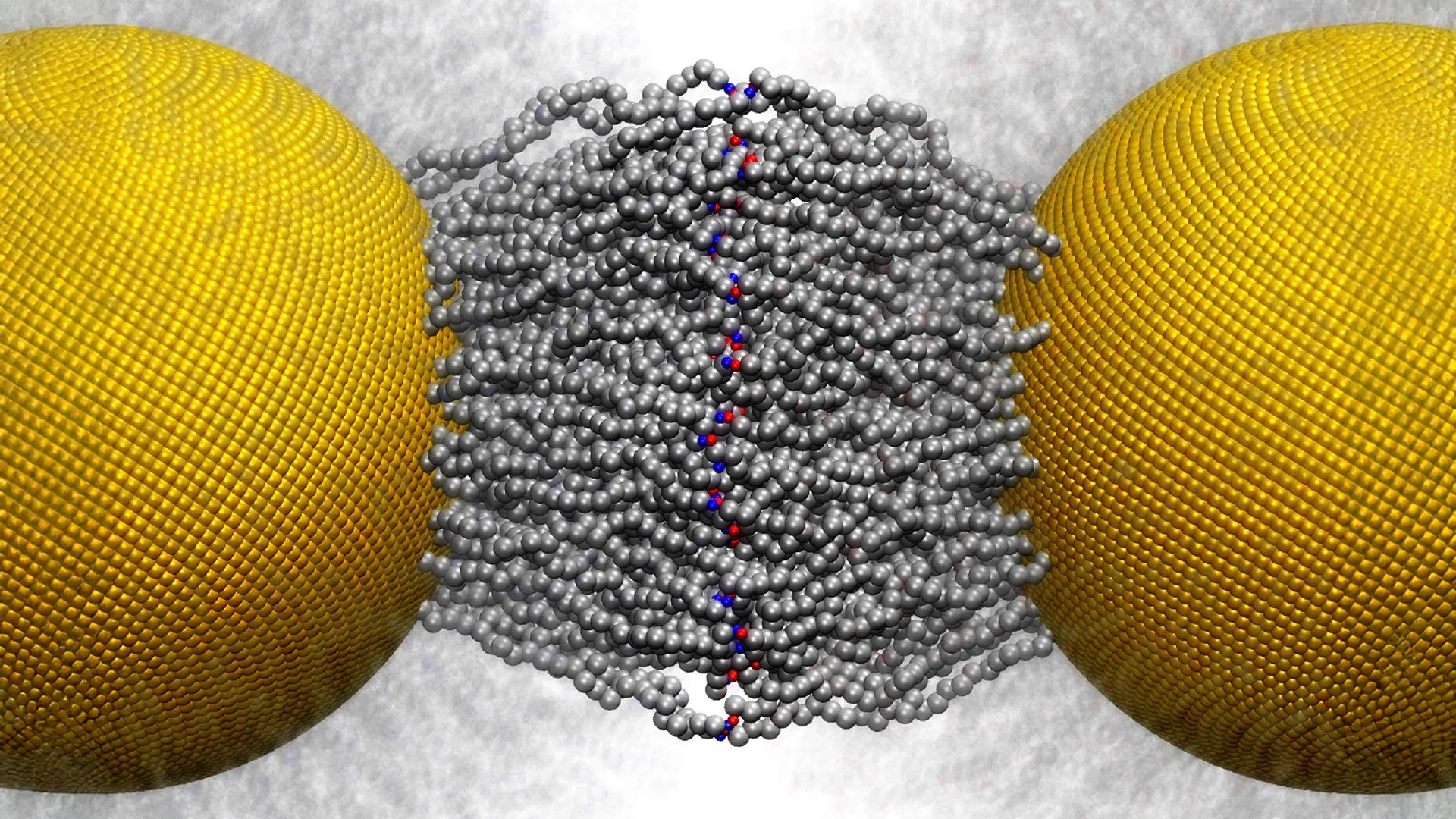
MIT researchers and their collaborators have shown that highly flexible, charged molecular connectors can help nanoparticles assemble into crystal structures that have not previously been observed. The counterintuitive approach reverses decades of conventional thinking, which has favored rigid connectors for controlling nanoparticle alignment, and could provide a more adaptable route to materials with precisely engineered properties.
The findings will be published in an upcoming paper in Nature Materials. The work shows how the flexibility and charge of molecular connectors can influence the structures formed by nanoparticles.
A different approach to nanoparticle assembly
“People are interested in nanoparticle superlattices because they hold promise for building designer materials where they have more say in what kinds of structures they can actually build,” said Rob McFarlane, the Richard P. Simmons (1953) Professor of Metallurgy in MIT’s Department of Materials Science and Engineering.
“This is a new approach to nanoparticle assembly that has never been explored before. We are very excited to have a counterintuitive new tool. This goes against the 20-year-old dogma that the connector ligand must be stiff and that any deviation will cause the assembly to fail. We showed that if you just take it to the other extreme, it works just as well.”
The research team also includes MIT doctoral candidate Nicholas Sbarbi, University of Delaware doctoral student Stephen Cronenberger, MIT undergraduate Hana Niizawa, PhD ’26 Matthew Yeh, and former University of Delaware professor Arti Jayaraman.
At the heart of the work is a basic principle of materials science: the arrangement of a material’s smallest components helps determine how the material behaves.
“This means that if you know what the components are and how they are arranged, you can explain what properties the material has,” McFarlane said. “By controlling this, we can create materials with new properties.”
This principle is particularly important for nanoparticles, whose shape, size, and other properties can be adjusted for applications including drug delivery, energy storage, computing, and sensors. The challenge is turning these tiny building blocks into larger materials with a controlled organization.
Why nanoparticle organization is difficult
Scientists need to control not only how many neighboring particles each nanoparticle connects to, but also the directions of those connections.
Without that control, nanoparticles tend to aggregate into tightly packed arrangements. Such structures limit the range of materials researchers can create and, consequently, the unusual properties those materials might offer.
Researchers have traditionally addressed the problem in two main ways. One method changes the shape of the nanoparticles so that it influences how they bind. Another modifies selected regions of a particle’s surface so that only those regions attract neighboring particles. The goal is similar to designing puzzle pieces that connect only in specific positions.
Although these methods can produce useful structures, they are often complex, highly specialized, and difficult to adapt to large-scale manufacturing.
“The challenge with both of these approaches is that they are difficult to do synthetically when making the particles,” McFarlane explained. “The methods of defining stickiness that are developed are always bespoke. They work on one material, one size scale, and one condition. They are good for research, but you can’t do much with them.”
Both strategies rely on molecular connectors known as ligands. These molecules attach to nanoparticle surfaces and help bind neighboring particles together. Researchers have generally tried to make the ligands rigid so that the connections retain carefully controlled angles. That can preserve a desired alignment, but it also restricts the types of structures and functions that can be achieved.
Flexible connectors provide a new form of control
The MIT team explored the opposite strategy: giving the molecular connectors almost complete freedom to bend rather than forcing them to remain in fixed positions.
“We thought, ‘Let’s do exactly the opposite, and make the bonds so flexible that it doesn’t matter which direction they’re initially oriented.’ Then, as the particles come together, the ligands can reorganize, and that reorganization itself limits the number of neighbors each particle can bind to,” McFarlane said.
Instead of specifying the direction of every connection in advance, the researchers allowed the connectors to adjust as the nanoparticles interacted.
McFarlane’s laboratory has spent years developing methods that use linked polymer chains to construct different types of nanoparticles. Polymers are large molecules made of repeating smaller units, and their flexibility can produce tunable molecular bonds.
For the new system, the researchers attached highly flexible ligands to the nanoparticles and placed a charge at the end of each ligand. Some ligands carried a positive charge, while others carried a negative charge.
Opposite charges attract, causing a connector to bend toward a molecule with the opposite charge. This attraction helps the nanoparticles bind, while the flexibility of the connector affects how many connections each particle can form.
“The idea was to say, ‘The bond will be as flexible as you want, and will spontaneously proceed to any valency to maximize bond stability,’ rather than defining a specific direction in which the bond will occur in a complex synthetic method,” McFarlane said.
Here, valency refers to the number of bonds a nanoparticle forms with neighboring nanoparticles. The researchers found that when the connectors could move freely, the system could settle into a stable arrangement without requiring every connection to be designed beforehand.
A previously unseen crystal structure
Experiments led by Sbarbi showed that the connections between nanoparticles could be tuned by changing two relatively simple variables: the size of the particles and the length of the flexible molecular chains.
These adjustments changed how the particles came together and allowed the team to control the number of neighbors each particle could connect to.
Most significantly, the method produced a crystal structure that had not previously been observed.
A crystal is a material whose components form an organized, repeating pattern. In this case, the repeating arrays consist of nanoparticles rather than individual atoms or small molecules. These regular nanoparticle networks are often called superlattices.
By reducing the number of connections between adjacent particles, the researchers created more open arrangements instead of the tightly packed structures that typically form during nanoparticle assembly.
“We can control the number of bonds each particle has without having to pre-design where the particles connect or the shape of the particles,” McFarlane explained. “The amount of flexibility in a polymer determines the number of bonds it has. This allows us to reduce the number of bonds each particle has, creating lattices unlike anything we’ve seen before.”
The results suggest that molecular flexibility, once viewed as an obstacle to precise nanoparticle assembly, can instead serve as a tool for designing new material structures.
Toward customizable materials
The researchers believe the method could help advance a long-standing goal in materials science: choosing the properties of individual nanoparticles independently from the larger structures they form together.
In principle, scientists could select nanoparticles for their electrical, optical, chemical, or other useful characteristics and then organize them into arrangements optimized for particular applications. In practice, existing assembly methods make that level of control difficult.
“We in the nanoparticle assembly community are talking about having complete independent control over what a particle is and what kind of assembly it goes into,” McFarlane said. “In theory it should be, but in practice it definitely isn’t.”
The new approach could help narrow that gap. By using connector flexibility and charge-based attraction to influence nanoparticle alignment, researchers may be able to create a broader range of structures without the complex manufacturing techniques required by traditional methods.
The team also sees the discovery as a possible route to producing customizable materials at scale, potentially helping nanoparticle technology move beyond laboratory experiments.
Potential applications
More open and diverse nanoparticle structures could be useful in the development of advanced materials. In photonics, precisely organized nanoparticles can help researchers engineer materials with specialized optical properties. In chemical catalysis, new particle arrangements could create opportunities to improve how catalysts accelerate chemical reactions.
The approach could also support future developments in medicine, agriculture, electronics, and energy technology.
Nanoparticles already possess a wide range of desirable properties. Controlling how they assemble could allow scientists to combine those individual capabilities in new ways.
“Nanoparticle superlattices offer a way to create designer materials whose building blocks have all sorts of unique properties,” McFarlane said. “However, simply packing these nanoparticles to a high density limits their applications. This provides a way to achieve the formation of less dense nanoparticles, and there are many interesting applications there.”
Further development will be needed before the method can be translated into commercial technology. However, the discovery establishes molecular flexibility as a potential strategy for creating materials with tailored structures, rather than treating flexible molecular bonds as a problem to be eliminated.
The research received partial support from the National Science Foundation, the Department of Energy, the U.S. Army, and the U.S. Navy.
Source: www.sciencedaily.com