


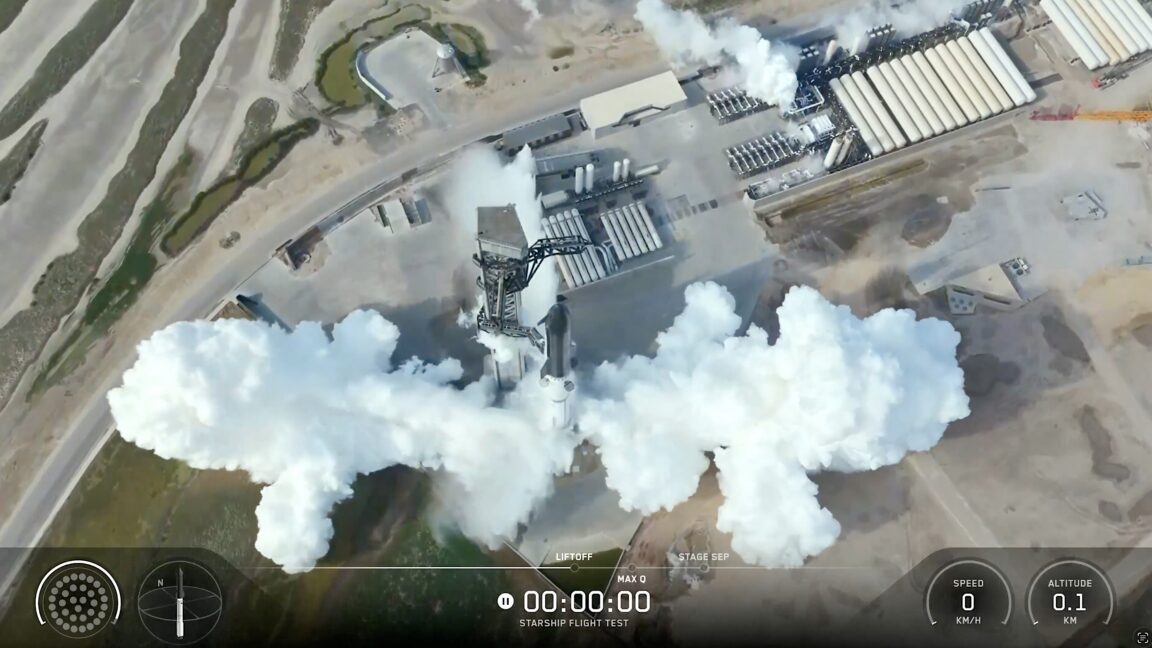
SpaceX has officially postponed a highly anticipated test flight of its robust Starship rocket and Super Heavy booster as the countdown reached zero at its South Texas spaceport.
The launch team at Starbase, Texas, situated just north of the U.S.-Mexico border, planned to lift off the towering 400-foot rocket at 5:45 p.m. local time (6:45 p.m. EDT, 22:45 UTC). Throughout the day, the countdown proceeded without issues, ultimately seeing over 11.5 million pounds of liquid methane and liquid oxygen loaded onto the two-stage rocket.
Regrettably, the countdown was halted by the computer system during the Super Heavy booster’s engine start sequence. Following this interruption, SpaceX called off the launch attempt, and engineers began preparations to vent the rocket’s propellant tanks. Officials have yet to announce a rescheduled launch date.
Elon Musk, the founder and CEO of SpaceX, shared updates on his social media platform X, indicating that the company may not be ready for a relaunch by the next opportunity Friday night. “Some of the engines failed to start, triggering an automatic launch abort,” Musk stated. “We are currently unloading the propellant. We aim to attempt the next launch within a few days.”
Later that night, Musk revealed that the Starbase ground team intends to replace two of the Super Heavy booster’s Raptor engines. “The most likely launch window is early next week,” he added.
Engine Tuning
The Super Heavy Booster is outfitted with 33 methane-fueled Raptor engines, each capable of generating over 500,000 pounds of thrust. These engines are designed to ignite in a staggered sequence following the activation of the launch pad’s water-cooled flame diverter, which is crucial for protecting the launch facility from the extreme heat and vibrations produced during the launch of the world’s most powerful rocket.
While SpaceX officials did not disclose the number of engines that failed to ignite during the ignition sequence, a graphic displayed during SpaceX’s live video stream indicated that 4 out of 33 engines did not start. Both the Starship and Super Heavy’s engines utilize SpaceX’s third-generation Raptor design. This test flight marks the 13th full-scale Starship launch and is the second to implement the upgraded Raptor 3 engine flying on SpaceX’s enhanced Starship Version 3 rocket.
Source: arstechnica.com