


NASA AI Model Predicts Emerging Sunspots Up to 12 Hours in Advance
As humanity prepares for future missions to the Moon and Mars, accurate space weather forecasting is becoming increasingly important. Space weather is driven primarily by the Sun and can affect astronauts, satellites, spacecraft, radio communications, and power systems on Earth.
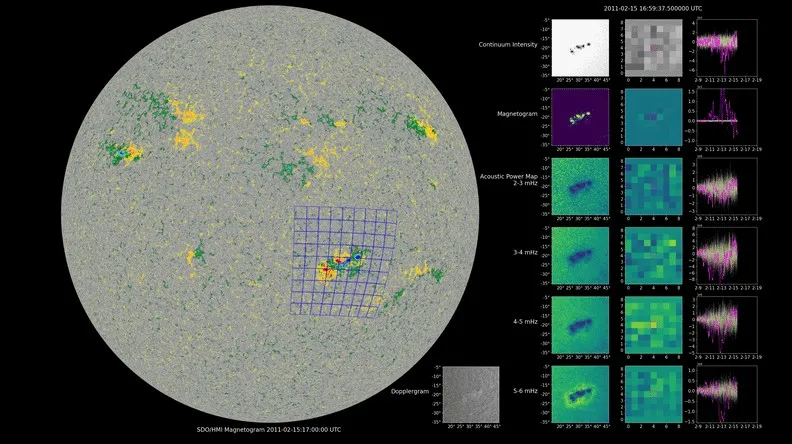
A team of astrophysicists and data scientists from NASA’s COFFIES initiative—short for Consequences of Magnetic Fields and Flows Inside and Outside the Sun—has developed a new artificial intelligence model that can predict the emergence of active regions on the Sun up to 12 hours before they become visible.
The breakthrough could improve early warnings for solar flares and coronal mass ejections, two of the most powerful events responsible for severe space weather.
How Sunspots Drive Space Weather
The Sun is constantly rotating, and powerful concentrations of magnetic fields can suddenly rise through its surface. When they emerge, they form dark regions known as sunspots.
Sunspots are visible indicators of active regions on the Sun. Space weather forecasters monitor and number these regions because they are often the source of solar flares and coronal mass ejections. These eruptions can send high-energy radiation and electrically charged particles into space, potentially threatening astronauts, damaging satellites, disrupting radio communications, and affecting other technologies on Earth.
NASA Researchers Use Machine Learning to Detect Solar Activity
COFFIES is a NASA DRIVE Science Center that brings together researchers from the New Jersey Institute of Technology, Princeton University, and NASA Ames Research Center in California’s Silicon Valley.
To identify subtle changes that occur before a solar active region appears, the team developed an advanced machine learning system. The researchers analyzed observations from NASA’s Solar Dynamics Observatory along with data processed using NASA Ames supercomputing resources.
The research, published in the Journal of Geophysical Research: Machine Learning and Computation, examines changes in sound waves generated by magnetic structures beneath the Sun’s surface. These structures rise through the solar interior before eventually emerging as sunspots.
“We cannot directly see the magnetic structures while they are still rising through the Sun’s interior. Instead, we have to look for the indirect effects of very small changes in the magnetic field and the patterns of sound waves that continuously travel through the Sun,” said Alexander Kosovichev, a COFFIES co-investigator at the New Jersey Institute of Technology.
“The developed technology identifies precursors associated with new areas of activity in small changes in the Sun’s acoustic power. It is similar to detecting small changes in rhythm within a very noisy orchestra,” Kosovichev added.
A New Approach to Predicting Sunspots
Current operational forecasts from the National Oceanic and Atmospheric Administration’s Space Weather Prediction Center and the U.S. Air Force focus mainly on active regions that are already visible on the Sun. Forecasters study their characteristics and estimate the likelihood of solar flares.
The COFFIES team hopes to improve this process with a specialized AI system known as a sliding-window transformer architecture. The model is designed to process long sequences of solar data while detecting small changes in acoustic activity and magnetic fields that may signal the formation of a new active region.
Rather than analyzing all solar activity at once, the AI model moves a fixed-size “viewing window” across a long timeline. This allows it to focus on recent observations while also retaining important information about broader patterns in the Sun’s activity.
By identifying these developing patterns, the model can estimate where new sunspots are likely to appear before they become visible on the surface. This represents a significant shift from forecasting methods that rely primarily on the number and characteristics of sunspots already observed.
Improving Space Weather Forecasts for Future Missions
The new AI architecture demonstrates how deep learning can support heliophysics—the study of the Sun, its influence on space, and its effects on planets and spacecraft.
Although the model is not yet ready to provide operational, real-time forecasts, researchers plan to test it against additional solar events and refine its predictions. Future development could help scientists identify potential flare-producing regions earlier and improve warnings for spacecraft and crewed missions.
NASA’s Real-Time Space Weather Monitoring
As NASA prepares for Artemis missions to the Moon and plans for the first human mission to Mars, reliable space weather monitoring will be essential. Early warnings of solar activity can help mission planners protect astronauts, spacecraft, communications systems, and scientific equipment from the Sun’s unpredictable environment.
NASA and NOAA are working to transform scientific research into real-world space weather forecasting and monitoring tools. Key organizations involved in this effort include NASA’s Space Radiation Analysis Group, the Moon-to-Mars Space Weather Analysis Office, the Community Coordinated Modeling Center, and NOAA’s Space Weather Prediction Center.
Predicting the emergence of sunspot regions—including regions on the far side of the Sun—could provide valuable information that complements existing forecasting models.
“The COFFIES AI model is of great interest to our team as it may provide new capabilities to proactively predict the location of potential flares,” said Michelangelo Romano, deputy director of the Moon-to-Mars Space Weather Analysis Office. “This will allow us to provide additional support to NASA’s missions.”
Understanding the Sun’s 11-Year Activity Cycle
NASA’s COFFIES is one of three DRIVE Science Centers created to promote collaborative research across institutions and scientific disciplines. The centers bring together modelers, theorists, computer scientists, and observers to investigate major questions in heliophysics.
The COFFIES team studies the interconnected processes that control solar activity. Understanding the Sun’s internal magnetic fields and changing flows is essential for improving knowledge of its 11-year activity cycle and developing more accurate space weather prediction tools.
Source: science.nasa.gov