


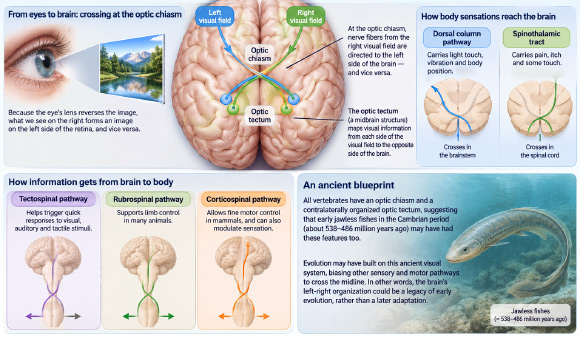
Why does the right side of the brain control the left side of the body, while the left side controls the right? In a hypothetical paper, University of Minnesota neuroscientists Martin W. Wessendorf and Daniel Derry Wang argue that this contralateral organization may be an inherited consequence of the evolution of vision rather than an adaptation that provided a direct survival advantage. They propose that early visual pathways established the crossed arrangement, which later sensory and motor systems retained because evolution tends to build on existing structures.
“In humans, the right motor cortex controls spinal motor neurons to move limbs on the left side of the body,” Wessendorf and Wang wrote.
“Similarly, the right side of the cerebral cortex primarily receives sensory information about the left side of the body and the left side of the outside world.”
“Many papers have speculated about the adaptive value of this contralateral tissue, going back at least to the anatomist Santiago Ramón y Cajal, but to date no papers seem to have examined its evolutionary history.”
Vision may have established the pattern
The researchers reviewed decades of comparative studies of brain circuits in fish, amphibians, reptiles, birds and mammals, looking for patterns in traits shared across these groups.
They identified vision as the oldest known system involving a major crossing. Every reported vertebrate species, from lampreys and hagfish to humans, has an optic chiasm, where fibers from the optic nerves cross. Signals from each visual field are sent to the opposite side’s optic tectum, a midbrain structure called the superior colliculus in mammals.
Wessendorf and Wang conclude that the last common ancestor of vertebrates probably had both an optic chiasm and a contralaterally organized optic tectum.
Other crossed circuits appear to have evolved later. The authors say that pathways carrying touch and pain signals to the thalamus, as well as the tectospinal and rubrospinal tracts, were likely present in tetrapods or their last common ancestors. The rubrospinal and tectospinal tracts are motor pathways that extend from the midbrain toward the spinal cord.
The corticospinal tract, the main pathway connecting the cortex with the spinal cord, is unique to mammals, although similar projections have been reported in some birds.
The researchers propose that the crossed visual map in the optic tectum served as a template for the later organization of other systems. The operculum also receives tactile and auditory information and sends motor commands, potentially linking the visual arrangement with additional sensory and motor circuits.
Evolutionary history rather than direct adaptation
By the time mammals appeared around 165 million years ago, many major pathways may already have been organized across the body’s midline. A mammalian neocortex without crossovers would not have been impossible, the authors argue, but creating one would have required adding new crossings or rewiring existing circuits.
Such changes would probably have increased “wiring costs,” which could have meant reduced functionality, greater energy demands or both. Connecting the neocortex to the existing circuits in a crossed arrangement may therefore have been the “most economical way” to extend the nervous system.
The researchers also point to differences in corticospinal pathways among species. In goats and elephants, the tract is bilateral, whereas in hedgehogs and moles there is almost no crossing. They interpret this variation as evidence that a strongly conserved crossed arrangement has not been consistently promoted by natural selection.
The paper examines six earlier hypotheses, including proposals that crossings structurally strengthen the nervous system, help animals withstand injury, solve engineering problems involved in steering toward a goal, or reflect an ancient twist in body planning.
According to the authors, each explanation has weaknesses. For example, a topological argument that intersections are needed to preserve spatial maps would imply that all mapped pathways must intersect, which is not the case.
Predictions that could be tested
Wessendorf and Wang emphasize that their proposal remains a hypothesis and identify several predictions that could be tested. These include whether the optic tectum and optic chiasm are preserved in Cambrian fossils of early vertebrates, whether crocodilians and various birds reach the spinal cord through telencephalic tracts, and whether crossed connections have proved more efficient than uncrossed ones.
“We propose that an evolutionarily ancient visual pathway, at least in quadrupeds, biased our central nervous system toward organizing on opposite sides,” the researchers wrote.
“Given that all modern vertebrates have both an optic chiasm and a contralaterally organized optic tectum, it is likely that the Cambrian jawless fishes, which lived approximately 538 million to 486 million years ago, had both an optic chiasm and an optic tectum.”
“We may be able to test this hypothesis by examining their fossilized skulls.”
“Because evolution is conservative in innovation, often retaining and building on existing structures, pathways, and mechanisms rather than inventing new ones, the organization of the visual system, particularly the optic tectum, may have defined the organizational principles needed for later-evolved sensory and motor pathways,” the researchers added.
“We propose that contralateral tissues did not necessarily evolve as an adaptation, but because evolution is an engineer who builds with the foundations and materials at hand.”
The paper was published in Frontiers in Neuroanatomy.
Martin W. Wessendorf and Daniel Derry Wang. 2026. “Why is the right hemisphere responsible for the left side of the body? Evolutionary history of puzzling traits.” Frontiers in Neuroanatomy 20. doi: 10.3389/fnana.2026.1937941.
Source: www.sci.news