


Close Menu
HitechubHitechub
    What's Hot
    Science

    Neural Basis of Compositional Control in the Brain

    Science

    How Queen Bees Survive Pesticide Exposure: A Surprising Survival Mechanism

    Technology

    Why Capital One Built a Multi-Agent AI Platform Using an Open-Weight Model

    Important Pages:
    • About Us
    • Privacy Policy
    • Terms & Conditions
    Facebook X (Twitter) Instagram Pinterest
    Facebook X (Twitter) Instagram
    HitechubHitechub
    Wednesday, November 25
    • Shop
      • Fashion
        • Mens
        • Womens
        • Accessories
          • Handbags
          • Keychain
          • Masks
          • Money clicps
          • Neck Pillow
          • Rings
          • Towels
          • Wallets
        • Jewelry
        • Watches
        • T-shirts
        • Hawaiian shirts
        • Vests
        • Swim trunks
        • Swimsuits
      • Fun
        • Magic cubes
        • Magnifiers
        • Misc
        • Photo books
        • Puzzles
        • Toys
      • Home
        • Cleaning/Care
        • Mailbox covers
        • Mugs
        • Pot Holders
        • Spoon
      • Office and Electronics
        • Chairs
        • Office Supplies
        • IPad cases
        • Laptop stickers
        • Mouse pads
        • Notebooks
        • Pencil bags
        • Pens
        • Phone cases
      • Personalized
      • Pets
      • Sports
        • Cycling
          • Balaclava Mask
          • Bike Bell
          • Bike Computer
          • Bike Fender
          • Bike Grips
          • Bike Kickstand
          • Bike Light
          • Bike Locks
          • Bike Mitts
          • Bike Pumps
          • Bike Repair Stand
          • Bike Seat
          • Bike Trainer
          • Bike Wheels
          • BIKES
            • Folding Bikes
            • Road Bikes
          • Carbon Fiber Bike Products
          • Cycling Mask
          • Kid’ Bike Helmets
          • Inner Tube
          • Motorcycle Bag
          • Nylon Pedals
          • Adult Helmets
          • Photochromic Sunglasses
          • Soft Coolers
          • Suction Cup Bike Rack
          • Tool accessories
          • Winter Cloth
          • Heart Rate Monitor
        • Outdoors/Camping
          • Outdoor Bags
        • Sweatband
    • Technology
      1. AI
      2. Gadgets
      3. View All

      This is the most popular CEO in the world

      Sectors in which “Chat-GPT” is most often used

      Artificial intelligence has begun to “swallow” professions

      The unusual robot conductor of a concert in Seoul

      Here’s how you can tell if your phone is being tapped

      PlayStation 5 becomes a completely silent console and gets more space

      This is the first phone that can be used to park a car

      Best Gaming Laptops 2023: Powerful Portables for PC Games

      Download the AI Gas Power Boom and Consciousness Reality Check Report

      Half of NASA’s Aging Mars Spacecraft Fleet Offline Due to Technical Issues

      Rackspace Shuts Down Spot Cloud Platform After Security Breach

      Reduce Enterprise Network Risk with AI Modernization

    • Science
      1. Space
      2. Wheels
      3. View All

      Space Perspective: A Journey to the Edge of Space

      5 Fascinating Facts About Space

      Space Exploration: Unveiling the Wonders of the Universe

      Toyota wants to make a new generation battery with a range of up to 1,200 km

      Meet Toyota’s lunar “baby” that could make exploring the Moon easier

      What does a night drive look like with one of the most beautiful cars in the world: the Rolls-Royce Ghost

      NASA+ Content Comes to the Big Screen at a Greenbelt, Maryland Movie Theater

      AI and the Future of Mathematics: Is It the End of Mathematics as We Know It?

      New Nasal Spray Restores Memory and Reduces Alzheimer’s-Related Decline in Aging Mice

      4.5-Billion-Year-Old Secret May Be Leaking From Earth’s Core

    HitechubHitechub
    Home » Why Does the Right Side of the Brain Control the Left Side of the Body?
    Science

    Why Does the Right Side of the Brain Control the Left Side of the Body?

    Share Facebook Twitter Pinterest WhatsApp
    Share
    Facebook Twitter LinkedIn Pinterest WhatsApp

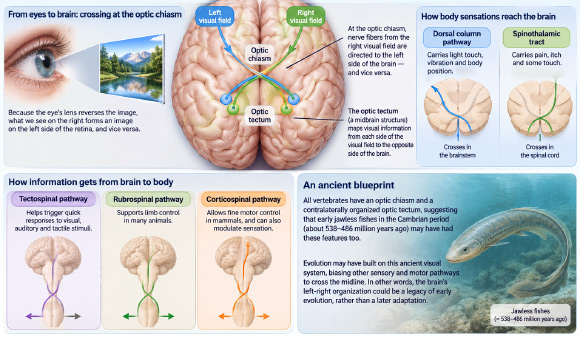
    Why does the right side of the brain control the left side of the body, while the left side controls the right? In a hypothetical paper, University of Minnesota neuroscientists Martin W. Wessendorf and Daniel Derry Wang argue that this contralateral organization may be an inherited consequence of the evolution of vision rather than an adaptation that provided a direct survival advantage. They propose that early visual pathways established the crossed arrangement, which later sensory and motor systems retained because evolution tends to build on existing structures.


    Martin W. Wessendorf and Daniel Derry Wang trace the cross-wiring of the vertebrate brain to the evolution of vision and say that the mammalian cortex inherited that arrangement.

    “In humans, the right motor cortex controls spinal motor neurons to move limbs on the left side of the body,” Wessendorf and Wang wrote.

    “Similarly, the right side of the cerebral cortex primarily receives sensory information about the left side of the body and the left side of the outside world.”

    “Many papers have speculated about the adaptive value of this contralateral tissue, going back at least to the anatomist Santiago Ramón y Cajal, but to date no papers seem to have examined its evolutionary history.”

    Vision may have established the pattern

    The researchers reviewed decades of comparative studies of brain circuits in fish, amphibians, reptiles, birds and mammals, looking for patterns in traits shared across these groups.

    They identified vision as the oldest known system involving a major crossing. Every reported vertebrate species, from lampreys and hagfish to humans, has an optic chiasm, where fibers from the optic nerves cross. Signals from each visual field are sent to the opposite side’s optic tectum, a midbrain structure called the superior colliculus in mammals.

    Wessendorf and Wang conclude that the last common ancestor of vertebrates probably had both an optic chiasm and a contralaterally organized optic tectum.

    Other crossed circuits appear to have evolved later. The authors say that pathways carrying touch and pain signals to the thalamus, as well as the tectospinal and rubrospinal tracts, were likely present in tetrapods or their last common ancestors. The rubrospinal and tectospinal tracts are motor pathways that extend from the midbrain toward the spinal cord.

    The corticospinal tract, the main pathway connecting the cortex with the spinal cord, is unique to mammals, although similar projections have been reported in some birds.

    The researchers propose that the crossed visual map in the optic tectum served as a template for the later organization of other systems. The operculum also receives tactile and auditory information and sends motor commands, potentially linking the visual arrangement with additional sensory and motor circuits.

    Evolutionary history rather than direct adaptation

    By the time mammals appeared around 165 million years ago, many major pathways may already have been organized across the body’s midline. A mammalian neocortex without crossovers would not have been impossible, the authors argue, but creating one would have required adding new crossings or rewiring existing circuits.

    Such changes would probably have increased “wiring costs,” which could have meant reduced functionality, greater energy demands or both. Connecting the neocortex to the existing circuits in a crossed arrangement may therefore have been the “most economical way” to extend the nervous system.

    The researchers also point to differences in corticospinal pathways among species. In goats and elephants, the tract is bilateral, whereas in hedgehogs and moles there is almost no crossing. They interpret this variation as evidence that a strongly conserved crossed arrangement has not been consistently promoted by natural selection.

    The paper examines six earlier hypotheses, including proposals that crossings structurally strengthen the nervous system, help animals withstand injury, solve engineering problems involved in steering toward a goal, or reflect an ancient twist in body planning.

    According to the authors, each explanation has weaknesses. For example, a topological argument that intersections are needed to preserve spatial maps would imply that all mapped pathways must intersect, which is not the case.

    Predictions that could be tested

    Wessendorf and Wang emphasize that their proposal remains a hypothesis and identify several predictions that could be tested. These include whether the optic tectum and optic chiasm are preserved in Cambrian fossils of early vertebrates, whether crocodilians and various birds reach the spinal cord through telencephalic tracts, and whether crossed connections have proved more efficient than uncrossed ones.

    “We propose that an evolutionarily ancient visual pathway, at least in quadrupeds, biased our central nervous system toward organizing on opposite sides,” the researchers wrote.

    “Given that all modern vertebrates have both an optic chiasm and a contralaterally organized optic tectum, it is likely that the Cambrian jawless fishes, which lived approximately 538 million to 486 million years ago, had both an optic chiasm and an optic tectum.”

    “We may be able to test this hypothesis by examining their fossilized skulls.”

    “Because evolution is conservative in innovation, often retaining and building on existing structures, pathways, and mechanisms rather than inventing new ones, the organization of the visual system, particularly the optic tectum, may have defined the organizational principles needed for later-evolved sensory and motor pathways,” the researchers added.

    “We propose that contralateral tissues did not necessarily evolve as an adaptation, but because evolution is an engineer who builds with the foundations and materials at hand.”

    The paper was published in Frontiers in Neuroanatomy.

    Martin W. Wessendorf and Daniel Derry Wang. 2026. “Why is the right hemisphere responsible for the left side of the body? Evolutionary history of puzzling traits.” Frontiers in Neuroanatomy 20. doi: 10.3389/fnana.2026.1937941.

    Source: www.sci.news

    Share. Facebook Twitter Pinterest LinkedIn WhatsApp
    Previous ArticleGoogle Is Bringing AI to the Classroom as Schools Search for a Way Forward
    Next Article Largest Pro-AI Super PAC Network Had Little Impact on Midterm Election Results

    Related Posts

    Science

    NASA+ Content Comes to the Big Screen at a Greenbelt, Maryland Movie Theater

    Science

    AI and the Future of Mathematics: Is It the End of Mathematics as We Know It?

    Science

    New Nasal Spray Restores Memory and Reduces Alzheimer’s-Related Decline in Aging Mice

    Science

    4.5-Billion-Year-Old Secret May Be Leaking From Earth’s Core

    Science

    How Earth’s Ancient Oceans Misled Scientists About Oxygen’s History

    Science

    Who Created Figure 3? Why Scientists Need to Visualize Experimental Contributions

    Science

    Has Earth’s Next Ice Age Already Begun? How Global Warming May Have Delayed It

    Science

    Francis Halzen’s Bet on “Ghost Particles” Beneath the South Pole Wins the 2026 Nobel Prize in Physics

    Add A Comment
    Leave A Reply Cancel Reply

    Stay In Touch
    • Facebook
    • Twitter
    • Instagram
    • Pinterest
    Top Picks
    Technology

    $6.3 Billion Binance Hack Completed Successfully in Just 20 Minutes

    North Korea-linked hacking group TraderTraitor has become a major threat to cryptocurrency and decentralized finance…

    Mysterious Mass Grave in Croatia Suggests Romans Dumped Plague Victims Into a Well

    San Diego Scraps Flock Safety Cameras and Smart Street Lights

    Mayo Clinic Discovers New Way to Fight Aging-Related “Zombie” Cells

    eMudhra Exits TLS Business After Certificate Private Key Misuse

    Most Popular
    Technology

    Top Climate Tech Companies to Watch in 2026: Energy Dome’s Carbon Dioxide Batteries

    Technology

    DIVD Announces AI-Driven Network Breach Exploiting Zammad Zero-Day Vulnerability

    Categories
    • AI (9)
    • Gadgets (6)
    • Science (3,568)
    • Space (3)
    • Technology (3,211)
    • Wheels (3)
    Our Picks
    Technology

    Best Battery-Powered Leaf Blowers of 2026: Tested for Power, Battery Life, and Noise

    Science

    Einstein’s Equations Could Explain the Universe Without Dark Energy

    © 2026 Hitechub.
    • Home
    • About Us
    • Privacy Policy
    • Terms & Conditions

    Type above and press Enter to search. Press Esc to cancel.

    GDPR Cookie Banner

    We are using cookies to give you the best experience on our website.

    You can find out more about which cookies we are using or switch them off in .

    Ad Blocker Enabled!
    Ad Blocker Enabled!
    Our website is made possible by displaying online advertisements to our visitors. Please support us by disabling your Ad Blocker.