


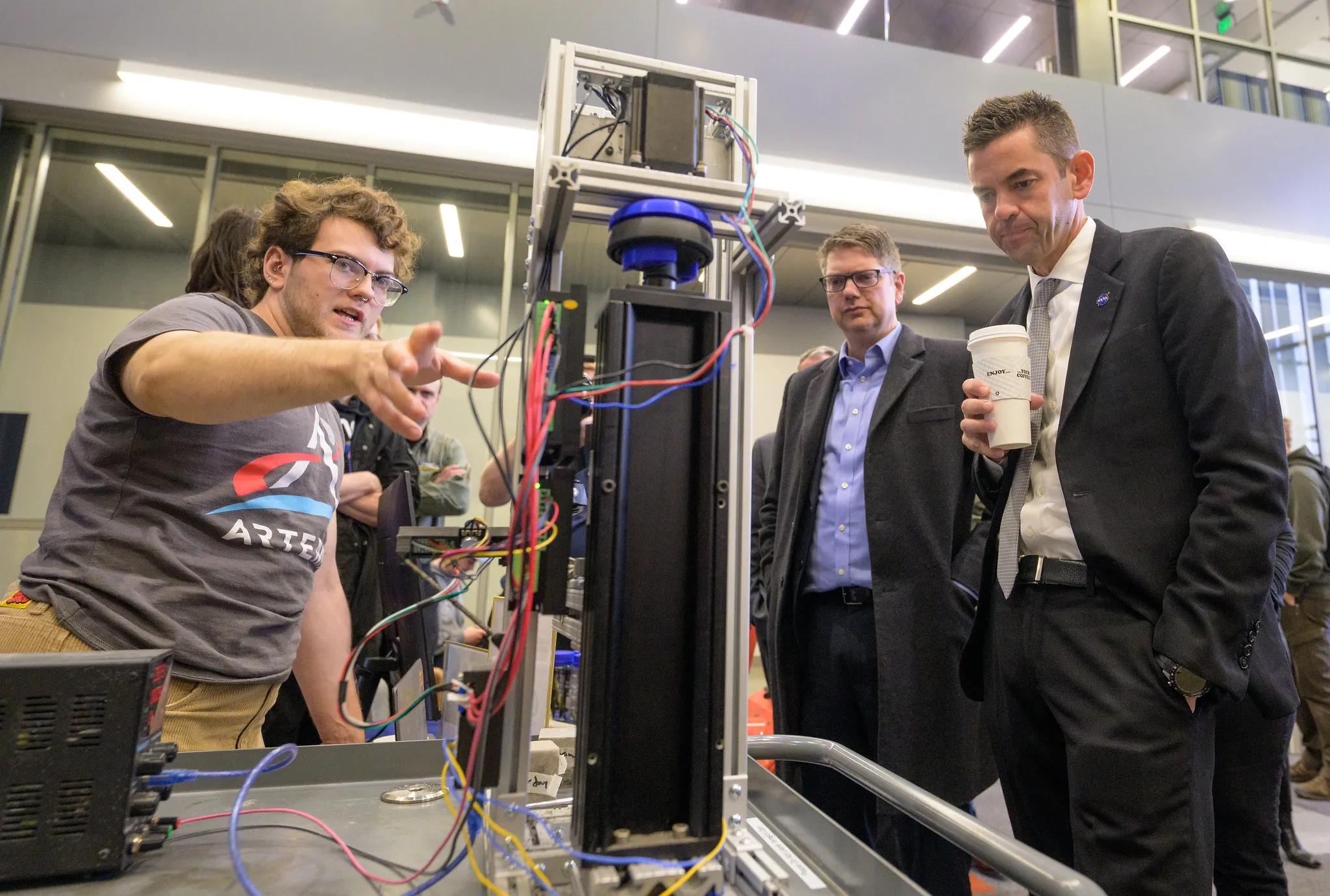
NASA’s Inspiration Tour has brought the agency’s space exploration and aviation work to communities across the United States, connecting the public, industry and universities with the people and technologies advancing the nation’s space capabilities. At stops in Iowa, Arizona, Alaska and North Dakota, NASA Space Grant students presented research, demonstrated spacecraft and robotics projects, and discussed future lunar exploration with NASA leaders and experts.
Students support NASA research in Iowa
In Iowa, NASA Administrator Jared Isaacman toured the Make to Innovate program laboratory at Iowa State University. Students in the Iowa Space Grant Consortium’s Mission Moon Program, along with consortium-funded organizations including Cardinal Space Mining, CySat and CyLaunch, presented research results and demonstrated projects funded by NASA.
At a well-attended town hall, NASA experts discussed the agency’s work on a moon base and explained how current research could contribute to future exploration.
“We are grateful for the opportunity to welcome NASA leaders to Iowa,” said Iowa Space Grants Director Sarah Nelson. “The students’ excitement was incredible, and this visit highlighted how the research and innovation taking place at Iowa State will help advance Artemis and NASA’s future exploration efforts.”
Space research and engineering in Arizona
At the University of Arizona, NASA administrators examined space research and engineering capabilities supported by the Arizona Space Grant Consortium. University of Arizona students have a long history of contributing to NASA missions and pursuing aerospace careers through work ranging from satellite communications testing and advanced optics for observing deep space to student-built high-altitude balloon payloads and small satellites.
The stop also included a question-and-answer session in which NASA administrators responded to questions from local high school and college students.
“It was incredible to be able to introduce the high-altitude balloon research that we do at SEDS to Jared Isaacman and the people at NASA,” said Ella Miller, a mechanical engineering student at the University of Arizona. “Thanks to the Arizona Space Grant, I was able to gain hands-on experience throughout the mission design process each semester, which helped me pursue a career in space research and secure an internship in the field.”
Exploration research in Alaska
At the University of Alaska in Fairbanks, administrators toured two Geophysical Institute facilities, the Poker Flat research range, the university’s scientific rocket launch facility and the Alaska Satellite Facility.
During the Alaska Space Grant Science Fair, students presented research on hibernation biology and demonstrated advances in CubeSat technology. They also learned about NASA’s moon base program and asked questions about opportunities for the next generation of innovators and explorers.
Preparing for future exploration in North Dakota
In North Dakota, the Inspiration Tour focused on technologies and research supporting future exploration. Space Grant-funded work at the University of North Dakota is contributing to exploration-related research across STEM fields.
Student fellows and NASA interns presented projects involving supercell merging analyzed with satellite imagery, auroral geomagnetic conditions and on-site resource utilization, among other topics. North Dakota Space Grant STEM Ambassador students also demonstrated robotics and drone activities developed through “Mission Moon,” a statewide initiative focused on Artemis efforts and collaboration with educators and other North Dakota universities.
“It was a great opportunity to speak with NASA administrators,” said researcher and STEM ambassador Marissa Reinhardt. “He genuinely cared about the opinions of our students and the research we were undertaking, which made all the effort we put into research and the North Dakota Space Grant Consortium so rewarding.”
Tour to conclude with MAX POWER showcase
NASA’s Inspiration Tour will culminate with MAX POWER, a public showcase of aerospace innovation, on November 7 and 8. The event will highlight NASA’s commitment to preparing the next generation of innovators and explorers for humanity’s next major step in space exploration.
As NASA enters what it describes as a golden age of innovation and exploration, the national network of Space Grant Consortia is expanding opportunities for students to participate in the growing aerospace workforce. Space Grant students are contributing to the future of U.S. space exploration at educational institutions around the world.
Information about joining NASA missions, careers and learning opportunities was provided in the source article, but no link was included.
Source: www.nasa.gov