


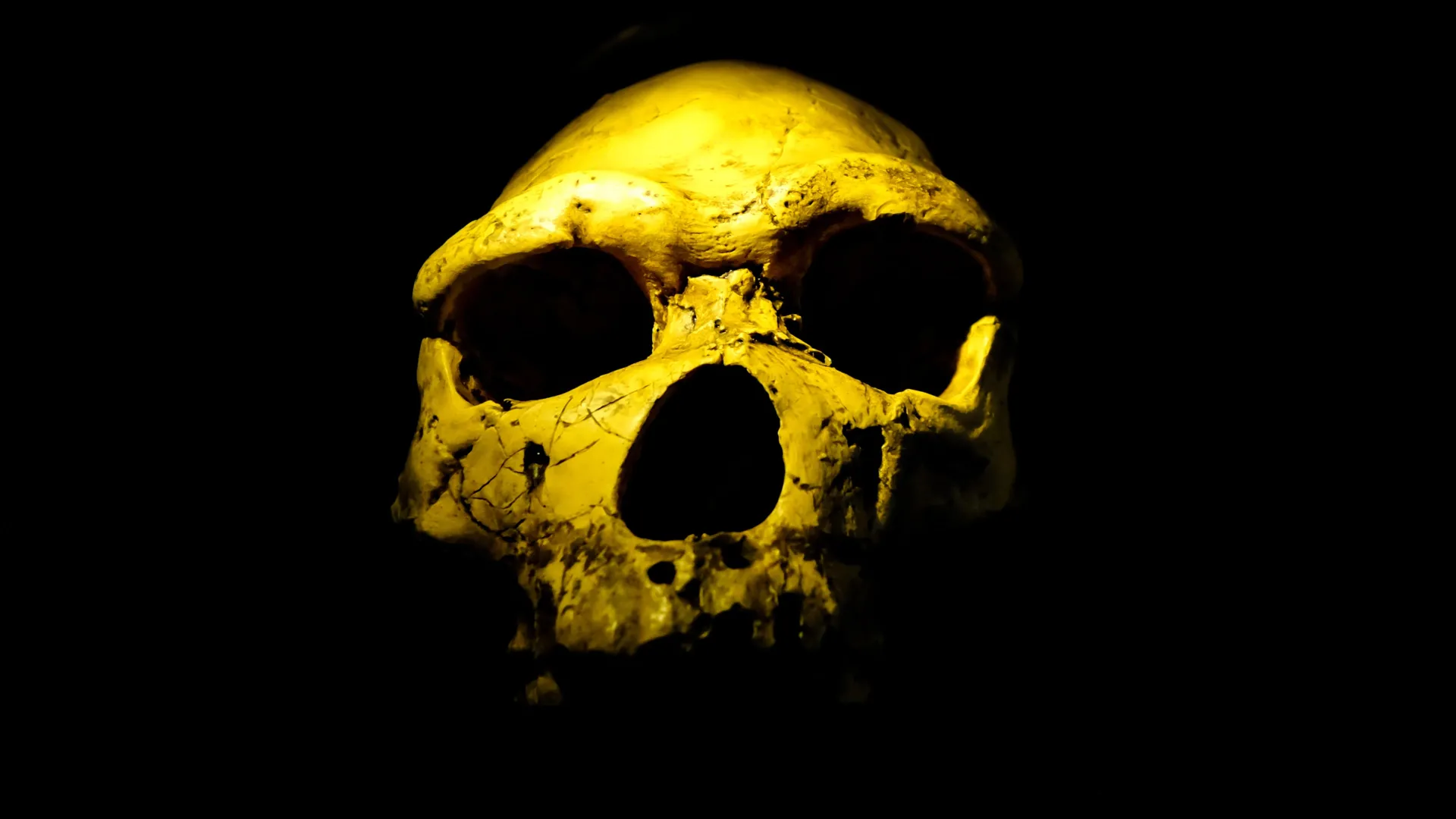
For much of the 20th century, human evolution was presented as a branching tree in which each hominin species occupied a distinct evolutionary branch. New research is replacing that model with a more complex picture: ancient human groups repeatedly interbred, and some lineages once considered evolutionary dead ends contributed genetic material to people living today. A study by Qiaomei Fu and colleagues at the Chinese Academy of Sciences, published in Nature, provides evidence that East Asian Homo erectus exchanged genes with Denisovans roughly 400,000 years ago.
When I was an undergraduate, I was taught a straightforward version of human evolution. Homo sapiens appeared in Africa, spread across the world and replaced the older human groups it encountered. Neanderthals, Homo erectus and other ancient relatives were treated as evolutionary dead ends: unlucky cousins that left no descendants.
That replacement story has been radically reconsidered over the past 30 years. The new study demonstrates something that seemed impossible only a decade ago: important biological information can be recovered from H. erectus fossils that are far too old to preserve usable DNA.
Proteins preserve a link to Homo erectus
Rather than sequencing DNA, the researchers extracted ancient proteins from the enamel of six teeth found at three Chinese sites: Zhoukoudian, the site associated with the Peking Man fossils excavated in the early 20th century; Hexian; and Sunjiadong. The specimens date to approximately 400,000 years ago.
Homo erectus is widely regarded as the first human species to leave Africa. Evidence suggests that it migrated into Eurasia about 2 million years ago, becoming the most geographically widespread of all known human ancestors.
Tooth enamel is the hardest tissue in the human body, and its proteins can survive long after DNA has been irreversibly degraded. The researchers found that all six specimens shared a previously unknown amino-acid variant—a small molecular difference involving a single change in a protein sequence. This variant has not been found in any other hominin, living or extinct.
The shared feature groups the East Asian H. erectus fossils together, supports their identification and helps resolve a long-running debate over whether the rare Hexian fossils were actually H. erectus.
The teeth also shared a second variant that is not unique to H. erectus. It appears in Denisovans, a mysterious archaic human group known primarily from caves in Siberia. A corresponding genetic variation is found in living people at a frequency of about 21% in the Philippines and approximately 1% in India. Its distribution is consistent with the possibility that it entered modern human populations through Denisovan ancestors.
The most reasonable interpretation is that East Asian populations of H. erectus passed this mutation to Denisovans through interbreeding. The Denisovans may then have passed it on to the ancestors of modern Southeast Asians and Oceanians. This transfer of genetic material between species or divergent populations is known as introgression.
A lineage once thought to be an evolutionary dead end therefore appears to have left a small but detectable trace in the genomes of living people—a molecular connection between the teeth of Peking Man and modern populations in Asia.
A recurring pattern of interbreeding
The importance of the study extends beyond the particular variants and populations involved. It supports the broader conclusion that interbreeding among ancient human lineages was not an unusual event. It was a recurring part of human evolution.
All of the major hominin lineages that researchers have been able to examine genomically show evidence of admixture. Modern humans outside Africa carry about 2% Neanderthal DNA, while Papuans and Indigenous Australians have an additional 2% to 5% Denisovan ancestry.
West African populations also carry genetic material from an previously unidentified ancient lineage. Even the Denisovans themselves probably received gene flow from older and more divergent groups, a possibility that gives the new H. erectus findings added significance.
A 2019 review in the American Journal of Physical Anthropology documented at least three separate introgression events from Denisovan-like populations into the ancestors of Southeast Asians and Oceanian peoples. Some of those events may have occurred as recently as 20,000 years ago.
The resulting picture is not a clean set of lineages splitting apart. It is a tangled web of contacts and genetic exchanges extending across millions of years. The human genome is not the product of a single, unbroken lineage that emerged from Africa. Instead, it is a mosaic assembled from contributions made by multiple ancient groups, each adapted to particular local environments.
Some Denisovan-derived variants in the Papuan genome, for example, appear to affect immune function. The functional effects of the H. erectus-related variants identified in the new study are unknown, and their significance remains an open question. However, the existence of other introgressed variants that influence adaptation suggests that genetic exchange may have helped later populations adjust to new environments.
The possibility of other “ghost” groups
The study may be even more important for what it suggests about ancient populations that researchers have not yet been able to study genetically. H. erectus may have survived in Indonesia until about 100,000 years ago. Homo floresiensis, a small “hobbit” species, lived on the island of Flores when modern humans arrived, while another lineage, Homo luzonensis, occupied the Philippines.
None of these populations has yielded DNA, and so far none has provided molecular data of any kind. It remains unknown whether they were partly absorbed into the human populations that followed them. Genomic studies of living people have not clearly detected signals from these groups, although the available tools have until recently been relatively blunt.
The proteomic approach demonstrated in the new study offers a possible way forward. If proteins can be recovered from H. erectus enamel after 400,000 years, applying the same method to H. floresiensis or H. luzonensis remains could eventually reveal whether those lineages also contributed genetic material to later humans.
The old metaphor of a tree with a single trunk branching into separate species has been quietly replaced in scientific research. Human evolution may be better understood as a braided river, with channels that sometimes flow apart and sometimes come together, continually exchanging water.
The new study adds to the evidence that when ancient human groups disappeared, they did not necessarily vanish without a trace. They may have left behind molecular remnants that still connect them to people living today.
Source: www.sciencedaily.com