


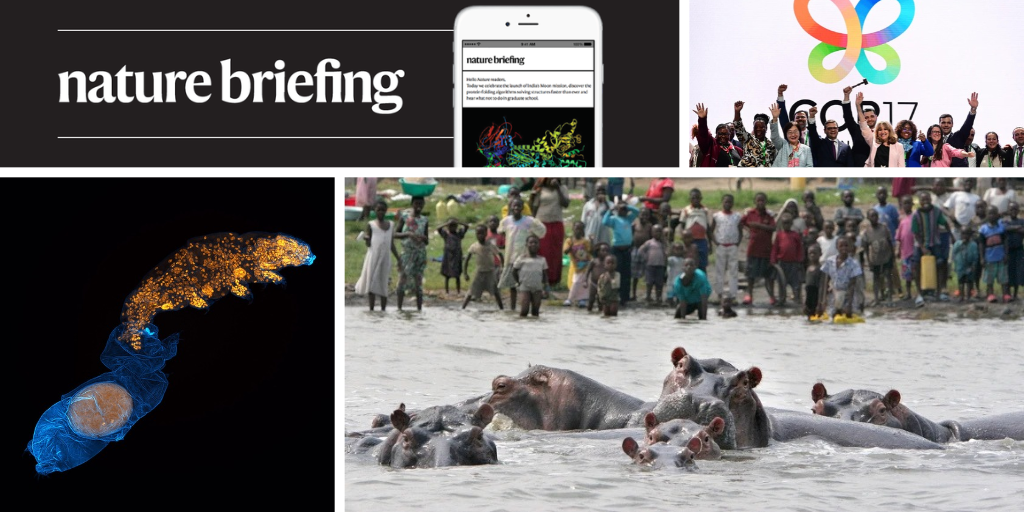
This briefing highlights a selection of recent developments in science and technology, including an award-winning image of a tardigrade, an anthrax outbreak among hippos in the Democratic Republic of the Congo, a sharp decline in US National Science Foundation social-science grants, and a mouse study examining how castration affects lifespan. It also explores biodiversity loss in rural Japan, a man who developed perfect pitch after a brain injury, and researchers recognized for their contributions to science and education.
Credit: Dr. Gonzalo Quiroga Artigas/Nikon Small World
Evolutionary biologist Gonzalo Quiroga-Artigacin created this image of a tardigrade molting and laying eggs in its old skin. It is one of the winners of the 2026 Nikon Small World Competition.
See more of this month’s sharpest science images, selected by the Nature photography team.
News and research
An anthrax outbreak has killed at least 30 hippos (Hippopotamus amphibius) in the Democratic Republic of the Congo (DRC) over the past month. So far, there have been no reports of human infections. As the DRC contends with armed conflict and outbreaks of Ebola and cholera, researchers say the wildlife outbreak will place additional pressure on already limited resources.
Nature | 4 minute read
Donations to a United Nations-run nature-conservation fund were expected to raise US$1 billion annually. Yet in the two years since its establishment, the fund has received only US$10,588. The Potash Fund seeks voluntary donations from companies that profit from genetic data collected from Earth’s biodiversity. So far, only five small biotechnology companies have contributed.
Nature | 6 minute read
In fiscal year 2026, which ended on September 30, the US National Science Foundation (NSF) awarded fewer than 100 new social-science grants, compared with a historical average of about 850 annually. In dozens of programme areas, including economics and archaeology, the agency awarded no new grants at all. Earlier this year, President Donald Trump’s administration announced its intention to eliminate the NSF’s Social, Behavioral, and Economic Sciences (SBE) division entirely, leaving the decades-old programme in limbo.
Nature | 7 minute read
A study in mice could help explain the long-known observation that castration extends the lifespan of most mammals, including humans, and why men generally live shorter lives than women. Researchers removed the testicles of mice before puberty, after puberty or in old age, and found that each intervention increased life expectancy. Delayed intervention led to the greatest improvement. The findings suggest that the testicles’ apparent harmful effects begin later in life, rather than during adolescence.
Reference: bioRxiv preprint
Features and impressions
Large-scale migration from the countryside to cities has contributed to an alarming decline in biodiversity in some low-intensity agricultural landscapes where humans and other species coexisted for thousands of years. In Japan, for example, forests that farmers once managed by cutting trees for fuel and collecting fallen leaves as fertilizer have grown dense and closed, contributing to the decline of species such as fireflies and Mus musculus. Volunteers have begun using saws to restore these habitats, but experts say long-term solutions will require measures including rewilding and action to address rural depopulation.
Nature | 11 minute read
Edward Freitag, a 66-year-old music teacher, developed the ability to recognize musical notes instantly after sustaining brain damage in a motorcycle accident. He is the first known person to acquire perfect pitch through a brain injury. This illustrated feature explores how the brain processes sound, how Freitag’s injury affected him and the fugue-like piece he wrote during the early stages of his recovery.
New York Times Magazine | Leisurely Scroll
Quote of the day
Marcia McNutt, former president of the National Academy of Sciences, discusses what the Trump administration’s policies—including widespread layoffs, funding cuts and increased political control—could mean for decades of US scientific leadership. New York Times | 24 minute read
The Nature Prize for Inspiring Women in Science recognized materials physicist Alexandra Patterson, among others, for her groundbreaking work developing semiconductors from flexible, polymer-based materials. In the science-support sector, sustainability researcher Tagreed Abdelmadjid is leading Share the Knowledge-Sudan, a women-led volunteer initiative operating amid one of the world’s worst humanitarian crises.
Many remarkable researchers and projects have been featured, but this award lives up to its name, and the work it recognizes is genuinely inspiring.
Thank you for reading,
Flora Graham, Nature Briefing Editor-in-Chief
Contributed by Jacob Smith
• Nature Briefing: Careers — insights, advice and award-winning journalism to help you optimize your work life.
• Nature Briefing: Microbiology — the most abundant life forms on Earth, microorganisms, and the roles they play in health, the environment and our food system.
• Nature Briefing: The Anthropocene — climate change, biodiversity, sustainability and geoengineering.
• Nature Briefing: AI and Robotics — 100% written by humans, of course.
• Nature Briefing: Cancer — a weekly newsletter written with cancer researchers in mind.
• Nature Briefing: Translational Research — biotechnology, drug discovery and pharmaceuticals.
Source: www.nature.com