


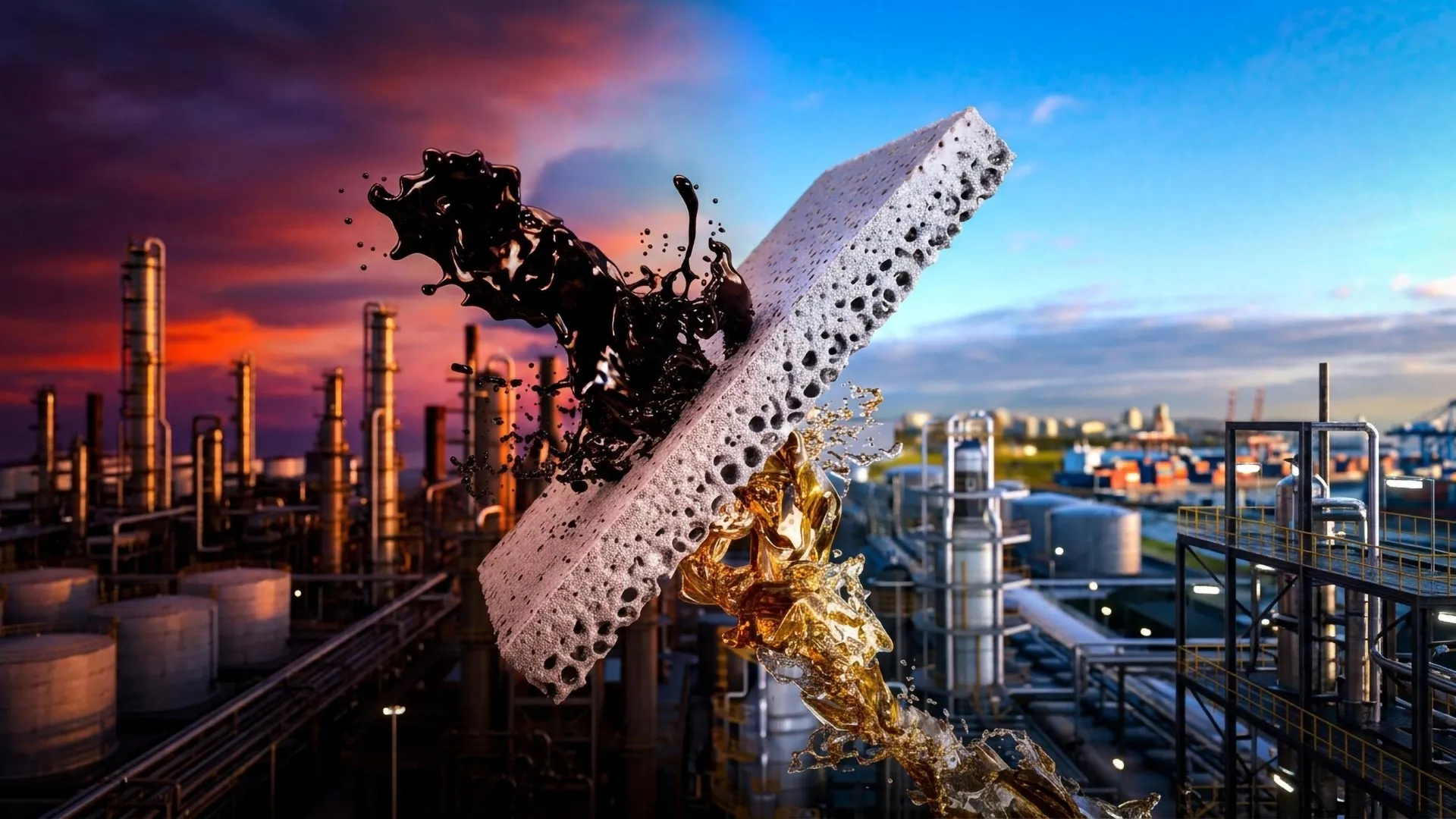
Researchers at the Korea Advanced Institute of Science and Technology (KAIST) and the Georgia Institute of Technology have demonstrated a membrane that separates crude oil at room temperature. The inexpensive, uncoated membrane uses a buildup of heavy hydrocarbons inside its pores to create separation channels, potentially reducing the energy, cooling water, operating costs and carbon emissions associated with conventional oil refining.
Why crude oil refining uses so much energy
The international research effort was led by Professor Dong-Yeun Koh of KAIST in collaboration with Professor Ryan Lively’s research group at the Georgia Institute of Technology. KAIST, chaired by Lee Kwang-Hyung, announced that the team had successfully demonstrated the room-temperature crude oil separation membrane. The findings were reported in Nature.
Crude oil is used for much more than gasoline and other transportation fuels. Refineries also produce raw materials for plastics, packaging, clothing and many everyday products. Because refining costs affect the price of these materials, improving the efficiency of the process could have broad economic and environmental benefits.
For more than a century, refineries have relied heavily on distillation to separate crude oil into useful components. The process heats oil to temperatures above 350 °C, converts some of it into vapor and then cools the vapor to collect different fractions.
That approach requires enormous amounts of energy. Worldwide, crude oil distillation consumes approximately 1,100 terawatt hours (TWh) each year—equivalent to the combined annual output of about 130 continuously operating nuclear power plants, each with a capacity of approximately 1 gigawatt.
Because of its high energy demand, distillation contributes substantially to fuel consumption and greenhouse gas emissions in the refining industry. Growing economic pressure across the global petrochemical market has increased interest in more efficient separation technologies.
Turning membrane fouling into a separation mechanism
Membranes are a promising alternative because they can separate substances without the extreme temperatures required by distillation. Previous designs, however, generally relied on very thin specialized coatings to achieve precise molecular separation. Those coatings can be expensive to manufacture and may develop defects during large-scale production, limiting their potential for industrial use.
Researchers at KAIST and Georgia Tech took a different approach. Instead of adding a complex coating, they used a bare membrane made from porous polyacrylonitrile (PAN), an inexpensive and chemically stable polymer already commonly used as a support material in industrial filtration systems.
The crude oil itself then helped create the structure needed for separation. As the oil passed through the membrane, heavier hydrocarbon molecules accumulated along the inner walls of the pores. The buildup gradually narrowed the openings, forming channels less than 2 nanometers in diameter.
These naturally formed channels allowed lighter oil fractions, including naphtha, gasoline and kerosene, to pass through quickly while restricting heavier materials.
The result reverses the usual understanding of membrane fouling. Accumulation inside membrane pores is normally considered a serious problem because it reduces filtration performance and can require cleaning or replacement. In this case, however, the buildup improved the membrane’s ability to separate different molecules.
The uncoated PAN membrane achieved crude oil permeability approximately 23 times higher than previously reported for leading crude oil separation membranes. It also operated stably for 28 consecutive days.
“One of the key challenges facing membrane systems for crude oil separation has been the low productivity of membrane units,” Professor Ryan Lively of the Georgia Institute of Technology said. “PAN membranes, with their amazing separation mechanisms, dramatically improve the productivity of membrane units, so industry should seriously consider implementing this technology.”
Potential reductions in energy use and emissions
The membrane could be installed as a modular filtration system that processes crude oil before it enters conventional distillation equipment. This would reduce the amount of work required during the heating and separation stages while allowing facilities to retain much of their existing infrastructure.
Computer simulations indicated that incorporating membranes into the purification process could reduce energy consumption by 31.6% and carbon dioxide emissions by 37.6%. The calculations also predicted a 20.7% reduction in cooling water consumption and a 36% reduction in operating costs.
Researchers estimate that implementing the system across South Korea’s refining and petrochemical industries could prevent approximately 10 million tons of greenhouse gas emissions each year. That is roughly equivalent to the annual emissions of 4 million vehicles equipped with internal combustion engines.
These figures are estimates based on process simulations, not savings already demonstrated across operating refineries. Nevertheless, the results suggest that membrane filtration could offer a practical way to improve the efficiency of existing facilities.
Possible uses beyond oil refining
Although crude oil separation was the main focus of the research, the same technology could eventually be useful in other industries. Potential applications include treating pyrolysis oil produced by breaking down waste plastics for recycling, recovering solvents used in battery manufacturing, purifying pharmaceutical compounds and improving biofuel production.
The approach may be suitable for complex liquid mixtures in which small filtration channels can form naturally to separate their components. This could provide a less expensive and more versatile alternative to membranes that require precisely manufactured surface coatings.
“This study reveals a new scientific principle that membranes interact with complex mixtures and spontaneously form their own separation channels,” Professor Dong-Yeun Koh of KAIST said. “By working with real crude oil sourced from the HD Modern Oil Bank, we were able to validate the technology under conditions relevant to industrial operations.”
Using actual crude oil allowed the researchers to examine membrane performance in the complex hydrocarbon mixtures found in industrial feedstocks.
Next steps toward industrial deployment
The researchers plan to improve large-scale membrane production and establish long-term reliability before introducing the technology more widely.
“By advancing large-area membrane modularization and long-term operational reliability, we hope to expand the adoption of membrane-based processes across the refining and petrochemical industries,” said KAIST Professor Jae W. Lee, a co-corresponding author of the study.
“Our goal is to precisely control this spontaneous pore shrinkage phenomenon and develop it into a membrane platform that can be applied throughout purification processes,” said the study’s co-lead authors, Dr. Jihoon Choi and Dr. Hyeokjun Seo of KAIST. “We also aim to extend this technology to plastic recycling, biofuel purification, and other sustainable chemical processes that support carbon neutrality.”
The research was supported through the Fundamental Research Program for Outstanding Young Researchers and the Engineering Research Center (ERC) Program of the Ministry of Science, Information and Communications of the Republic of Korea.
Source: www.sciencedaily.com