


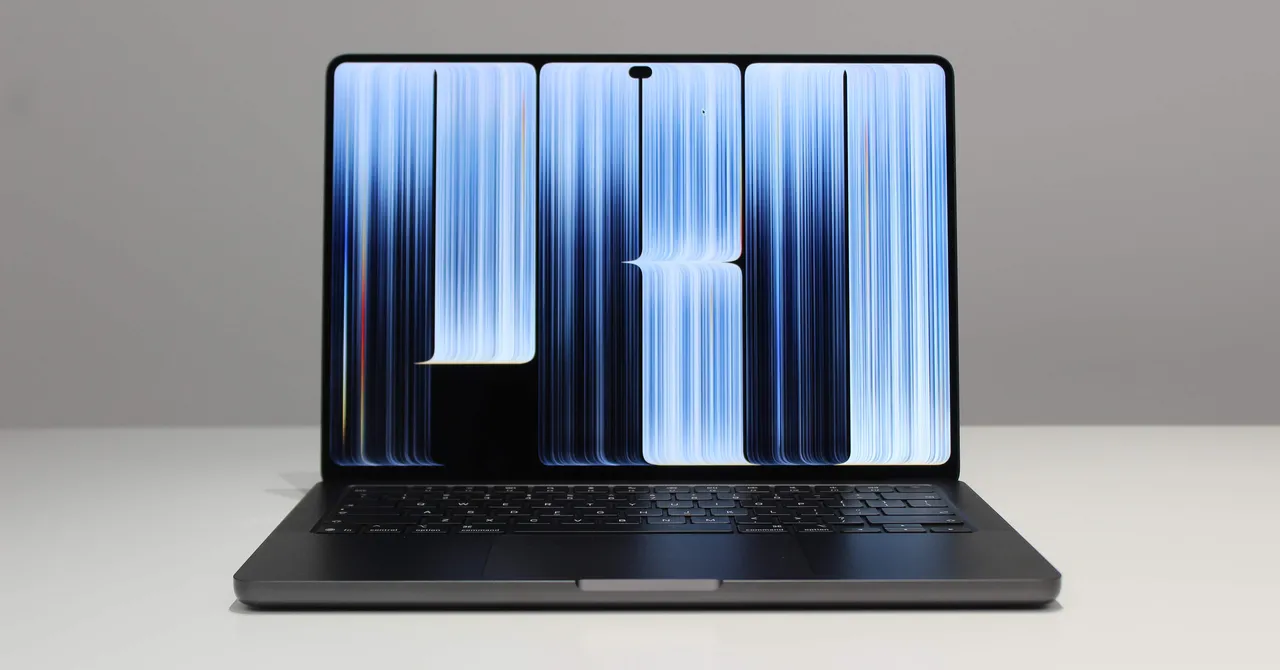
Apple’s OLED MacBook Pro introduces a brighter tandem OLED display that reaches up to 1,000 nits for everyday SDR content and up to 2,000 nits in specific conditions, including HDR and bright outdoor environments. Combined with an optional nano-texture finish, the display is designed to improve visibility and deliver unusually detailed HDR images, while the laptop also receives smaller design refinements such as softer rubber feet and a slimmer screen bezel.
A brighter OLED display
More than two years after Apple introduced a tandem OLED display in the iPad Pro, the technology has finally arrived in the MacBook Pro. MacBook Pro users had continued to rely on the same Mini-LED display, but Apple has now pushed its tandem OLED panels further than before.
This is the brightest laptop display I’ve ever tested, reaching up to 1,000 nits in SDR. That brightness applies to everyday content across the operating system and apps. The display can reach 2,000 nits, but only in specific situations.
Photo: Luke Larsen
Outdoor visibility
In very bright light or outdoors, an ambient light sensor built into the webcam module detects the conditions and raises the display brightness above the 1,000-nit limit. Users must enable the “Automatic Brightness” setting, which is disabled in the testing described here.
With the optional nano-texture screen, the MacBook Pro is well suited to outdoor work. That is particularly notable because glare is a common problem on OLED laptop displays. Apple supplied an OLED model with standard glass for testing. Its anti-reflective coating is described by the company as “groundbreaking,” but compared with the non-OLED M6 MacBook Pro, it appears almost equally reflective. For regular outdoor use, the nano-texture upgrade is the more suitable option.
HDR reaches 1,849 nits in testing
The second situation in which the display can reach up to 2,000 nits is HDR content. The higher brightness is intended to reveal more detail rather than simply make the screen appear brighter. HDR photos, videos, movies, and games benefit from the additional brightness, which can produce greater depth and color.
In testing, the OLED MacBook Pro did not reach the full 2,000 nits, instead peaking at 1,849 nits. It also produced 1,025 nits with every pixel illuminated in a 25 percent window. Brighter OLED displays are currently found only in the latest OLED televisions.
Source: www.wired.com