


This view of the Vikram 1 rocket’s payload deck was captured shortly after it entered orbit on Saturday, successfully deploying two CubeSats along with several other payloads.
Credit: Skyroot Aerospace
Skyroot’s revolutionary launch aligns with the Indian government’s initiative, under Prime Minister Narendra Modi, to rejuvenate India’s space industry. With a long-standing heritage in space exploration, India’s capabilities were showcased through government-developed rockets like the Polar Satellite Launch Vehicle and the large LVM3, drawing commercial interest from clients in the U.S. and Europe. As of 2023, India is poised to become the fourth nation to successfully land a spacecraft on the moon, and is actively progressing towards developing a long-awaited human-rated crew capsule designed to transport astronauts into low-Earth orbit.
Prime Minister Modi has set an ambitious target for India’s space sector to escalate its annual launch capacity from approximately five to 50 by the end of 2010. Following the successful launch on Saturday, he congratulated the Skyroot team, emphasizing the significance of this achievement.
“This is a defining moment for India’s space endeavors,” Prime Minister Modi stated. “The increase in private sector participation is pioneering new avenues and fostering innovation. This accomplishment will inspire countless young minds to dream bigger and innovate without fear.”
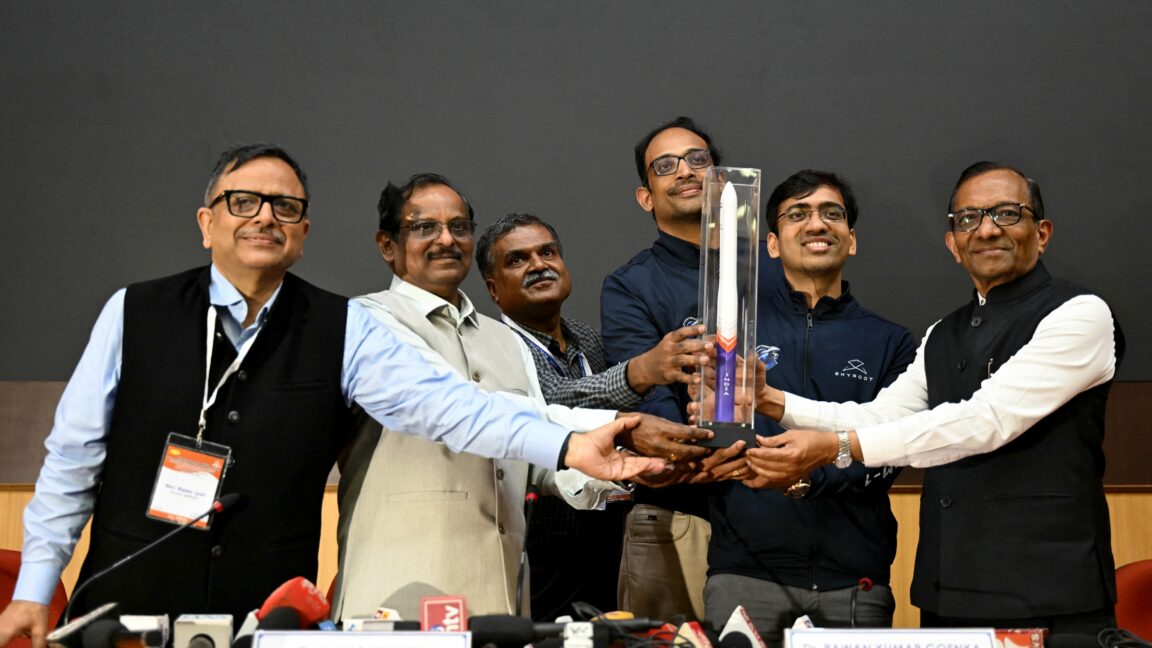
Skyroot, founded in 2018 by Chandana, a former Indian Space Agency engineer, alongside ISRO scientist Naga Bharath Dhaka, focused their efforts on engineering a solid-fuel launcher to reduce development time and minimize the cost per launch. “Our goal was to create an orbital launch vehicle within a few years,” Chandana shared with Ars.
“This initial launch serves as a test,” he noted. “Historically, first launches by private companies have a high failure rate. New systems often face significant challenges for success. However, we ensured that our first launch was successful.” Indeed, the inaugural launch exceeded all expectations, with plans for a second Vikram 1 launch potentially occurring by the end of this year.
“This rocket is 100% designed, built, and operated by Indian engineers. It stands as a proud moment not only for India but for the entire global space sector, emphasizing the urgent need for enhanced access to space,” Chandana declared following Saturday’s historic launch.
Source: arstechnica.com