


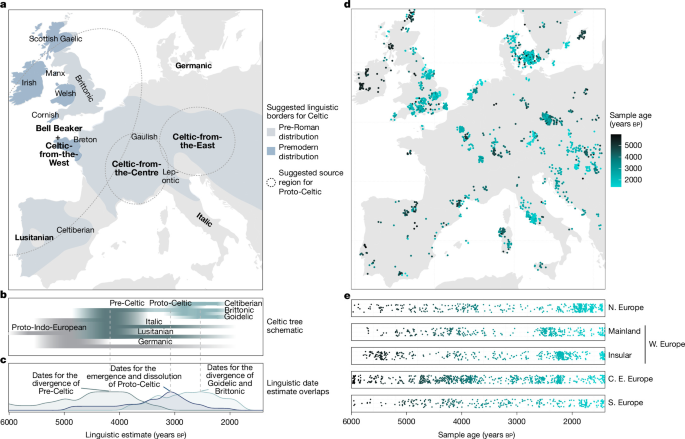
The supplied source is a bibliography of 66 works on Celtic languages, archaeology, population history and ancient genomics. Together, the references cover debates over the origins and spread of Celtic and Indo-European languages, Bronze and Iron Age migrations across Europe, the formation of early medieval populations, and the methods used to recover and analyse ancient DNA.
References
- Jørgensen, A. R. “Celtic.” In The Indo-European Language Family: A Phylogenetic Perspective, edited by T. Olander, 135–151. Cambridge University Press, 2023.
- Karl, R. and D. Stifter. The Celtic World: Critical Concepts in Historical Studies. Routledge, 2007.
- Sims-Williams, P. “The location of the Celts according to Hecataeus, Herodotus, and other Greek writers.” Études Celtiques 42, 7–32 (2016). Google Scholar.
- Gibson, C. and D. S. Wodtko. The Background of the Celtic Languages: Theories from Archaeology and Linguistics. University of Wales, 2013.
- Chadwick, N. K. The Celts. Penguin, 1970.
- Powell, T. G. E. The Celts. Thames & Hudson, 1958.
- Schmidt, K. H. “History and culture of the Celts, draft plan of a comprehensive survey.” In Geschichte und Kultur der Kelten, edited by K. H. Schmidt, 14–24. Carl Winter, 1986.
- Schmidt, K. H. “The Celts and the ethnogenesis of the Germanic people.” Historische Sprachforschung 104, 129–152 (1991). Google Scholar.
- Haber, M., M. Mezzavilla, Y. Xue and C. Tyler-Smith. “Ancient DNA and the rewriting of human history: be sparing with Occam’s razor.” Genome Biology 17, 1 (2016). Article · PubMed · PubMed Central.
- Stolarek, I. et al. “Genetic history of east-central Europe in the first millennium CE.” Genome Biology 24, 173 (2023). Article · PubMed · PubMed Central.
- Speidel, L. et al. “High-resolution genomic history of early medieval Europe.” Nature 637, 118–126 (2025). Article · ADS · PubMed · PubMed Central.
- Gretzinger, J. et al. “The Anglo-Saxon migration and the formation of the early English gene pool.” Nature 610, 112–119 (2022). Article · ADS · PubMed · PubMed Central.
- Antonio, M. L. et al. “Stable population structure in Europe since the Iron Age, despite high mobility.” eLife 13, e79714 (2024). Article · PubMed · PubMed Central.
- MacAulay, D. The Celtic Languages. Cambridge University Press, 1992.
- Ball, M. J. and N. Muller. The Celtic Languages. Routledge, 2012.
- Haak, W. et al. “Massive migration from the steppe was a source for Indo-European languages in Europe.” Nature 522, 207–211 (2015). Article · ADS · PubMed · PubMed Central.
- Allentoft, M. E. et al. “Population genomics of Bronze Age Eurasia.” Nature 522, 167–172 (2015). Article · ADS · PubMed.
- Heggarty, P. et al. “Language trees with sampled ancestors support a hybrid model for the origin of Indo-European languages.” Science 381, eabg0818 (2023). Article · PubMed.
- Mallory, J. P. “From the steppe to Ireland: the impact of aDNA research.” In The Indo-European Puzzle Revisited, edited by K. Kristiansen et al., 129–145. Cambridge University Press, 2023.
- Brun, P. “L’origine des Celtes. Communautés linguistiques et réseaux sociaux.” In Celtes et Gaulois, l’Archéologie face à l’Histoire. 2 La Préhistoire des Celtes, edited by D. Vitali, 29–44. Collection Bibracte, 2006.
- Gallay, A. “Bell Beakers today. Pottery, people, culture, symbols in prehistoric Europe.” In Proceedings of the International Colloquium Riva del Garda 1998, edited by F. Nicolis, 41–57. Provincia Autonoma di Trento, 2001.
- Cunliffe, B. “Setting the scene.” In Exploring Celtic Origins, edited by B. Cunliffe and J. T. Koch, 1–17. Oxbow Books, 2018.
- Cunliffe, B. W. Facing the Ocean: The Atlantic and its Peoples. Oxford University Press, 2001.
- Cunliffe, B. W. and J. T. Koch. Celtic from the West: Alternative Perspectives from Archaeology, Genetics, Language, and Literature. Oxbow Books, 2010.
- Koch, J. T. “Out of the flow and ebb of the European Bronze Age: heroes, Tartessos, and Celtic.” In Celtic from the West 2: Rethinking the Bronze Age and the Arrival of Indo-European in Atlantic Europe, edited by J. T. Koch and B. Cunliffe, 101–146. Oxbow Books, 2013.
- Sims-Williams, P. “An alternative to ‘Celtic from the East’ and ‘Celtic from the West’.” Cambridge Archaeological Journal 30, 511–529 (2020). Article.
- Schrijver, P. “Sound change, the Italo-Celtic linguistic unity, and the Italian homeland of Celtic.” In Celtic from the West 3, edited by J. T. Koch and B. Cunliffe, 489–502. Oxbow, 2016.
- Pope, R. “Re-approaching Celts: origins, society, and social change.” Journal of Archaeological Research 30, 1–67 (2022). Article.
- Childe, V. G. The Bronze Age. Cambridge University Press, 1930.
- de Hoz, J. “Lepontic, Celtiberian, Gaulish and the archaeological evidence.” Études Celtiques 29, 223–240 (1992). Google Scholar.
- Kristiansen, K. Europe Before History. Cambridge University Press, 2000.
- McColl, H. et al. “Tracing the spread of Germanic languages using ancient genomics.” Nature (2026). DOI: 10.1038/s41586-025-09064-1.
- Yediay, F. E. et al. “Ancient genomics support deep divergence between eastern and western Mediterranean Indo-European languages.” Preprint at bioRxiv, 2024. DOI: 10.1101/2024.12.02.626332.
- Patterson, N. et al. “Large-scale migration into Britain during the Middle to Late Bronze Age.” Nature 601, 588–594 (2022). Article · ADS · PubMed.
- Gretzinger, J. et al. “Evidence for dynastic succession among early Celtic elites in Central Europe.” Nature Human Behaviour 8, 1467–1480 (2024). Article · PubMed · PubMed Central.
- Olalde, I. et al. “The Beaker phenomenon and the genomic transformation of northwest Europe.” Nature 555, 190–196 (2018). Article · ADS · PubMed · PubMed Central.
- Heyd, V. “The mobility and migration revolution in 3rd millennium BC Europe.” In Rethinking Migrations in Late Prehistoric Eurasia, edited by M. Fernández-Götz et al., 41–62. British Academy, 2022.
- Soetaert, K., K. Van den Meersche and D. van Oevelen. limSolve: Solving Linear Inverse Models. R package version 1.5.6 (2008). DOI: 10.32614/cran.package.limsolve.
- Allentoft, M. E. et al. “Population genomics of post-glacial western Eurasia.” Nature 625, 301–311 (2024). Article · ADS · PubMed · PubMed Central.
- Papac, L. et al. “Dynamic changes in genomic and social structures in third millennium BCE central Europe.” Science Advances 7, eabi6941 (2021). Article · ADS · PubMed.
- Olalde, I. et al. “Lasting Lower Rhine–Meuse forager ancestry shaped Bell Beaker expansion.” Nature 652, 938–946 (2026).
- Patterson, N. “What genetics can say about Iron Age and Bronze Age Britain.” In Presenting Counterpoints to the Dominant Terrestrial Narrative of European Prehistory, edited by J. T. Koch et al., 187–190. Oxbow Books, 2025.
- Bretos Ezcurra, M. et al. “Genomic insights from a final Bronze Age community buried in a collective tumulus in an Urnfield settlement in northeastern Iberia.” Communications Biology 8, 1299 (2025). Article · PubMed · PubMed Central.
- Olalde, I. et al. “The genomic history of the Iberian Peninsula over the past 8000 years.” Science 363, 1230–1234 (2019). Article · ADS · PubMed.
- Renfrew, C. Archaeology and Language: The Puzzle of Indo-European Origins. Jonathan Cape, 1987.
- Mallory, J. P. In Search of the Indo-Europeans: Language, Archaeology and Myth. Thames & Hudson, 1989.
- Anthony, D. W. The Horse, the Wheel, and Language: How Bronze-Age Riders from the Eurasian Steppes Shaped the Modern World. Princeton University Press, 2007.
- Campbell, L. “Do languages and genes correlate?” Language Dynamics and Change 5, 202–226 (2015). Article.
- Barbieri, C. et al. “A global analysis of matches and mismatches between human genetic and linguistic histories.” Proceedings of the National Academy of Sciences of the USA 119, e2122084119 (2022). Article · PubMed.
- Müller-Karpe, H. Beiträge zur Chronologie der Urnenfelderzeit nördlich und südlich der Alpen. de Gruyter, 1959.
- Sørensen, M. L. S. and K. A. Rebay-Salisbury. “A brief history of urns, urnfields, and burial in the Urnfield culture.” In Death and the Body in Bronze Age Europe: From Inhumation to Cremation, edited by M. L. S. Sørensen and K. Rebay-Salisbury, 15–35. Cambridge University Press, 2023.
- Sienkewicz, T. J. “Hallstatt Culture.” Research Starters in Anthropology. EBSCO, 2022.
- Gerloff, S. “Hallstatt fascination: ‘Hallstatt’ buckets, swords and chapes from Britain and Ireland.” In From Megaliths to Metals: Essays in Honour of George Eogan, edited by H. Roche et al., 124–154. Oxbow Books, 2004.
- Fontijn, D. and H. Fokkens. “The Emergence of Early Iron Age ‘Chieftains’ Graves’ in the Southern Netherlands: reconsidering transformations in burial and depositional practices.” In The Earlier Iron Age in Britain and the Near Continent, edited by C. Haselgrove and R. Pope, 354–374. Oxbow Books, 2007.
- Sims-Williams, P. “Celtic.” In The Indo-European Languages, edited by M. Kapović et al., 352–386. Routledge, 2017.
- Damgaard, P. B. et al. “Improving access to endogenous DNA in ancient bones and teeth.” Scientific Reports 5, 11184 (2015). Article · PubMed · PubMed Central.
- Meyer, M. and M. Kircher. “Illumina sequencing library preparation for highly multiplexed target capture and sequencing.” Cold Spring Harbor Protocols 2010, db.prot5448 (2010).
- Gansauge, M.-T., A. Aximu-Petri, S. Nagel and M. Meyer. “Manual and automated preparation of single-stranded DNA libraries for the sequencing of DNA from ancient biological remains and other sources of highly degraded DNA.” Nature Protocols 15, 2279–2300 (2020). Article · PubMed.
- Hanghøj, K., I. Moltke, P. A. Andersen, A. Manica and T. S. Korneliussen. “Fast and accurate relatedness estimation from high-throughput sequencing data in the presence of inbreeding.” GigaScience 8, giz034 (2019). Article · PubMed.
- The 1000 Genomes Project Consortium. “A global reference for human genetic variation.” Nature 526, 68–74 (2015). Article.
- Browning, B. L. and S. R. Browning. “Detecting identity by descent and estimating genotype error rates in sequence data.” American Journal of Human Genetics 93, 840–851 (2013). Article · PubMed.
- Lawson, D. J., G. Hellenthal, S. Myers and D. Falush. “Inference of population structure using dense haplotype data.” PLoS Genetics 8, e1002453 (2012). Article · PubMed.
- Racimo, F. et al. “The spatiotemporal spread of human migrations during the European Holocene.” Proceedings of the National Academy of Sciences of the USA 117, 8989–9000 (2020). Article · ADS · PubMed.
- Pebesma, E. and B. Graeler. gstat: spatial and spatio-temporal geostatistical modelling, prediction and simulation. R package version 2.1.2 (2003). DOI: 10.32614/cran.package.gstat.
- Maier, R. et al. “On the limits of fitting complex models of population history to f-statistics.” eLife 12, e85492 (2023). DOI: 10.7554/eLife.85492.
Source: www.nature.com