


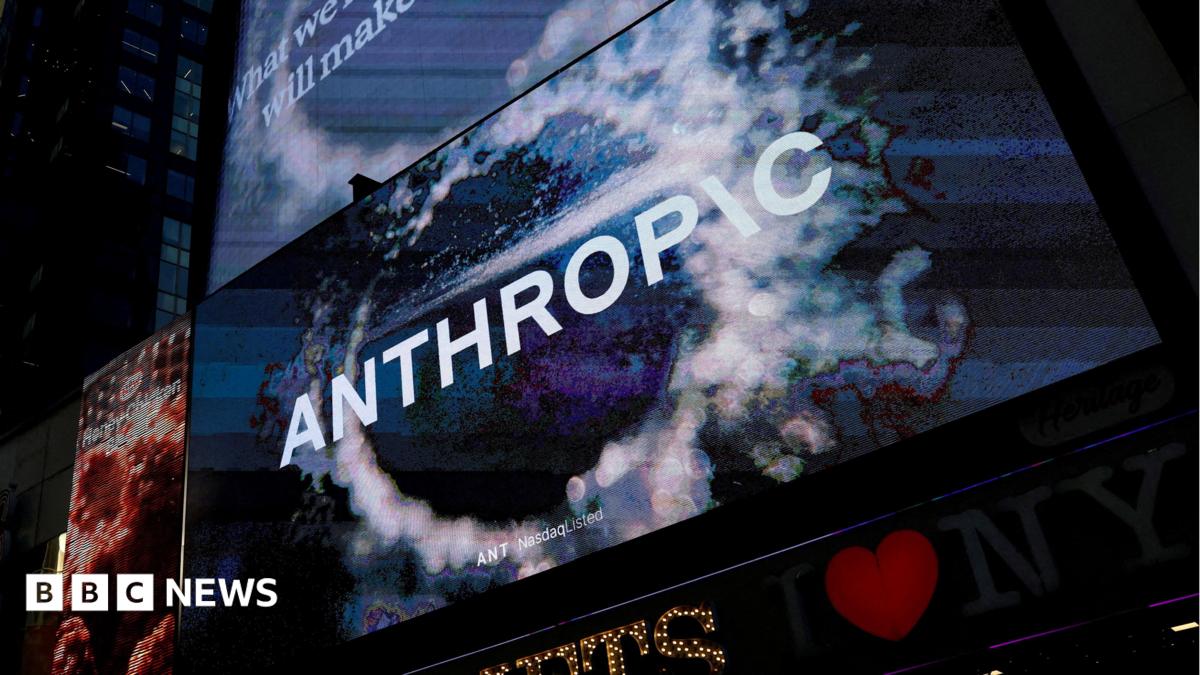
An Anthropic employee and mathematician says he used the company’s Claude artificial intelligence chatbot to develop a possible proof of the famous Riemann Hypothesis. Levent Alpöge said the work took about six weeks, but the claim remains unverified and could take months or longer to assess. If confirmed, it would represent one of the most significant mathematical breakthroughs in history.
A proposed proof of the Riemann Hypothesis
Alpöge announced the claim on Friday, one day after Anthropic debuted on the U.S. stock market. He said he used a private version of Anthropic’s Claude to create a detailed proof of the nearly 170-year-old mathematical problem.
Named after mathematician Bernhard Riemann, the hypothesis concerns the distribution of prime numbers and is widely regarded as one of mathematics’ most famous and difficult unsolved problems. Prime numbers are fundamental to higher mathematics, and breakthroughs involving them could have far-reaching implications.
Alpöge described the possible result as “the dawn of something far greater, beyond science.” However, the proposed proof has not yet been independently validated.
The full proof was written in Lean, a computer language used to check mathematical proofs, and is more than 250,000 pages long. Alpöge also published a detailed account of the work.
Mathematicians call for careful review
Terence Tao, a prominent mathematician, said on Friday that the evidence still needs to be tested.
“I think the digestion process will take some time, but in this case we at least need to communicate with a human author to help with this work,” Tao said in a comment.
Alpöge said he sent Anthropic CEO Dario Amodei a message on Sunday asking how the company would announce the discovery. He acknowledged that the timing was unusual because of Anthropic’s public offering.
“The exact timing is terrible,” Alpöge said. “If I could, I would have finished everything sooner.”
“Obviously I’m unilaterally responsible for feeling like I wouldn’t be able to survive if I waited any longer. There’s obviously some cynicism in relation to the timing, but that’s wrong,” he added.
Recent AI claims in mathematics
The claim comes as AI companies, including OpenAI and Anthropic, have announced systems that they say can address difficult problems in mathematics and physics.
In September, OpenAI said employees using a private version of its AI tools had solved some notoriously difficult problems in only 88 hours. The work involved a problem related to the Navier–Stokes equations, which describe fluid motion. More than 10,000 AI agents—computer-programmed bots that operate with some degree of autonomy—were commissioned as part of an AI training exercise.
OpenAI’s Navier–Stokes proof has not been confirmed as accurate. Its release prompted criticism from academics, higher mathematics communities and other organizations concerned about the use of AI to solve mathematical problems.
Anthropic has also highlighted claimed advances in mathematics and physics.
Concerns over AI-generated proofs
A group of mathematicians said AI companies were promoting leading results to demonstrate the sophistication of their commercial products, but warned that this was “detrimental to mathematical science.”
“We are seeing a disconnect between the outcomes of AI applications and their original objectives, and a general threat to intellectual labor,” the academics said in a group letter.
One month later, OpenAI announced solutions, proofs or major advances involving 372 additional unsolved higher-mathematics problems.
Experts are expected to need many months, if not longer, to examine and validate these AI-related mathematical claims—including Alpöge’s proposed proof of the Riemann Hypothesis.
Source: www.bbc.co.uk