


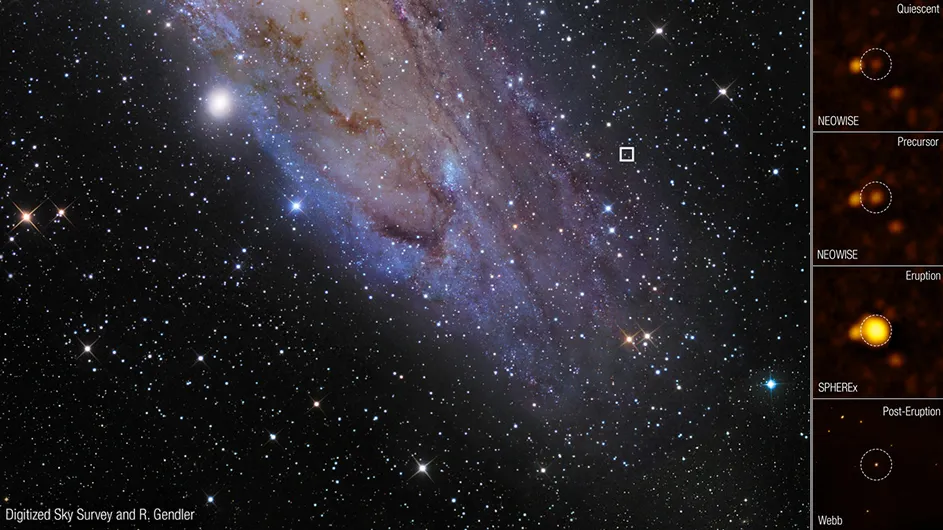
Decades of observations indicate that the stellar system AT 2025abao underwent a dramatic engulfment event. Researchers traced changes in the system from a 1989 photographic sky plate through a rapid brightening in October 2025, concluding that a small companion star spiraled into the envelope and eventually collided with the giant star’s core.
Decades of data
In April 2025, Karanbelkar’s team published a paper suggesting that AT 2025abao was undergoing an ongoing engulfment. At the time, however, the researchers could not rule out competing explanations, including instability originating deep within a single star’s core. They therefore continued monitoring the system.
The researchers combined observations and measurements from about a dozen telescopes to reconstruct the system’s history, reaching back to a photographic sky plate from 1989. The star changed little until 2018. Modeling this relatively quiet period revealed a giant star late in its life, measuring about 350 times wider than the Sun. Its companion was not directly visible.
“Giant stars are about 18,000 times more luminous than small stars,” Karanbelkar said. To estimate the companion’s mass despite its faintness, the researchers examined the amount of dust the system had ejected before the engulfment. Their estimates suggest that the companion had about 0.7 times the mass of the Sun.
From 2018 to early 2025, the giant became two to three times brighter in visible light and expanded while its temperature remained nearly constant. Dr. Karanbelkar compared the process to a spacecraft re-entering Earth’s atmosphere. The companion appeared to skim across the giant’s outer layers as its orbit gradually shrank, with friction heating the star’s surface. The energy released by that resistance matched the system’s additional visible light.
The star’s visible brightness later fell by half, but its infrared glow continued to increase. NASA’s SPHEREx space telescope happened to observe the system in July 2025, revealing that the giant had expanded to about 860 times the width of the Sun and was surrounded by newly formed dust.
A bomb inside the star
In October 2025, the star brightened nearly 100-fold in just 25 days, reaching a peak luminosity equivalent to 1.5 million Suns. “At some point, the orbit decayed very quickly,” Karanbelkar said, comparing the release of gravitational energy to an explosion.
“The companion star fell very deep and very quickly into the star’s envelope and collided with the core,” Karanbelkar said. “The violent collision detonated a bomb inside the star, which brightened the star rapidly and ejected some of its material.”
Source: arstechnica.com