


How AI, Drones and Silicon Valley Are Reshaping Modern Warfare
Two new books examine the global technology arms race—and the growing influence of private companies on national security.
Bits and Bullets: Global Competition, Civilian Technology, and the Future of Modern Warfare
Steve Feldstein
Monoray (2026)
Valley of Death: How Big Technology Is Driving the Future of War
Sharon Weinberger
Little, Brown and Company (2026)
Countries have competed for thousands of years to gain a technological advantage over their rivals. More than 3,500 years ago, ancient Egypt won a race to master the horse-drawn chariot, helping it establish military control across the region. Today, a similar contest is unfolding as the world’s great powers compete for leadership in artificial intelligence, drones, space weapons systems and advanced semiconductors.
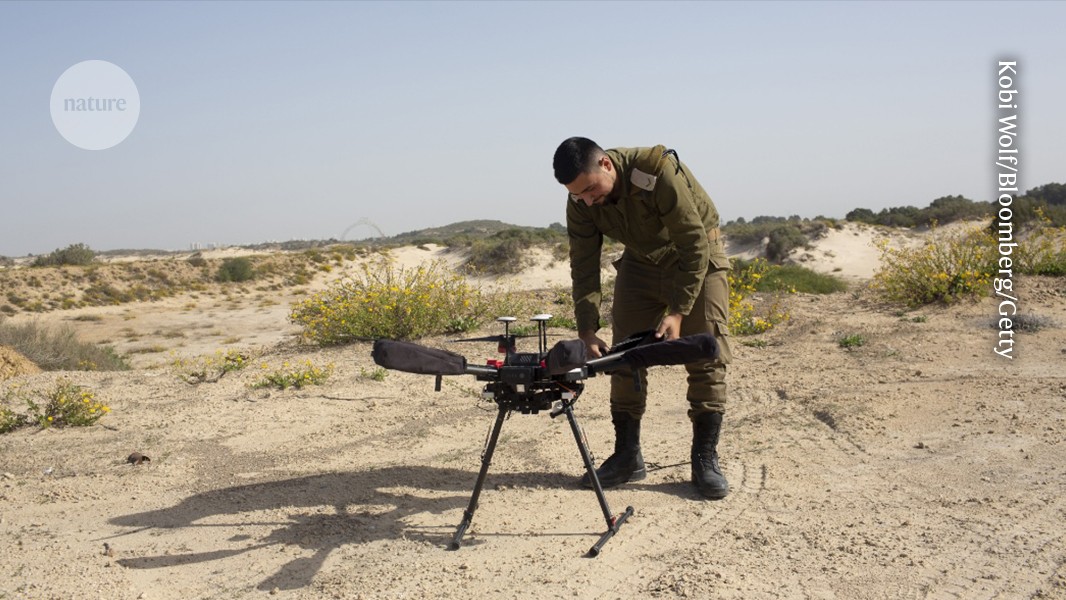
Two new books examine this latest technology arms race and ask who is most likely to win. In Bits and Bullets, former US State Department official Steve Feldstein argues that technological innovation is becoming “an important piece in the geopolitical chess match.” He explores examples including Israel’s early leadership in drone technology and innovative prototypes being tested on the battlefields of Ukraine.
How AI is shaping the Iran war and what future conflicts will look like
In Valley of Death, security-focused journalist Sharon Weinberger examines how technology has been adopted by the US defence establishment. Her book offers a detailed account of the meetings, negotiations and contract battles that helped make Silicon Valley an integral part of the US national-security apparatus.
Weinberger challenges the idea that Silicon Valley is inherently liberal and instinctively hostile to government power. Instead, she shows how the Pentagon supported the early growth of many technology companies, how those companies accumulated enough wealth and influence to operate independently of the state, and how the defence establishment is now reshaping its relationships with technology founders and investors. These figures have greater autonomy than traditional military contractors. Weinberger describes this evolving relationship as the “Department of Defense and the Silicon Complex”.
For Weinberger, the connection between government and the technology industry is best illustrated by the story of NeXT, the computer company Steve Jobs founded after leaving Apple. She recounts how Department of Defense funding helped turn Northern California into a centre for electronics and computing during the early years of the Cold War, and how that relationship began to change in the 1980s.
Intelligence agencies increasingly turned to the private sector for technology that outperformed their own systems. The CIA, for example, adopted NeXT computers because their powerful and easy-to-use design was better suited to analysing and sharing satellite imagery than government systems. The agency needed 20,000 workstations with faster processors and specialised graphics hardware.
How intelligence agencies helped save NeXT
These secret government acquisitions provided an important lifeline for NeXT during its troubled early years. The company had discovered that funding was not available in the university market it had originally targeted. Government investment kept NeXT afloat, and Apple bought the company for $400 million in December 1996 before rehiring Jobs.
As Weinberger puts it, “The spies saved Jobs.” Without the CIA’s support, she argues, the NeXT–Apple merger might never have happened. NeXT’s software became the basis of the Mac operating system and, in turn, the iPhone, which is used by hundreds of millions of people today.
From PayPal to Palantir and Anduril
Weinberger traces the evolution of Silicon Valley’s relationship with the US national-security establishment over the following decades. PayPal co-founder Peter Thiel and his Stanford Law School contemporary Alex Karp applied fraud-detection technology developed at PayPal to Palantir, the software company they co-founded in 2003. Palantir’s platform can sift through vast amounts of intelligence data.

Elon Musk sells commercial space-rocket launch services to the US government.Credit: Saul Martinez/Getty
Former PayPal CEO Elon Musk founded SpaceX, a space-technology company that commercially develops rockets and sells launch services to the US government and military. Unlike traditional defence contractors, Musk retains ownership of the technology.
Palmer Luckey founded virtual-reality company Oculus VR before selling it to Facebook, now Meta. He later co-founded Anduril, a military-technology company that extended the trend of using Silicon Valley start-up technology for national security. From the beginning, Anduril aimed to supply the US military with drones, surveillance systems and anti-drone technology, while competing directly for major contracts with established defence giants such as Lockheed Martin.
The uneasy relationship between Big Tech and the Pentagon
Partnerships between technology companies and the US military have not always been smooth. In 2018, Google employees protested Project Maven, a Pentagon programme that uses commercial artificial-intelligence systems to analyse and gather information from unclassified drone footage. Other companies were also active in the defence sector, including Palantir, which eventually took over from Google.
Together, these books explore how artificial intelligence, drones, space technology and advanced computing are transforming modern warfare—and how the balance of power is increasingly shaped by the relationship between governments and private technology companies.
AI used in war requires a strong ethical framework
Source: www.nature.com