


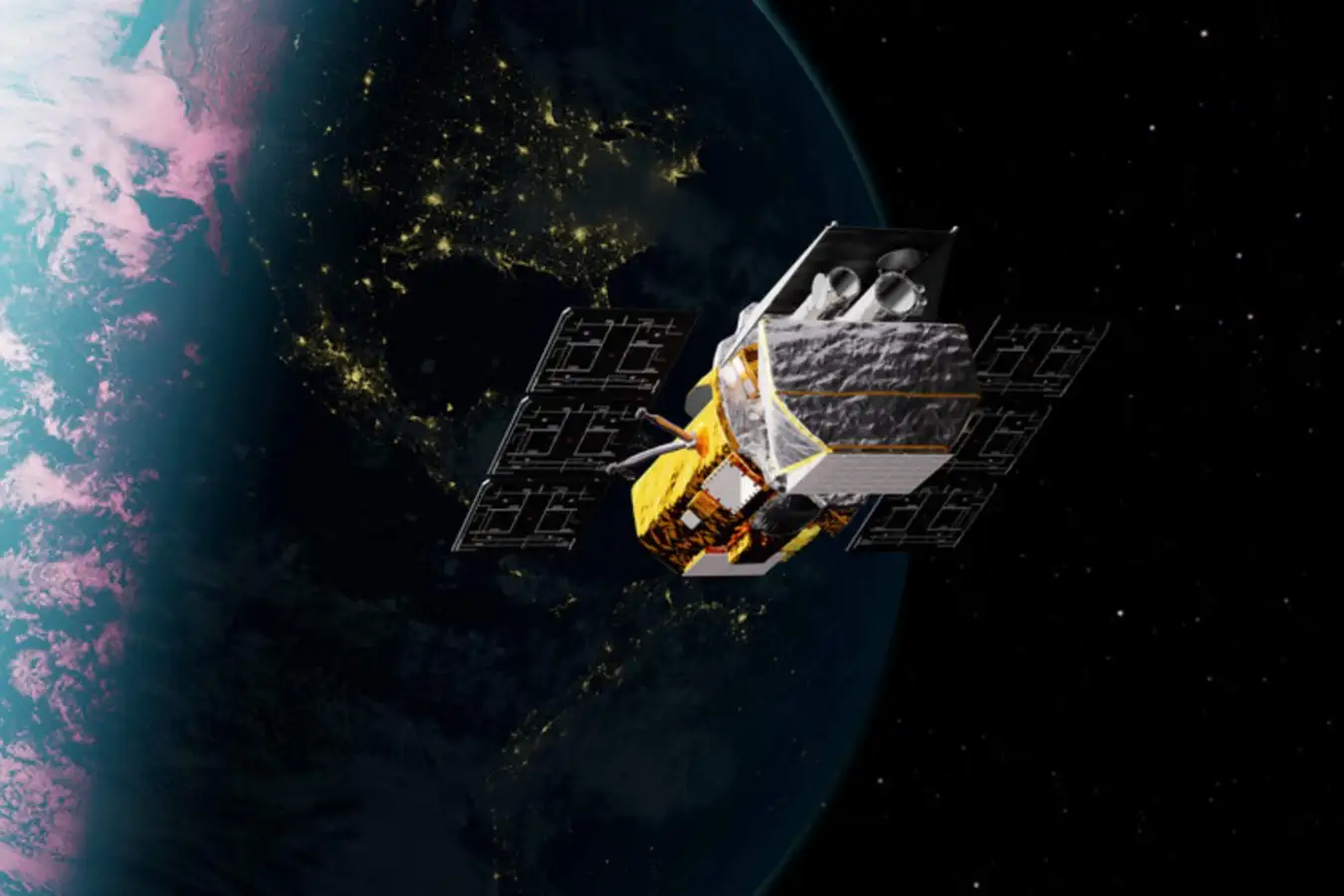

NASA’s Neil Gehrels Swift Observatory
NASA Goddard Space Flight Center
The Neil Gehrels Swift Observatory, one of NASA’s most advanced space telescopes, is facing an imminent descent back to Earth. However, a groundbreaking rescue mission is underway to extend its observational capabilities for years to come.
All satellites experience orbital decay over time, and Swift is no exception. Launched in 2004, it has been gradually pulled closer to Earth due to atmospheric drag. Its altitude has diminished from an initial 600 kilometers to approximately 375 kilometers. Recent solar flares have accelerated this descent by creating increased atmospheric drag.
To prevent Swift from becoming inoperable, NASA considered several options, ultimately selecting a plan from Catalyst Space Technologies, a startup based in Arizona, to boost the observatory’s orbit.
The innovative strategy involves a satellite named Link designed to use three robotic arms to capture Swift and elevate it. Although Link is less than 2 meters tall—only about a third the size of Swift—it features large solar panels that provide power for its thrusters and gripping arm.
Link successfully launched aboard a Northrop Grumman Pegasus XL rocket on the morning of July 3, marking its final flight before the Pegasus XL is retired. The ambitious mission plan outlines a two-month process of carefully lifting Swift back to its original orbit of 600 kilometers. If successful, this operation could prolong Swift’s operational life by up to ten years.
Originally designed to study gamma-ray bursts—some of the universe’s most luminous explosions—Swift has identified approximately 1,800 of these events while also advancing our understanding of various celestial phenomena, including comets, planets, supernovae, and black holes.
Not only would this orbital boost sustain Swift’s observations, but it would also serve as a pioneering demonstration of rescue techniques for space telescopes. Ghonhee Lee, CEO of Katalyst, stated, “Swift is not designed to be serviced. By demonstrating that we can extend its life quickly and cost-effectively, we are establishing a model for servicing spacecraft that were not intended for in-orbit maintenance.” This methodology could potentially extend the lifespans of other satellites, including the Hubble Space Telescope, which faces retirement in the 2030s without intervention.
Topic:
Source: www.newscientist.com