


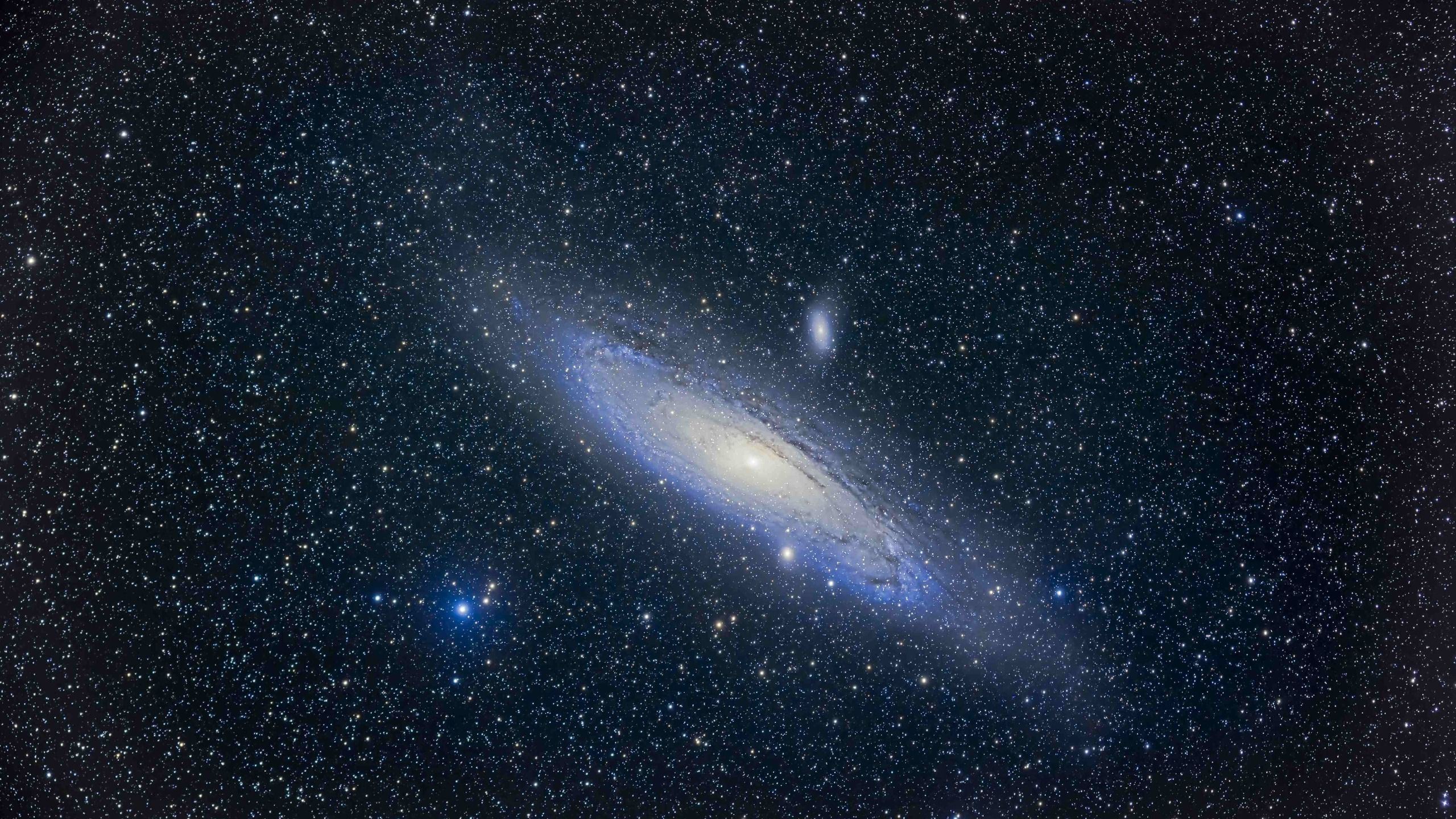
For decades, astronomers assumed that galaxies formed first and that the supermassive black holes at their centers grew later by consuming matter and merging with other black holes. But observations from the James Webb Space Telescope (JWST) are challenging that sequence: some black holes existed only a few hundred million years after the Big Bang and appear surprisingly massive compared with the galaxies around them. The evidence has left astronomers uncertain about whether black holes or galaxies came first—or whether the answer varies across the universe.
Almost all large galaxies are believed to contain a supermassive black hole at their center. The Milky Way’s black hole, Sagittarius A*, has a mass roughly 4 million times that of the sun. The question is how these enormous objects and their host galaxies formed in the first place.
Observations challenge the standard model
For decades, the prevailing model held that galaxies came first. The remnants of dying massive stars could form black holes, which would then grow by feeding on surrounding material and merging with other black holes until they reached millions or billions of solar masses, said Joseph Silk, an astrophysicist and professor at Johns Hopkins University.
Recent observations have complicated that picture. JWST can observe very distant galaxies as they appeared in the early universe, and it has found evidence of surprisingly large black holes only a few hundred million years after the Big Bang.
“Recent observations refute this situation, or at least show that it is not the whole story,” Roberto Maiolino, a professor of astrophysics at the University of Cambridge, said in an email to Live Science. “We are finding very large black holes only a few hundred million years after the Big Bang.”
Image credits: NASA / ESA / CSA / T. Treu, UCLA / NAOJ / T. Bakx, Nagoya University
Some of the early black holes also appear to be too massive for their host galaxies. In nearby galaxies, the central black hole typically has a mass about 1,000 times smaller than the galaxy itself, Maiolino said. But some of the earliest black holes appear to be about as massive as the stars in their host galaxies.
In research published in Nature, Maiolino and his colleagues directly measured the mass of a black hole in an object called Abell2744-QSO1. They found that the black hole accounted for most of the object’s mass.
How could early black holes have grown so large?
Maiolino outlined several possible explanations, and more than one could be correct. Some supermassive black holes may be the remains of ordinary stars that grew much faster than expected. Others may have been “born big” through the direct collapse of a giant gas cloud, giving them a substantial head start in their growth.
A third possibility is that some black holes began as “seeds” formed by primordial black holes shortly after the Big Bang, before the first stars and galaxies existed.
A cosmic tug of war
Black holes and galaxies do not simply grow independently of one another. As a black hole grows, it can release vast amounts of energy that heat and eject gas from its galaxy, potentially suppressing or stopping the formation of new stars.
Black holes can also compress gas and trigger the birth of stars. “Black holes and galaxies influence each other throughout evolution, and neither can be completely understood in isolation,” Maiolino said.

Image credit: Universal History Archive via Getty Images
Silk said the balance between black holes and their host galaxies varies. In giant elliptical galaxies, black holes weighing billions of suns may have a “history of extreme violence” that helped limit the growth of their hosts. In spiral galaxies such as the Milky Way, however, feedback from stars tends to dominate.
More data are needed
Determining which formed first will require many more observations from JWST. Astronomers currently have a sample of “dozens, maybe 20, 30, 40 objects,” Silk said, and they need a much larger sample to establish whether unusually massive early black holes are typical.
If black holes are found to be larger than the galaxies astronomers observe at comparable distances, that would strongly suggest that the black holes formed first, Silk said. If the stars and galaxies consistently dominate in mass, the evidence would point in another direction.
Maiolino suggested that the question may be too simple. “The question of which came first may be too simple,” he said. “A more interesting question may be how black holes and galaxies formed, grew, and influenced each other at different stages in the history of the universe.”
There may not be one universal sequence. “Different black holes may have formed and evolved in different environments, during different cosmic epochs, and via different routes,” Maiolino added.
For now, the cosmic chicken-and-egg puzzle remains unsolved. Astronomers are “beginning to explore a period in the history of the universe that still has many unanswered questions,” Maiolino said.
Test your knowledge of space with our black hole quiz.
Topics: life’s little mysteries
Source: www.livescience.com