


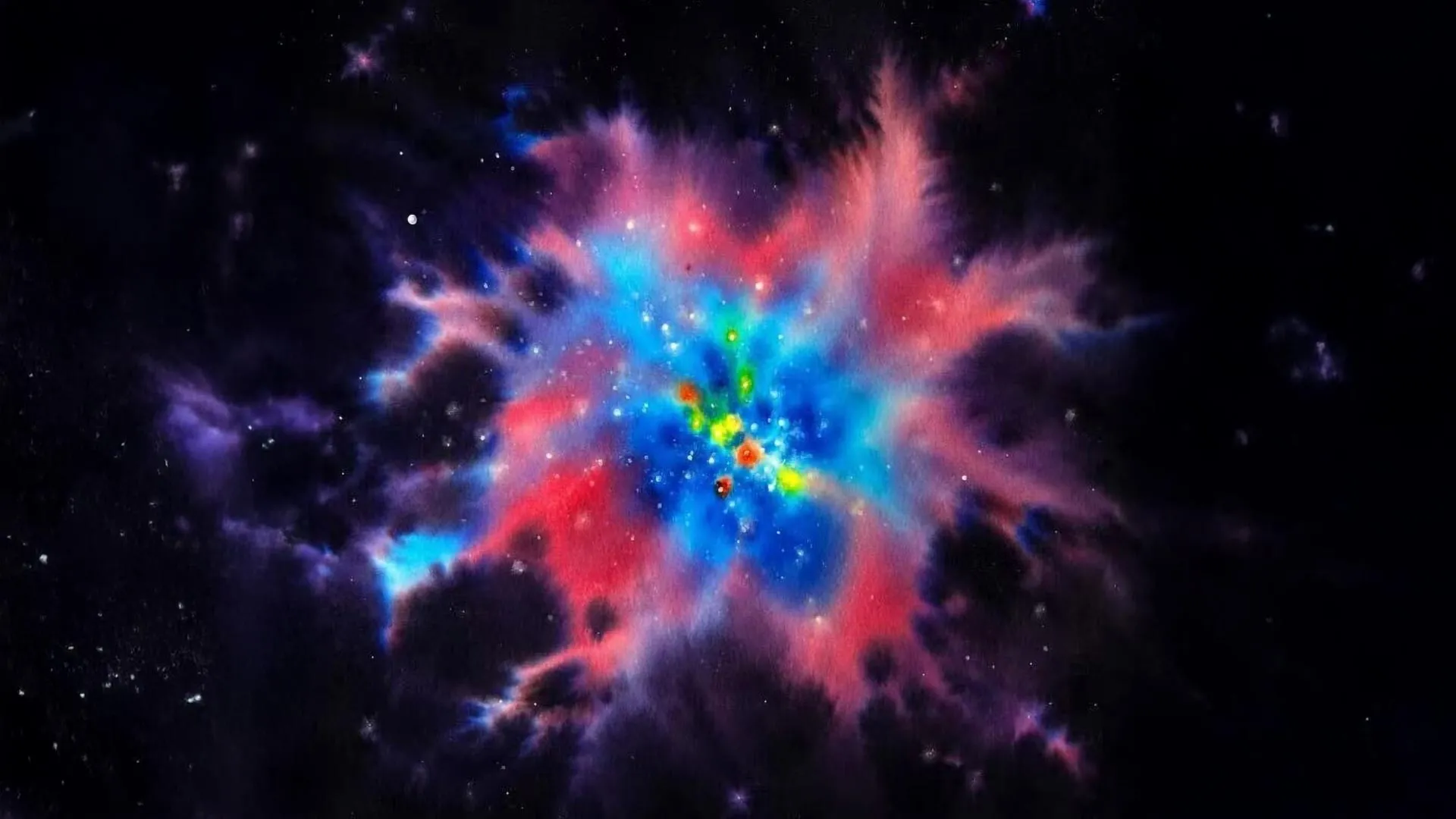
Astronomers using NASA’s Hubble Space Telescope have found that winds from supernovae may hinder, rather than help, the escape of ultraviolet radiation from early galaxies. The result challenges a leading explanation for how the early universe became transparent during reionization, suggesting that ionizing radiation may have escaped from young stars before the first powerful stellar explosions reshaped their surroundings.
Reconsidering how the universe became transparent
During the first billion years after the Big Bang, intergalactic space was filled with neutral hydrogen. This hydrogen acted as a cosmic fog, absorbing ultraviolet light and preventing it from traveling freely across the universe.
That changed during reionization, a period that began about 13 billion years ago. Radiation from early galaxies gradually stripped electrons from hydrogen atoms, leaving positively charged protons and free electrons. As more hydrogen became ionized, ultraviolet light could travel farther through intergalactic space, helping create the relatively transparent universe observed today.
“Eventually, when most of the hydrogen that fills intergalactic space is ionized, that’s the end of reionization, and we can see the Universe as we see it today,” said Cody Carr, a postdoctoral fellow in the University of Michigan’s Department of Astronomy. “We call reionization the last major phase transition in the universe.”
Astronomers still do not fully understand which objects supplied the radiation responsible for reionization or how enough of that radiation escaped from early galaxies.
“We don’t know exactly what objects caused reionization or how it evolved,” said Carr, who conducted and led the study while working as a postdoctoral fellow at Zhejiang University in China before joining the University of Michigan. “We know it happened, but we don’t have complete answers to those questions.”
Supernova winds may block ionizing radiation
For many years, one leading explanation focused on supernovae—the powerful explosions that occur when certain stars reach the ends of their lives. Supernovae can generate enormous winds that push gas and other material out of a galaxy.
Scientists proposed that these winds might clear gas from around young stars, opening channels through which ultraviolet radiation could escape into intergalactic space. Once outside the galaxy, that radiation could ionize the neutral hydrogen responsible for the early universe’s cosmic fog.
New Hubble observations suggest that the process may work in the opposite way. The researchers found that galaxies with stronger winds allowed less ionizing radiation to escape. This indicates that supernova-driven winds can make it more difficult for radiation to leave a galaxy.
“Basically, how these galaxies leak ionizing radiation is not what we thought,” Carr said.
The findings support another possibility: radiation from young, massive stars may escape before those stars explode as supernovae and generate large galactic winds.
“Our observations show that these photons escape before the galactic wind forms,” Carr said.
Photons are individual packets of light energy. In this study, the researchers focused on ultraviolet photons with enough energy to ionize hydrogen, making them central to understanding how the early universe became transparent.
What Hubble found in starburst galaxies
To investigate how radiation escapes, an international team used Hubble to study nearby starburst galaxies. These galaxies have undergone periods of exceptionally intense star formation and can serve as modern examples of the types of galaxies that may have contributed to reionization.
Hubble, a NASA mission launched with a contribution from the European Space Agency, allowed the researchers to examine the galaxies’ light in detail. The team analyzed each galaxy’s spectrum—the distribution of light across different wavelengths.
Gas absorbs light at specific wavelengths, producing recognizable dips in a galaxy’s spectrum. The locations and shapes of these features provide information about the gas surrounding the stars and the speed at which galactic winds are moving.
When the researchers compared wind speeds with the amount of ionizing radiation emitted by each galaxy, they found that galaxies with the fastest winds allowed only a small fraction of that radiation to escape.
The result contradicts the expectation that stronger winds would remove more gas and make it easier for ultraviolet radiation to reach intergalactic space.
“The energy input from the supernova appears to be perturbing the surrounding environment, increasing rather than decreasing the range of neutral gas and dust that suppresses the emission of ionizing radiation,” said Stephen McCandriss, the study’s senior author and director of the Johns Hopkins University Center for Astrophysical Sciences.
In other words, energy from a stellar explosion may be redistributed in a way that increases the amount of gas and dust blocking ultraviolet light, rather than clearing a path for it to escape.
Young stars may have helped drive reionization
Although large galactic winds appear to suppress the escape of ionizing radiation, smaller winds and other activity around young stars may still create openings in the surrounding gas. These processes can occur before the first supernova explosion, giving radiation an opportunity to escape under more favorable conditions.
The findings suggest that astronomers may need to focus more closely on the earliest stages of star formation, rather than concentrating primarily on the effects of stellar explosions.
Carr and his colleagues are seeking additional Hubble observing time to study more galaxies and determine whether the same relationship between wind strength and radiation leakage appears elsewhere. Further observations could clarify how important young stars are in enabling ionizing radiation to escape.
The result also has implications for computer simulations of the early universe. These models attempt to reproduce how galaxies formed, how gas moved, and how radiation transformed the hydrogen-filled space between galaxies.
“Supernovae play a central role in cosmological hydrodynamic simulations that explain how ionizing radiation escapes from galaxies,” said Renyue Sen, senior author of the study and professor and director of the Center for Cosmology and Computational Astrophysics at Zhejiang University. “Our findings highlight the need to investigate how radiation and winds from young stars form the surrounding gas before the first supernova explodes.”
More accurate descriptions of the early interactions among stars, radiation and gas could lead to improved models of reionization.
The discovery does not identify the definitive cause of the universe’s last major phase transition. It does, however, provide an important clue: radiation that helped clear the universe’s ancient hydrogen fog may have escaped from galaxies before powerful stellar explosions began altering their surroundings.
International collaboration and funding
The study involved nearly 30 scientists from more than a dozen institutions around the world. Sally Ooi, a professor of astronomy at the University of Michigan, also contributed to the research.
The project received additional financial support from Zhejiang University, the Zhejiang Provincial Top-Level Research Support Program, the National Natural Science Foundation of China, the Spanish Ministry of Science and Innovation Universities, the European Regional Development Fund, and the European Union’s Horizon 2020 Research and Innovation Program.
The research was also supported in part by NASA and the National Science Foundation. Additional support for the Hubble Space Telescope observations came through grants administered by the Space Telescope Science Institute.
Source: www.sciencedaily.com