


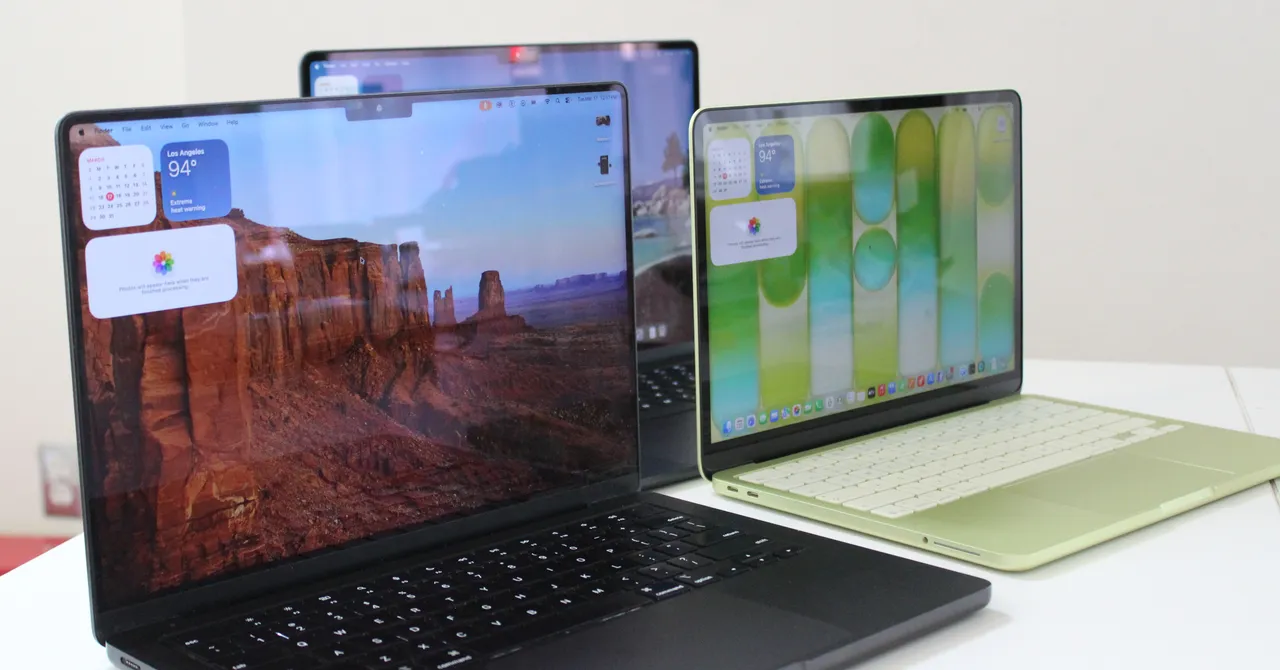
Apple’s M-series processors span MacBook Air and MacBook Pro models, desktop Macs, iPad Pro and Vision Pro. Older Macs remain available through third-party retailers, including refurbished stores, but the differences between generations and chip tiers can be substantial. Here is a guide to the M1 through M6 families, including their core counts, memory limits, graphics capabilities and intended workloads.
M6 series
M6
Apple has released the M6 family, although its rollout has been slower than usual. As of this year, the base M6 is available only in the 14-inch MacBook Pro, iMac and Mac mini. Apple is expected to bring it to products such as the iPad Pro and MacBook Air eventually, but reports about the rest of the M6 lineup remain uncertain.
According to reports, Apple may skip the M6 Pro and M6 Max entirely in the second half of 2027, moving directly to the M7 Pro and M7 Max. That possibility follows Apple’s launch of the OLED MacBook Pro, which uses the same M5 Pro and M5 Max chips as the previous generation.
M5 series
M5
Apple launched the M5 in the 14-inch MacBook Pro, iPad Pro and Vision Pro in late 2025. The standard M5 offers up to a 10-core CPU and 10-core GPU, while the iPad Pro remains available with a lower-tier nine-core CPU configuration.
Apple’s M5 delivers around 10% to 15% faster CPU performance than the M4, along with significant improvements in graphics, artificial-intelligence workloads and storage speeds. The chip is also available in the MacBook Air.
M5 Pro
The M5 Pro is available in the 14-inch and 16-inch MacBook Pro. It includes a 15-core CPU and 16-core GPU, with options for an 18-core CPU and 20-core GPU. Like the previous generation, it retains the M5 architecture while adding more cores and greater memory bandwidth.
The largest gains are in GPU and on-device AI performance. Both the M5 Pro and M5 Max also introduced “Fusion Architecture,” a new version of UltraFusion, previously used only on Ultra chips. The technology connects two dies through an ultra-high-speed interconnect.
M5 Max
The M5 Max builds on the M5 Pro with substantially more GPU power. With up to 40 GPU cores, it gives the MacBook Pro graphics performance comparable to high-end gaming laptops. A neural accelerator in each GPU core also makes it one of the most powerful AI-focused laptops available. The chip is offered in the MacBook Pro and Mac Studio.
M5 Ultra
As with other Ultra chips, the M5 Ultra is available only in the 2026 Mac Studio. It is Apple’s most powerful chip, but it is not configurable in MacBook models.
M4 series
M4
Apple launched the M4 in 2024. It features a 10-core CPU and 10-core GPU. Apple claims that the M4 delivers 1.8 times faster CPU performance and 2.2 times faster GPU performance than the M1. Its Neural Engine is more than three times faster than the original version and twice as fast as the M3’s.
The M4 also starts with 16GB of unified memory, which helps Apple Intelligence, the company’s suite of artificial-intelligence features, run more smoothly. It is available in the 14-inch MacBook Pro (2024), iMac (2024) and 13-inch and 15-inch MacBook Air models from 2025.
M4 Pro
The M4 Pro has a 14-core CPU, up to a 20-core GPU and support for up to 64GB of unified memory. Built on a second-generation 3-nanometer process, it supports advanced GPU features including mesh shading and ray tracing. Apple says ray tracing is twice as fast as on the M3.
The chip is included in the 14-inch and 16-inch MacBook Pro models from 2024, as well as the Mac mini (2024).
M4 Max
The M4 Max features a 16-core CPU, up to a 40-core GPU and support for up to 128GB of unified memory. Apple says its CPU is up to 2.2 times faster and its GPU up to 1.9 times faster than the M1 Max. Like the M4 Pro, it supports mesh shading and ray tracing.
The M4 Max is available as an option in the 14-inch and 16-inch MacBook Pro models from 2024, as well as in the current Mac Studio.
M3 series
M3
The M3 was available in the 14-inch MacBook Pro from late 2023, the 13-inch and 15-inch MacBook Air from 2024, and the 24-inch iMac from 2023. It includes an eight-core CPU, up to a 10-core GPU and support for up to 24GB of unified memory.
Apple claimed that the M3 delivers up to 35% faster CPU performance and up to 65% faster GPU performance than the M1. The company also said that both its CPU and GPU are 20% faster than those in the M2. Like the M1 and M2, the M3 is suited to word processing, email, spreadsheets and light gaming, as well as other everyday tasks.
The 13-inch and 15-inch MacBook Air models with M3 also support two external displays: one with a resolution of up to 6K at 60Hz and another of up to 5K at 60Hz.
M3 Pro
The M3 Pro has a 12-core CPU and 18-core GPU. Apple said its GPU is up to 10% faster than the M2 Pro, making it a relatively modest upgrade over its predecessor. Compared with the M1 Pro, however, the M2 Pro delivered up to 40% faster GPU performance and 20% faster CPU performance.
The M3 Pro is available in 14-inch and 16-inch MacBook Pro models starting in 2023. It was positioned as a middle option for users who needed more performance than the M3 but did not require the full capabilities of the M3 Max.
M3 Max
The M3 Max was the next step up from the M2 Max. It had a 16-core CPU, 40-core GPU and support for up to 128GB of unified memory. Apple said CPU performance was up to 80% faster than the M1 Max and up to 50% faster than the M2 Max.
Apple also claimed that GPU performance was up to 50% faster than the M1 Max and up to 20% faster than the M2 Max. The M3 Max was available in the 14-inch and 16-inch MacBook Pro models from late 2023.
M3 Ultra
Apple announced the M3 family in 2023 but did not announce the M3 Ultra until 2025. The chip was faster than the then-current M4 Max and M5. It offered up to 32 CPU cores, including 24 performance cores, and up to 80 GPU cores.
Apple claimed that the M3 Ultra was up to 2.5 times faster than the M1 Ultra. It also supported 96GB of unified memory, expandable to 512GB, and up to 16TB of SSD storage. The chip was available only in the 2025 Mac Studio.
M2 series
M2
The M2 was an entry-level chip similar to the M1, but with somewhat greater processing power. It has an eight-core CPU, up to a 10-core GPU—two more GPU cores than the previous generation—and support for up to 24GB of unified memory.
Apple says the second-generation chip has an 18% faster CPU and a 35% more powerful GPU than its predecessor. The M2 is well suited to everyday tasks such as word processing and web browsing, while workloads including multiple streams of 4K video editing and 3D rendering are better suited to Pro or Max chips.
The M2 was available in the 13-inch MacBook Air (2022), 15-inch MacBook Air (2022) and 13-inch MacBook Pro (2022).
M2 Pro
The M2 Pro offers up to 12 CPU cores, up to 19 GPU cores and up to 32GB of unified memory. Apple claimed up to 20% faster performance and 30% faster graphics than the 10-core M1 Pro.
It was aimed at intermediate video and photo editors. Although it was a relatively small upgrade over the M1 Pro, it offered a more future-proof option for users who wanted additional performance. The M2 Pro was available in the early 2023 14-inch and 16-inch MacBook Pro models and the 2023 Mac mini.
M2 Max
The M2 Max includes up to a 12-core CPU, up to a 38-core GPU and support for up to 96GB of unified memory. Apple says its graphics performance is 30% faster than the M1 Max.
It is suited to graphics-intensive work such as graphic design, 3D modeling and demanding video production. As with the M2 Pro, however, the upgrade is more gradual for users moving from the M1 Max. The M2 Max was available in the 14-inch and 16-inch MacBook Pro and Mac Studio models released in early 2023.
M2 Ultra
The M2 Ultra, successor to the M1 Ultra, was available in the second-generation Mac Studio and the 2023 Mac Pro.
Built from two M2 Max chips connected with Apple’s UltraFusion technology, the M2 Ultra has a 24-core CPU and a GPU configurable with 60 or 76 cores. Apple claimed up to 20% faster CPU performance and up to 30% faster GPU performance than the M1 Ultra. It was designed for extremely demanding workloads beyond the capabilities of the M1 Ultra, M2 Pro or M2 Max.
M1 series
M1
Introduced in 2020, the M1 was Apple’s first custom silicon processor designed for the Mac. It has an eight-core CPU and up to an eight-core GPU. At launch, it could be configured with up to 16GB of unified memory for an additional fee, although only an 8GB model is now available.
The M1 was significantly faster than the Intel-powered MacBook Pro models that preceded it, making it a practical choice for most users. It can handle everyday tasks, light gaming and more demanding work such as photo editing. For a long time after its launch, Apple sold the M1 MacBook Air through Walmart. At $599, it was a strong value for the laptop. The MacBook Neo later replaced it and uses the A18 Pro chip from the iPhone 16 Pro models.
M1 Pro
The M1 Pro was the next step up, with up to 10 CPU cores, up to 16 GPU cores and support for up to 32GB of unified memory. Apple said its CPU and graphics performance were both twice as fast as the M1.
The M1 Pro was substantially more powerful than the base chip, making it suitable for users who regularly produce music or edit photos and videos. It was available only in the 14-inch and 16-inch MacBook Pro models from 2021.
M1 Max
The M1 Max has the same 10-core CPU as the M1 Pro but a more powerful 32-core GPU, with support for up to 64GB of unified memory. Apple says it is four times faster than the M1 for graphics performance.
The chip was designed for demanding workloads such as multiple streams of 8K or 4K video, 3D rendering, app development and software demonstrations. It was available in the 14-inch and 16-inch MacBook Pro models beginning in 2021.
M1 Ultra
The M1 Ultra was the most powerful member of the M1 family. It combines two M1 Max chips through Apple’s UltraFusion technology and includes a 20-core CPU, 64-core GPU configurable with up to 128GB of unified memory, and a 32-core Neural Engine.
Apple said the M1 Ultra has seven times more transistors than the base M1. Even after newer models appeared, it remained a powerful option for intensive visual and graphics work. The M1 Ultra was available only in the first-generation Mac Studio.
Source: www.wired.com