


GL.iNet has confirmed that an unauthorized party exploited a vulnerability in its GoodCloud remote management service to install malware on customers’ routers and KVM devices. Customers and researchers have reported backdoors, root-level reverse shells, suspicious outbound connections and other signs of compromise, although the company has not disclosed how many devices were affected or whether data was stolen.
GL.iNet makes networking products including home routers, travel routers and KVM devices. Its KVM products allow customers to remotely access and control connected computers and servers, while the GoodCloud platform provides remote management for supported devices.
GL.iNet blocks the attack vector
In a security advisory published on November 20, GL.iNet said an unauthorized third party had exploited a vulnerability in its cloud remote management service to access devices and install malicious software.
“The attack vector has been blocked. We have fixed the cloud vulnerability and blocked the access used in this incident,” the company said.
GL.iNet added that “no additional devices can be infected through this attack vector,” but warned that the measures taken to block the attack “do not remove malware from already infected devices.”
The company has not explained how the attackers exploited GoodCloud, how many customers were affected or whether information was taken from compromised devices. It is also investigating whether computers connected to infected KVM devices were compromised.
GL.iNet recommends that customers check their devices for signs of infection and install the latest security firmware, even when no malware is detected. The company initially advised users to look for the process crond -i /tmp/.log, which it identified as an indicator of compromise.
A stable firmware release containing additional security fixes for routers and KVM devices was scheduled for November 22, 2026. Router owners should install the latest security firmware for their specific model as soon as it becomes available.
Firmware and detection guidance
For KVM devices, GL.iNet’s firmware upgrade guidance recommends version 1.10.3 or later for the RM10, RM1, RM1V2, RM1PE and RM4PE; version 1.10.3 beta or later for the RM10RC; and version 1.8.7 or later for the RMQ1.
Members of the GL.iNet forum have cautioned that the company’s original detection procedure may not identify every compromised device, including systems infected with different backdoors or a reverse shell.
GL.iNet has also published community-developed detection and cleanup tools as part of its support procedures for routers and KVM devices. The scanner checks for known malware files, suspicious processes, modified system utilities and configuration files altered to maintain persistence. It can also collect forensic evidence and remove known malware components when necessary.
The project’s developers warn that some compromised devices may require a firmware reinstallation without preserving existing settings. Scanners cannot detect every infection, and malicious files stored in configuration directories may survive a normal firmware upgrade.
Customers who suspect a compromise should preserve evidence before resetting a device, avoid restoring potentially infected configurations and rotate credentials and access keys that may have been exposed. GL.iNet also asked customers running the scanner to submit anonymous reports when prompted, helping developers estimate the number and types of affected devices.
Because malware on a KVM device may have provided access to connected computers, those computers should also be examined for possible compromise.
Researchers find reverse shells and persistent backdoors
After GL.iNet disclosed the incident, customers and security researchers shared evidence of custom malware targeting GL.iNET routers and KVM devices. They also found a root-level reverse shell that connected infected routers to 170.39.226[.]219.
The reverse shell used the Linux nc utility to create an outbound connection, allowing a remote attacker to execute commands on the infected device.
Researchers at RemoteToHome Consulting also identified a potential command-injection vulnerability in the GoodCloud client. The issue appears to involve a handler used for AstroWarp and SD-WAN functionality.
According to the researchers, the handler passes cloud-provided values to shell commands that run with root privileges without properly validating those values. GL.iNet has not confirmed that this potential vulnerability was used in the attack.
RemoteToHome said it analyzed 183 routers that it owns or manages. Of those, 152 showed suspicious activity, including 24 with signs of root-level reverse shells, 47 with older persistent backdoors and 81 with evidence that attackers had executed commands on the devices.
The researchers stressed that their results may not represent the experience of other GL.iNet customers. They also noted that older backdoor infections may be unrelated to the November attack.
Infected KVM showed suspicious network activity
A separate forum report said the owner of a compromised GL-RM1 KVM device found that it had downloaded a malicious ni.sh script and an additional executable payload from 66.245.219[.]252 on November 19.
The owner also reported that the device began communicating with approximately 1,800 residential IP addresses each day, repeatedly connected to the TRON blockchain API and displayed behavior suggestive of a peer-to-peer network.
The purpose of those connections remains unknown. There is no confirmation that the compromised devices were being used as residential proxies or incorporated into a larger botnet.
Malware installs persistence and hides network traffic
BleepingComputer examined copies of the malicious ni.sh script through VirusTotal and found code specifically designed for GL.iNet routers and KVM devices.
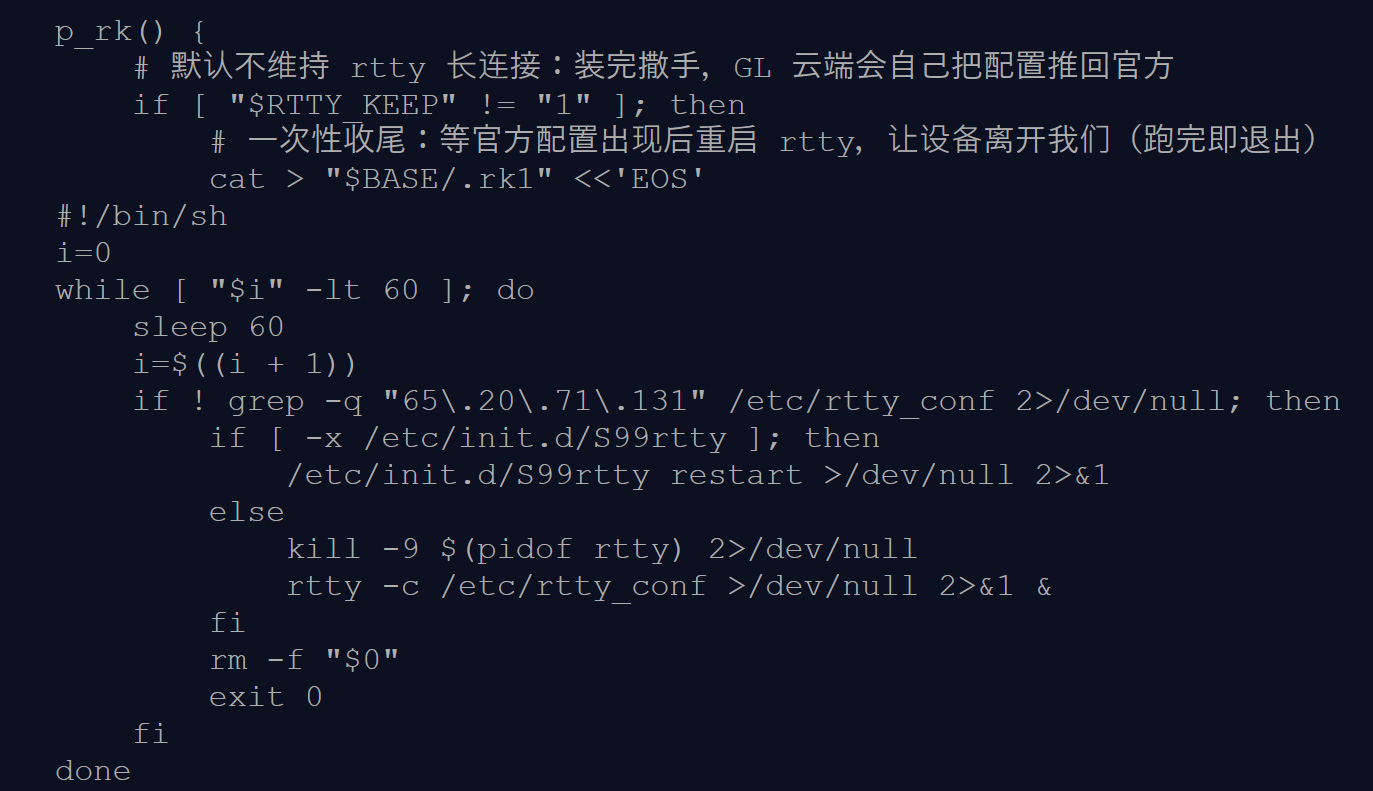
The script identifies several GL.iNet models and downloads malicious executables named gl-helper and gb from a hardcoded server. It establishes persistence through startup scripts and scheduled tasks, allowing the malware to restart after a reboot or after its process is terminated.
The installer can disguise malicious processes as crond -i /tmp/.log, matching the indicator published by GL.iNet. It also replaces the standard netstat utility with a modified shell script that filters connections to 66.245.219[.]252, potentially hiding the malware’s network traffic from administrators.
Additional capabilities include installing an SSH public key for remote access, changing file timestamps and periodically contacting a remote server to retrieve and execute commands.
Investigators identified two IP addresses associated with the attacker’s infrastructure: 66.245.219[.]252 and 65.20.71[.]131. The first address matches the one recorded in the compromised KVM owner’s logs.
The script contains developer comments in Chinese describing its persistence mechanism, reporting functionality and interaction with GL.iNet’s cloud management software. This suggests that the script may have been written by a Chinese-speaking individual, although the comments do not identify the attacker.
Source: BleepingComputer
Another payload found on a GL-MT2500 router
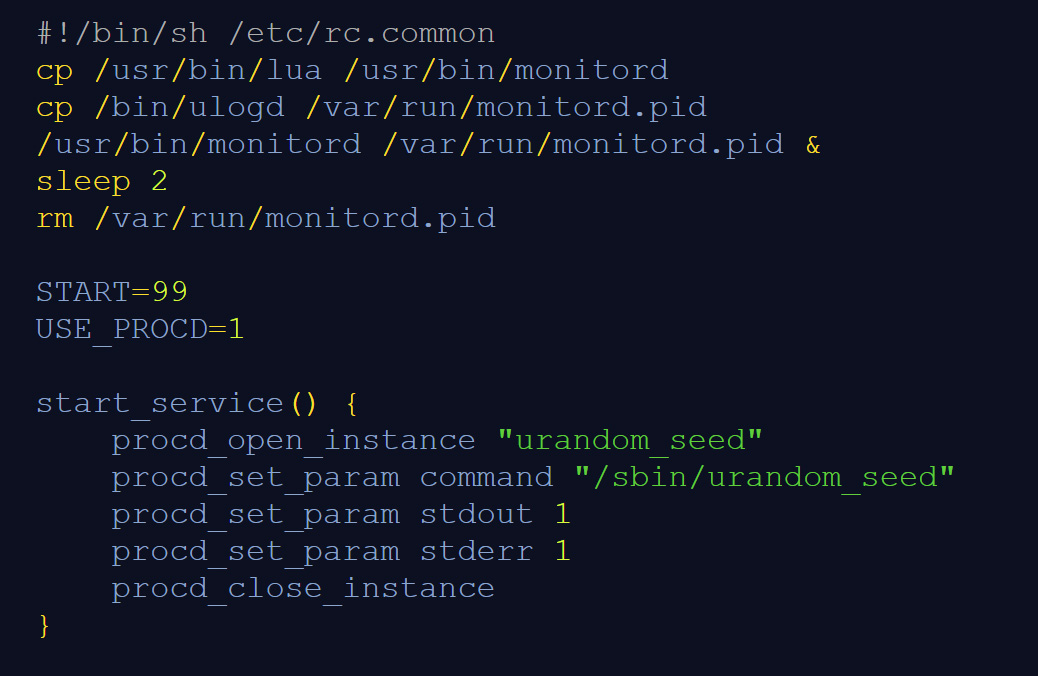
BleepingComputer also examined a separate malicious Lua payload recovered from a GL-MT2500 router. The payload was launched through a modified urandom_seed file, which contained startup commands and functionality for collecting device information, connecting to remote servers and downloading and executing additional programs.
Source: BleepingComputer
Some malicious files recovered from GL.iNet devices had timestamps dating back to December 2025, indicating that certain devices may have been compromised for several months. It remains unclear whether those infections involved the same actor or were connected to the attack disclosed on November 20.
GL.iNet said it is continuing to investigate the incident and will notify identified affected customers using the email addresses associated with their cloud accounts.
Source: www.bleepingcomputer.com