



The ShinyHunters extortion group claims it has resumed publishing data on a new breach site after a series of arrests involving suspected members over the past two months. Launched on November 23, the new Tor site uses historical ShinyHunters PGP keys to authenticate its messages, although the available evidence does not prove that the people operating it are the same individuals who previously controlled the group.
The site contains statements in Russian and English announcing ShinyHunters’ return, distancing the operation from alleged fraudsters and former members who have been arrested or are reportedly cooperating with law enforcement.
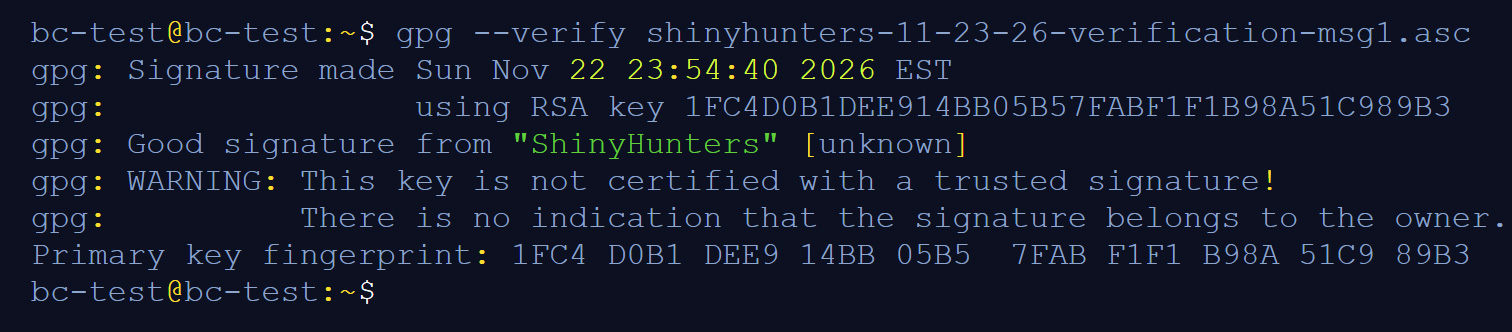
It also includes two verification messages signed with historical ShinyHunters PGP keys dating back to 2020. One of the messages uses a key previously used to authenticate communications with BleepingComputer in August 2025.
BleepingComputer confirmed that both messages were signed with known PGP keys associated with the ShinyHunters extortion gang. This indicates that the new operator had access to private signing keys historically used by the group.
However, the keys have circulated among a large number of people. As a result, it is not possible to confirm whether the individuals behind the new operation are the same people who previously controlled ShinyHunters.
ShinyHunters claims to be returning
The announcement follows several law enforcement operations targeting suspected ShinyHunters members after the group claimed in September that it had exploited a vulnerability in Oracle PeopleSoft to infiltrate FBI systems.
Later that month, Dutch police confirmed the arrest of a 24-year-old man from Amsterdam for alleged involvement with ShinyHunters. Media reports identified the man as Pepin van der Stapp, who was previously known online as Umbreon.
In early October, reports said that another suspected ShinyHunters member, known as Ray or Saif, had been detained in Jordan and was cooperating with law enforcement. Around the same time, Canadian cybersecurity executive Edward Dubrovsky was arrested in Pennsylvania in an alleged extortion investigation related to ShinyHunters.
Following the arrests, key ShinyHunters representatives who had regularly communicated with BleepingComputer and other media outlets stopped responding. Their Telegram accounts were also deleted, and the group’s data breach site soon went offline.
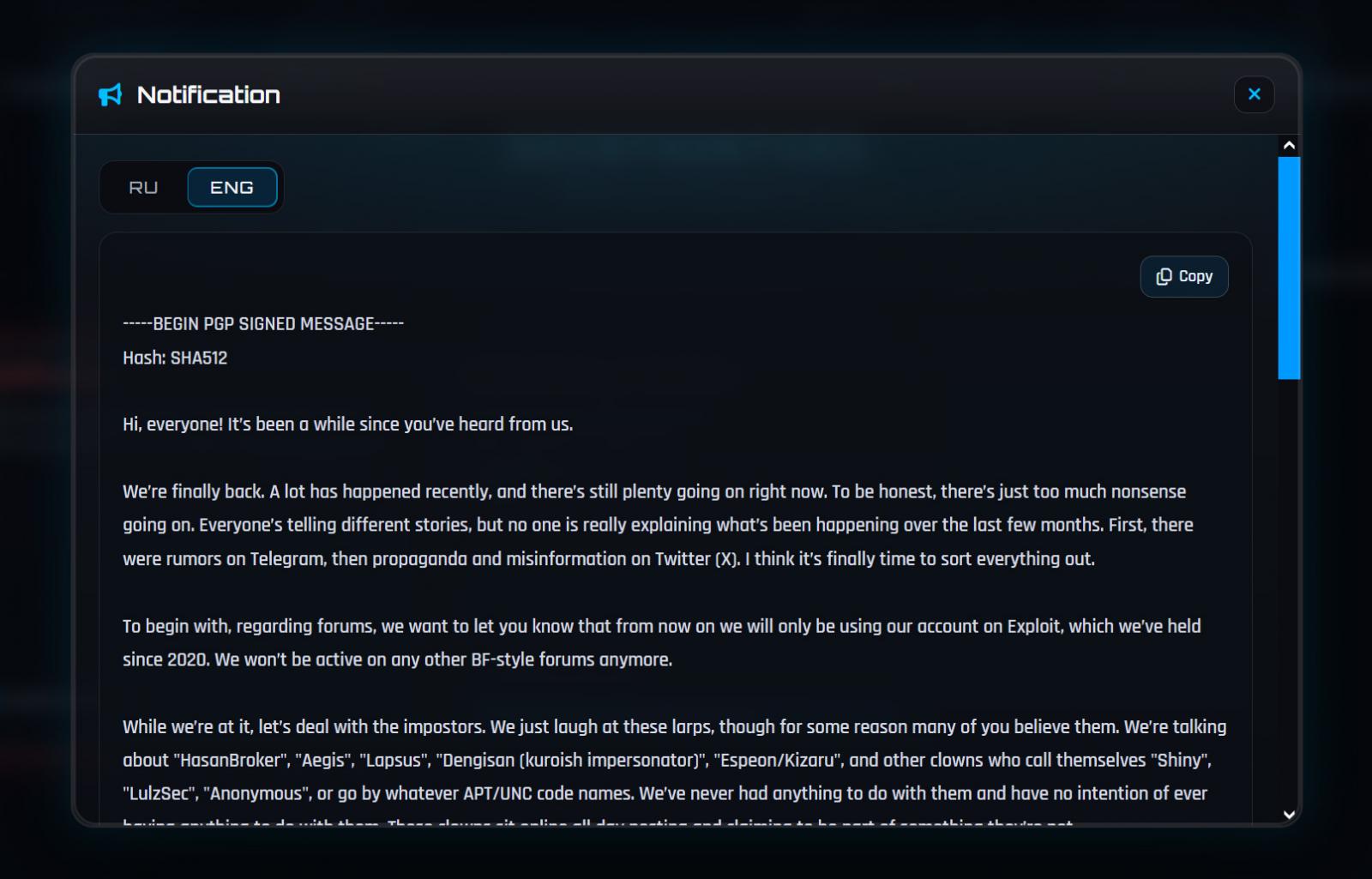
In the new statement, the purported operators say they are returning after months of rumors and misinformation about the group.
“We’re finally back. A lot has happened lately, and a lot is still happening,” the English-language announcement reads.
“To be honest, there’s so much nonsense going on. Everyone’s telling a different story, but no one’s explaining exactly what’s been going on in recent months.”
Source: BleepingComputer
The operators of the new data leak site say they communicate only through the new Tor site and an account on an exploit-hacking forum that they claim to have controlled since 2020.
The statement also refers to reports that hackers and alleged ShinyHunters members known as Ray, Dedere and Saif were detained in Jordan in late September.
According to the announcement, Ray previously collaborated with ShinyHunters but later began operating independently and created a Telegram channel without the group’s approval.
“As far as we know, he has already been arrested and is currently ‘actively cooperating’ with authorities,” the English-language message says.
“The PGP key Ray used for DLS is likely compromised, so we’ve already rotated it.”
The message also mocks Umbreon and Edward Dubrovsky, two other people implicated in the ShinyHunters investigation, and refers to their arrests.
“It was a pleasure working with you guys, and it’s really unfortunate that our guys got caught for such a stupid mistake, which could have been easily avoided if the idiots hadn’t gotten involved with the wrong people,” the post says.
The operators also say they plan to launch a new content delivery network to host stolen data and will stop using existing backup servers.
Historical PGP keys used to authenticate the new site
To support its claim of legitimacy, the operator published two verification messages signed with historical ShinyHunters PGP keys created in January and August 2020.
BleepingComputer verified that both messages were signed with known PGP keys associated with the ShinyHunters extortion gang.
PGP relies on cryptographic keys. A public key can be shared and used to verify messages and data, while a corresponding private key is used to create digital signatures. The private key must remain secret to prevent others from impersonating its owner.
BleepingComputer previously published a message received from ShinyHunters on August 26, 2025. That communication was associated with the public key 1FC4D0B1DEE914BB05B57FABF1F1B98A51C989B3.
The successful verification of the November message with the same public key indicates that whoever signed it had access to the corresponding private signing key. That key had been used in previous communications linked to the ShinyHunters operation behind a large-scale data theft attack in 2026.
However, both historical keys were revoked in March 2026. At that time, the group announced an alternative PGP key and published the fingerprint F4953411767DE71BEDCDABCB76F4E26F7A20978A in an archived announcement.
The group said it would continue using the two 2020 keys to authenticate the exchange but would no longer use those old keys for communications.
Despite that announcement, the November 23 statement reuses the two revoked 2020 keys to authorize another new PGP key: 27DA9D5B183247CADFC322880ABC63E30F73822E.
None of the November messages examined by BleepingComputer were signed with the alternative key introduced in March 2026. It therefore remains unclear whether the new operator also has access to that key’s private counterpart.
The signatures do not definitively prove that ShinyHunters has returned or that the brand has not been revived by scammers. Many people were reportedly believed to possess the original 2020 keys.
Source: www.bleepingcomputer.com