


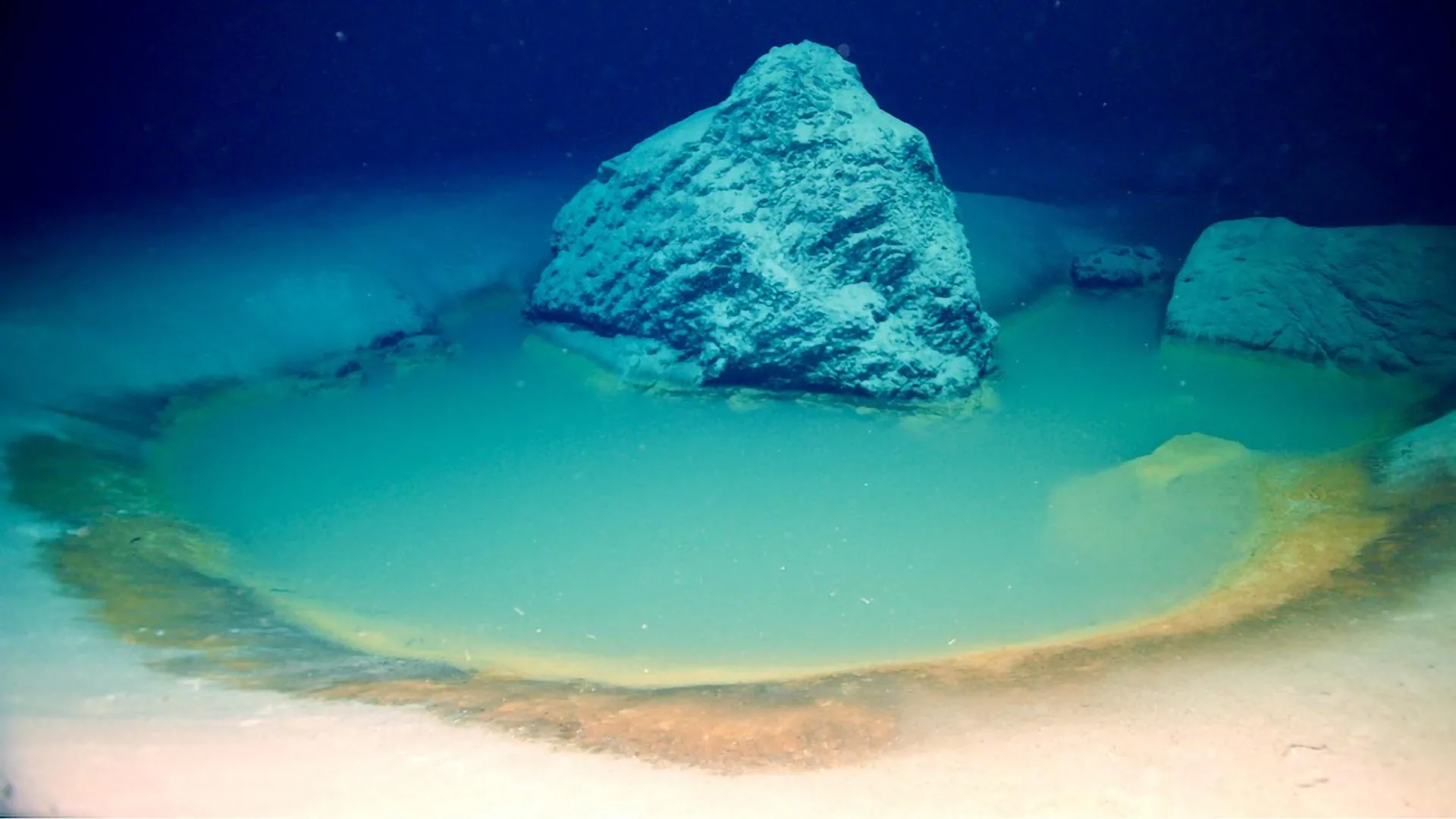
Researchers from the University of Miami’s Rosenstiel School of Marine and Atmospheric Sciences have discovered a deep-sea saltwater pool in the Gulf of Aqaba, the northern extension of the Red Sea. Located more than a mile (1,770 meters) below the surface, the pool contains extreme conditions that support microbial life and preserve geological evidence of ancient tsunamis, flash floods and earthquakes. Such environments may also help scientists define the limits of life on Earth and guide the search for life beyond our planet.
A rare discovery in the Gulf of Aqaba
Sam Purkiss, professor and chair of the University of Miami School of Marine and Earth Sciences, and his colleagues discovered the pool in collaboration with OceanX. The team used a remotely operated underwater vehicle (ROV) deployed from the Ocean Explorer, a research vessel designed to investigate some of the most inaccessible environments on Earth.
“Until we understand the limits of life on Earth, it will be difficult to determine whether extraterrestrial planets are habitable,” Purkiss said. “The discovery of rich communities of microorganisms that survive in extreme environments will help us track the limits of life on Earth and may have applications in the search for life elsewhere in the solar system and beyond.”
Life thrives in extreme underwater pools
Saltwater pools are among the harshest environments on Earth. Their water contains extremely high concentrations of salt, has unusual chemical properties and is completely devoid of oxygen. Despite these conditions, the pools support abundant microbial life. Earlier studies of microorganisms in Red Sea saltwater pools have also identified biologically active molecules with potential anticancer properties.
The study represents the first documented discovery of a saltwater pool in the Gulf of Aqaba. The researchers nearly missed it.
“We were very lucky,” Purkiss said. “This discovery occurred during the last five minutes of the 10-hour ROV dive that we were able to devote to this project.”
A natural archive of earthquakes and tsunamis
Beyond its biological importance, the pool preserves a record of the region’s geological history. Because it lies relatively close to the coastline, its highly saline, oxygen-free water can preserve evidence of tsunamis, flash floods and earthquakes that struck the Gulf of Aqaba thousands of years ago. Regional tectonic activity has created numerous faults and cracks in the seafloor in this part of the bay.
In early 2022, Purkiss and his colleagues found evidence of a 500-year-old undersea landslide that may have generated a massive tsunami. Understanding the history of such events could have important implications for coastal development in Egypt and Saudi Arabia.
Study and expedition
The study, titled “Discovery of a deep-sea NEOM saline pool in the Gulf of Aqaba, Red Sea,” was published in Communications Earth & Environment on June 27, 2022.
The research team included Sam J. Purkis, Hannah Shernisky, Peter K. Swart, Arash Sharifi, Amanda Oehlert, Gaëlle Duchâtellier, James Klaus, Gregor P. Eberli, Larry Peterson and Graham Kolodziej of the University of Miami’s Rosenstiel School; Fabio Marchese and Francesca Benzoni of the Red Sea Research Center at King Abdullah University of Science and Technology; Giovanni Cimienti of the University of Bari Aldo Moro in Italy; Andrew Craig and Matty Rodrig of OceanX; Jürgen Titchack of MARUM—the German Marine Environmental Science Center; and Ameer Abdulla of NEOM.
Saudi Arabia’s coastline development company NEOM funded the four-week exploration expedition aboard the Ocean Explorer.
Source: www.sciencedaily.com