


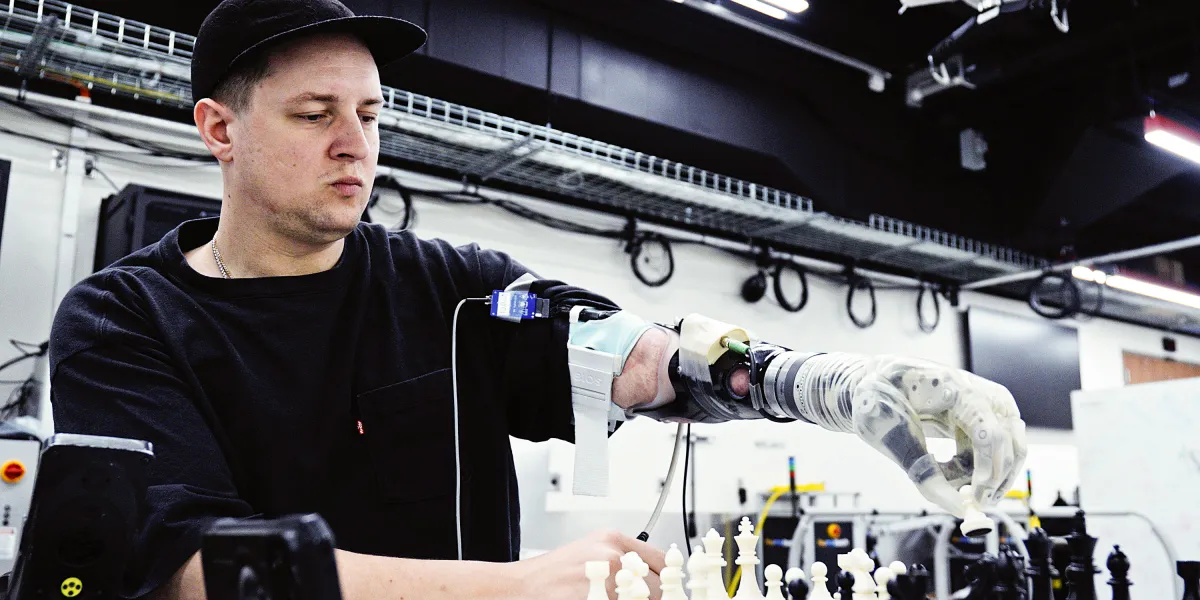
Davidson is testing a new neural interface for the bionic LUKE Arm, a prosthetic system named after Luke Skywalker. The research goes beyond controlling movement: the connection is designed to let the user control the arm and receive feedback about how much pressure the prosthetic is applying. Researchers hope his experience will show how useful the technology is in daily life, where it may fail, and how it affects his health, brain and nervous system.
The LUKE Arm and neural control
The hands used in the trial are part of the bionic LUKE Arm, whose name refers to Luke Skywalker from Star Wars. The system is a realistic prosthesis; Luke Skywalker’s own arm was cut off with a lightsaber, as shown in this video.
The arms were developed in the 2000s and were first piloted in 2014. The device was approved by the U.S. Food and Drug Administration in the same year.
Davidson’s trial focuses less on the arm itself than on a new method of connecting it to the human nervous system. This connection is intended to allow the user to control the arm’s movements while also receiving sensory feedback about the pressure being applied.
Researchers want Davidson’s experience to help answer long-standing questions about the technology. They are studying when such devices are useful in everyday life, where they might fail, and how they affect the user’s physical health as well as the brain and nervous system.
Losing a limb at 16
In 2009, when Davidson was 16, he climbed a telephone pole to get what he described as the best view of the sunset. “We climbed about 35 feet,” he recalls. When he tried to climb down, he tripped. He grabbed a wire but was electrocuted before falling to the ground.
The accident caused second- and third-degree burns across 37 percent of his body. Davidson said he had “broken his hip in about 50 separate places.” He also broke eight ribs, and his spinal cord was severed. He was sure he had also broken his left wrist.
About 10 days later, gangrene began developing in his left hand. It was his dominant hand and had been holding the wire, so the hand was amputated.
Davidson remained in a coma for about a month. “When I woke up, they explained to me, ‘You’re paralyzed, you’ll never walk again, and we took your left hand too,’” he recalls. “It’s a little inconvenient for a 16-year-old, to say the least.”
Now 33 and working as a trauma therapist, Davidson has continued physical therapy while adapting to life with a changed body. He has tried several prosthetic devices. The first, which he received a year and a half after the injury, was a basic hook designed to help him hold objects. It was not advanced, he says, but it gave him “a psychological sense of being whole again.”
From basic hooks to bionic hands
The prosthetic hands Davidson has used since then have become increasingly sophisticated. Some can control individual fingers through muscle movements. He says some devices are covered by his medical insurance and can be replaced about every five years, while he has had to pay for others himself.
For example, Davidson bought his third prosthetic arm on eBay. “It’s crazy to think you bought something second-hand,” he says.
A new connection to the nervous system
A chance meeting with a scientist in a supermarket led Davidson to a research team at the University of Utah. The team specializes in devices that connect to the body and, since 2013, has been testing a system designed to connect with nerves in an amputation stump.
The goal is to allow amputees to control bionic systems through their own nervous systems. Jake George, director of the university’s Neurorobotics Laboratory, says Davidson was an ideal candidate for the research.
Source: www.technologyreview.com