


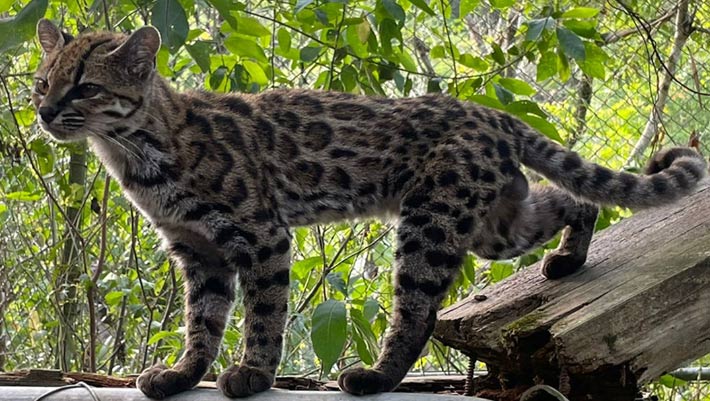
Genomic Study Reveals Five Distinct South American Tabby Cat Lineages
Scientists say the South American tabby cat complex, Hyōmon, contains five genetically distinct species, including Leopardus tyrcayo, a species previously unknown to science.
South American tabby cats are small, spotted felines found throughout Central and South America. They are also known as small spotted cats or tigrinas.
Because the cats have only subtle physical differences, scientists have struggled to classify them. Earlier studies based on limited morphological traits and mitochondrial DNA produced contradictory conclusions.
Dr. Jonas Lescroart of the University of Antwerp and the Pontifical Catholic University of Rio Grande do Sul and his colleagues said that much of Earth’s biodiversity remains unknown, creating challenges for conservation planning amid widespread human impacts.
“A necessary step in biodiversity assessment is the correct separation of species.”
“In this context, species complexes pose significant challenges to simple taxonomic assignments due to their delicate boundaries.”
Genomic analysis clarifies tabby cat diversity
The tabby cat species complex has resisted taxonomic resolution since its official description, which was based on a single animal illustration from Cayenne, French Guiana.
To investigate the cats’ evolutionary history, the researchers analyzed complete genomes from 38 individuals across the genus Leopardus. The team also sequenced DNA from eight historic museum specimens.
Among the museum material was a fragment of a Guyanese skull. It provided the first genetic data from the species’ original type locality in the Guiana Shield, a population that had never previously been sampled using molecular methods.
The genomic analysis identified five mutually distinct lineages within the complex. The study included the previously recognized southern tabby cat and revealed previously unknown diversity.
New species found in Bolivia’s Yungas cloud forest
One of the newly identified species is Leopardus tyrcayo, discovered in Bolivia’s Yungas cloud forest. Researchers also identified a new subspecies from Peru’s Yungas region, Leopardus tigrinus antisuyo.
Leopardus tyrcayo is a small cat with a head-and-body length of 42.5 to 50.5 centimeters (17 to 20 inches) and a tail measuring 25 to 26.5 centimeters (10 to 10.4 inches).
Its back is light brown, becoming darker along the central ridge and paler toward the extremities. The coat has relatively large, irregular, dark brown to black rosettes on a light brown to beige background. The rosettes may be largely open or partially closed.
An ancient lineage shaped by changing climate
The researchers found that Leopardus tyrcayo branched from the Leopardus tigrinus/pardinoides lineage during the early Pleistocene, approximately 1.4 million years ago.
This period was marked by major climatic fluctuations that fragmented montane forests and likely increased geographic isolation among populations.
Genomic data reveal long-term population declines
Beyond clarifying the cats’ taxonomy, the genomic data revealed long-term population declines in nearly all tabby cat lineages. These declines began during the Pleistocene and Holocene eras.
Several lineages, including the newly described Leopardus tyrcayo, experienced population reductions of more than 60%.
“Taken together, our results reveal the evolutionary history of a complex radiation of wild cats, reveal new taxa, and form the basis for conservation planning for these elusive wild cats,” the scientists concluded.
The findings were published in the journal Current Biology.
_____
Jonas Lescroart and others. “Phylogenomics and museology have revealed five distinct species of tabby cats in South America.” Current Biology, published online September 17, 2026. doi: 10.1016/j.cub.2026.08.059
Source: www.sci.news