


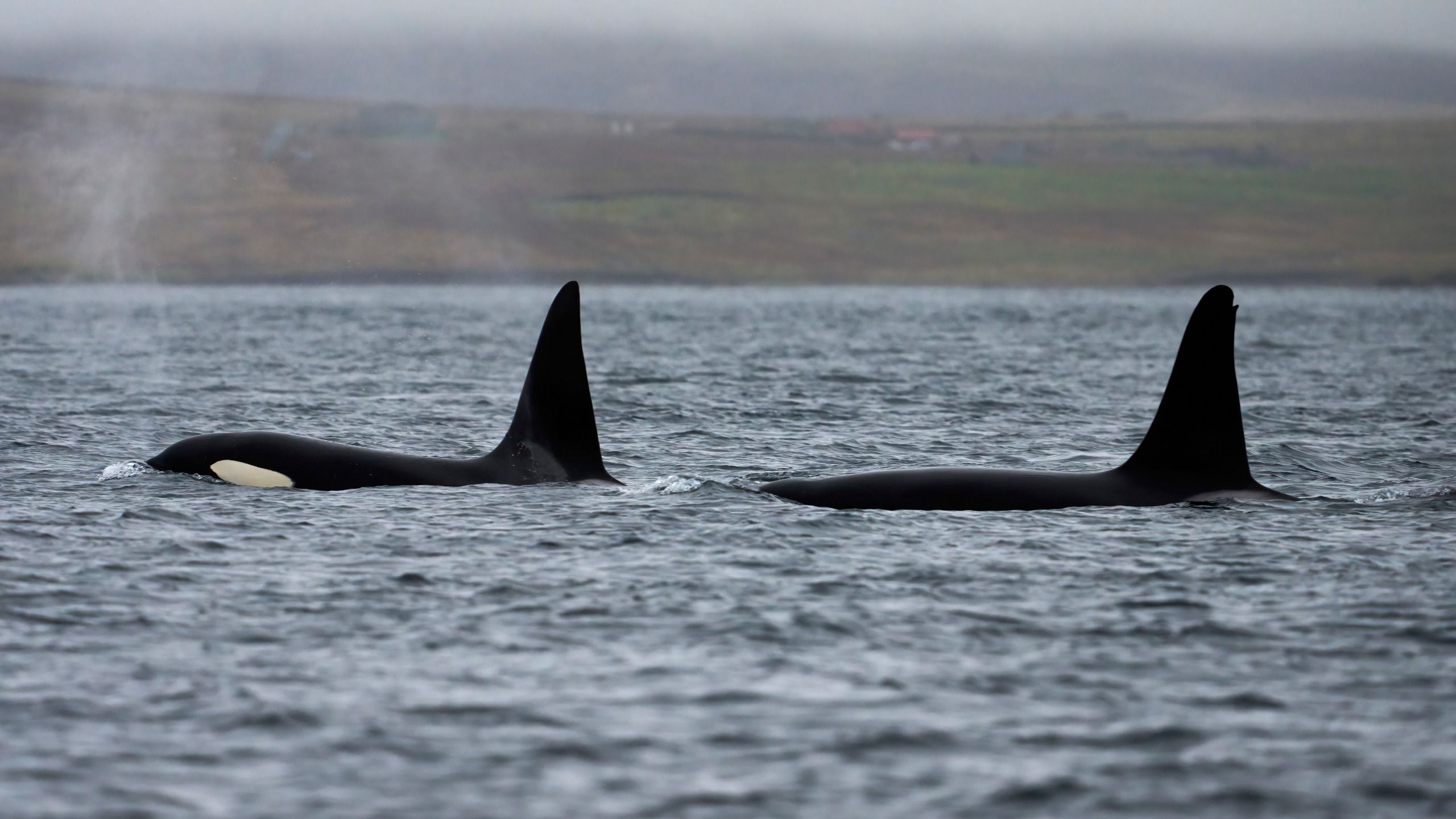
Radioactive fallout preserved in a stranded killer whale’s tooth may indicate that the animal was at least 65 years old when it died, potentially making it the oldest male killer whale ever recorded. The finding comes from a study that used radiocarbon signatures from nuclear-weapons testing, along with annual growth layers and stable-isotope analysis, to investigate the lives and diets of whales stranded in Scotland.
“It gives what we call a kind of bomb pulse,” said Kieran Tierney, the study’s lead author and a researcher at the Scottish Universities Environmental Research Centre.
Male killer whales are generally thought to live for a maximum of 50 to 60 years. However, the study, published Oct. 1 in Frontiers in Marine Science, identified radiocarbon signatures in the tooth of one stranded male suggesting that he was more than 65 years old.
The researchers emphasized that radiocarbon data cannot provide an exact age. They said, however, that the estimate is not implausible.
Reading a whale’s age in its teeth
Determining the maximum lifespan of wild animals is notoriously difficult. Researchers cannot monitor every individual in a species, and there is no comprehensive worldwide record of killer-whale longevity.
“The age estimates we have from life-history studies are only a few decades old, and researchers have only studied a limited number of individuals from a small orca population,” said Erich Hoyt, co-chair of the IUCN Important Marine Mammal Expert Group and author of Orca: The Whale Called Killer (Firefly Books, 2019). Hoyt was not involved in the study.
“I wouldn’t be surprised if male killer whales could live to be over 65 years old,” Hoyt told Live Science in an email.
Killer-whale and sperm-whale teeth contain striped growth layers that researchers believe form each year, much like the growth rings of a tree. To investigate this idea and learn more about whales stranded in Scotland, the researchers examined teeth from three killer whales stranded between 1995 and 2016 and two sperm whales stranded in the 1990s.
Nuclear-weapons tests, particularly those conducted in the mid-20th century, released large amounts of radioactive material, including radiocarbon. This isotope entered the marine environment and was incorporated into the teeth of cetaceans such as sperm whales and killer whales.
Radiocarbon occurs naturally in the atmosphere, but the bomb tests sharply increased environmental levels. By measuring the isotope in a tooth, researchers can determine whether an animal lived through the period when the atmospheric radiocarbon increase occurred.
The growth layers in the sperm-whale teeth were consistent with the timing of the atomic signal. The two sperm whales were estimated to have died in their 20s and 40s, respectively, suggesting that the layers formed annually at least through early and middle adulthood.
However, the tooth layers matched the radiocarbon-based age for only one of the killer whales. The data for the other male did not match.
KW2’s unusual age estimate
The unusual killer whale, named KW2, stranded on the island of Uist in western Scotland in 2015. Analysis of his teeth suggested that he lived into his 50s, while radiocarbon analysis indicated that he was at least 65 years old when he died.
Tierney said the discrepancy could mean that multiple tooth layers formed within a single year or that new layers stopped forming later in KW2’s life.
“We believe there is virtually no space left on the tooth to put any more layers,” Tierney said.
Lulu and Scotland’s endangered killer whales
The growth layers and radiocarbon data also failed to match in Lulu, the only female killer whale examined in the study. Comparisons were difficult because Lulu did not show a clear bomb-pulse signal.
The layers in Lulu’s teeth suggested that she was in her 30s when she died. Her radiocarbon signal instead pointed to a release from a nuclear power plant in the Irish Sea during the late 20th century. That material was transported to Scotland’s west coast.
Stable-isotope analysis of carbon and nitrogen in the tooth samples provided clues about the whales’ diets. Lulu appeared to have eaten a higher proportion of marine mammals than the males, while the males likely ate more fish.
Killer-whale diets vary between populations, and Lulu’s diet may have reflected her social community. She belonged to Scotland’s West Coast community, a genetically distinct population of endangered killer whales known to prey on other marine mammals.
Lulu was the last known female in the West Coast community and had not produced calves. Researchers had studied the group for decades. Only two bulls now remain, and they are expected to be the last of their kind, according to the Hebridean Whale and Dolphin Trust.
The living bulls from the West Coast community were not included in the study, but they are believed to be more than 50 years old. Their longevity, together with KW2’s estimated age, raises questions for future research on killer whales.
Tierney noted that much orca research has focused on populations off the Pacific coast of North America. In those populations, males are typically observed to remain with their mothers throughout their lives, and their life expectancy is significantly reduced when their mothers die.
If male killer whales off Scotland live longer and the West Coast community’s bulls can survive without maternal assistance, they may be more independent than killer whales in the North American Pacific.
“It seems like the killer whales around our coast are probably doing something a little different,” Tierney said.
Study details
Tierney, K. M., McGill, R. A. R., Brownlow, A., Sayle, K. L., Tripney, B. G., Dunbar, E., Newton, J., Terrapon, M., Doeschate, M. T. I. T., Davison, N. J., Timmons, Z., and Kitchener, A. C. (2026). “Integrating radiocarbon and stable isotopes in toothed whale teeth to reveal life history.” Frontiers of Marine Science, 13.
Source: www.livescience.com