


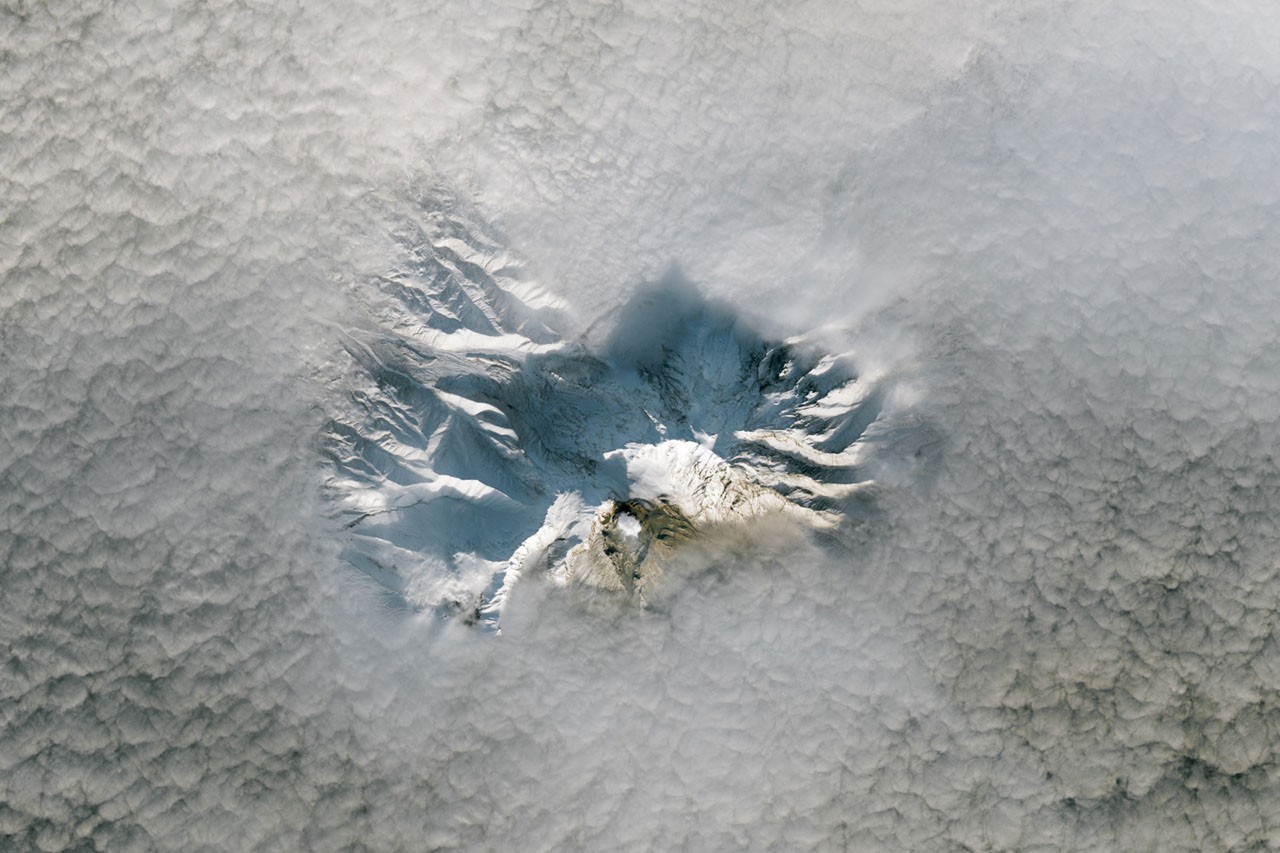
Clouds surround Shiveluch, one of Kamchatka’s most active volcanoes, in a Landsat 9 image captured on November 8, 2026. The clouds obscure much of Russia’s snowy Kamchatka Peninsula but remain below the volcano’s 3,283-meter (10,771-foot) summit, revealing an opening in its caldera and the lava dome on its northern upper slope.
A lava dome inside the caldera
Shiveluch, also known as Siberuch, frequently exhibits volcanic activity and is often covered by clouds. Its caldera is 9 kilometers (5.6 miles) wide and opens to the south. Inside it, a lava dome appears as a dark area. Lava domes form when vents push out viscous magma.
Shiveluch’s lava dome undergoes cycles of growth and collapse. A collapse can trigger high-velocity movements of hot ash and rock known as pyroclastic flows.
Months of activity
In November 2026, Shiveluch was experiencing a major eruption involving lava and explosive activity. According to a report from the Kamchatka Volcanic Eruption Response Team (KVERT), the activity had continued for months. Despite the frequent cloud cover, satellites regularly detected thermal anomalies at the volcano.
On the day the image was captured, KVERT reported that a resuspended plume of volcanic ash had drifted 120 kilometers (75 miles) eastward. Such activity is relatively tame for Shiveluch, whose explosions regularly send ash several kilometers into the atmosphere. The ash can travel long distances, creating risks to aircraft.
In July 2026, according to news coverage, an ash plume crossed the Bering Sea into Alaskan airspace on the jet stream, prompting the cancellation of multiple flights.
Source: science.nasa.gov