


Close Menu
HitechubHitechub
    What's Hot
    Technology

    Russia Was Unprepared for the Data Center War It Started With Ukraine

    Science

    Thanksgiving Storm Brings Flooding and Flight Delays Across the U.S.

    Technology

    Exclusive: Get a 4-Month Head Start on Frontier AI Models for 5x the Cost

    Important Pages:
    • About Us
    • Privacy Policy
    • Terms & Conditions
    Facebook X (Twitter) Instagram Pinterest
    Facebook X (Twitter) Instagram
    HitechubHitechub
    Monday, November 30
    • Shop
      • Fashion
        • Mens
        • Womens
        • Accessories
          • Handbags
          • Keychain
          • Masks
          • Money clicps
          • Neck Pillow
          • Rings
          • Towels
          • Wallets
        • Jewelry
        • Watches
        • T-shirts
        • Hawaiian shirts
        • Vests
        • Swim trunks
        • Swimsuits
      • Fun
        • Magic cubes
        • Magnifiers
        • Misc
        • Photo books
        • Puzzles
        • Toys
      • Home
        • Cleaning/Care
        • Mailbox covers
        • Mugs
        • Pot Holders
        • Spoon
      • Office and Electronics
        • Chairs
        • Office Supplies
        • IPad cases
        • Laptop stickers
        • Mouse pads
        • Notebooks
        • Pencil bags
        • Pens
        • Phone cases
      • Personalized
      • Pets
      • Sports
        • Cycling
          • Balaclava Mask
          • Bike Bell
          • Bike Computer
          • Bike Fender
          • Bike Grips
          • Bike Kickstand
          • Bike Light
          • Bike Locks
          • Bike Mitts
          • Bike Pumps
          • Bike Repair Stand
          • Bike Seat
          • Bike Trainer
          • Bike Wheels
          • BIKES
            • Folding Bikes
            • Road Bikes
          • Carbon Fiber Bike Products
          • Cycling Mask
          • Kid’ Bike Helmets
          • Inner Tube
          • Motorcycle Bag
          • Nylon Pedals
          • Adult Helmets
          • Photochromic Sunglasses
          • Soft Coolers
          • Suction Cup Bike Rack
          • Tool accessories
          • Winter Cloth
          • Heart Rate Monitor
        • Outdoors/Camping
          • Outdoor Bags
        • Sweatband
    • Technology
      1. AI
      2. Gadgets
      3. View All

      This is the most popular CEO in the world

      Sectors in which “Chat-GPT” is most often used

      Artificial intelligence has begun to “swallow” professions

      The unusual robot conductor of a concert in Seoul

      Here’s how you can tell if your phone is being tapped

      PlayStation 5 becomes a completely silent console and gets more space

      This is the first phone that can be used to park a car

      Best Gaming Laptops 2023: Powerful Portables for PC Games

      VisionQuest Review: A Satisfying Conclusion to the WandaVision Trilogy

      New Balance Japan Data Breach Exposes 3.7 Million Customer Records

      Webz.io Launches Self-Service Dark Web API with Free Monthly Credits

      University Board Confirms Data Breach After Unauthorized Password Change

    • Science
      1. Space
      2. Wheels
      3. View All

      Space Perspective: A Journey to the Edge of Space

      5 Fascinating Facts About Space

      Space Exploration: Unveiling the Wonders of the Universe

      Toyota wants to make a new generation battery with a range of up to 1,200 km

      Meet Toyota’s lunar “baby” that could make exploring the Moon easier

      What does a night drive look like with one of the most beautiful cars in the world: the Rolls-Royce Ghost

      Licensing Mechanisms of RNA-Guided DNA Integration in Type I-F3 CAST Systems

      What Archaeological Treasure Would You Discover?

      5 Key Lessons from the Failed COP31 Climate Change Negotiations

      Top Major Cities Worldwide for High-Quality Research in 2025

    HitechubHitechub
    Home » Mars’ Arctic Ice Is Far Cleaner Than Scientists Thought
    Science

    Mars’ Arctic Ice Is Far Cleaner Than Scientists Thought

    Share Facebook Twitter Pinterest WhatsApp
    Share
    Facebook Twitter LinkedIn Pinterest WhatsApp

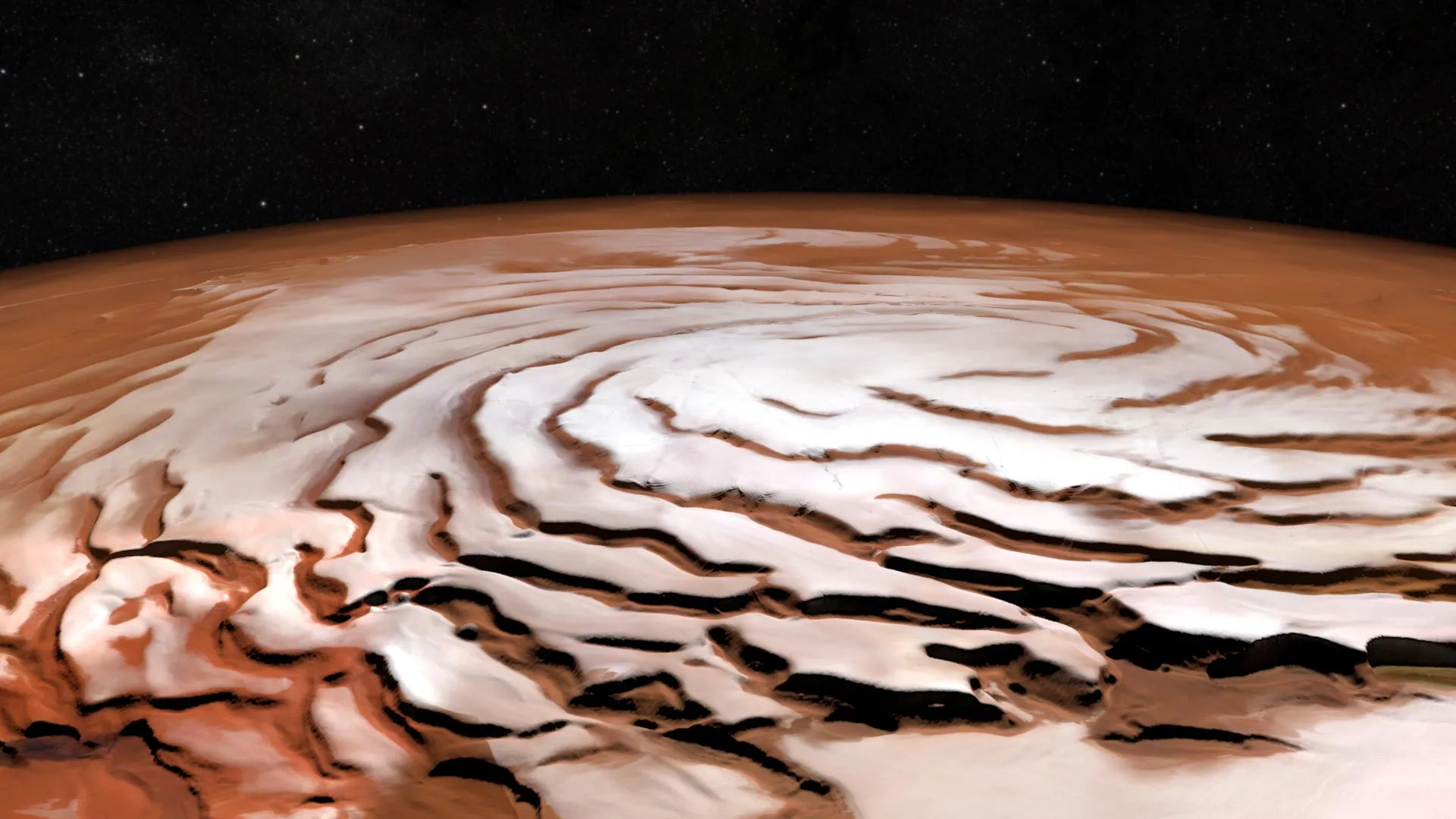
    Mars may once have shared important similarities with Earth, but today its cold, dry surface appears largely inhospitable. Its frozen water deposits nevertheless preserve clues about the planet’s ancient climate and may help scientists determine whether Mars could support life now—or whether it did so in the past. A new study from the University of Washington, published in npj space exploration, suggests that Mars’ north polar ice contains substantially less dust than earlier estimates indicated.

    Most Martian ice is covered by surface dust, although some is exposed near the poles. On Earth, dust can influence climate by darkening ice and reducing the amount of sunlight reflected into space. Darker ice absorbs more heat, which can accelerate melting or evaporation.

    “We know there is water ice in the region surrounding Mars’s north pole, but there is wide disagreement about how dusty that ice is,” said lead researcher Aditya Kular of the University of California’s Applied Physics Laboratory. “The more dust there is, the darker the ice will be. Just like wearing a dark T-shirt in the sun will make you warmer, dusty ice will be warmer on Mars and evaporate faster.”

    Reconstructing Mars’ frozen climate

    Ice samples have helped scientists reconstruct thousands of years of climate history on Earth. Researchers drill into polar ice sheets and extract long, cylindrical cores whose layers preserve evidence of past atmospheric conditions. Much like tree rings, these layers allow scientists to study different periods in Earth’s history. Obtaining similar samples on Mars would be considerably more difficult.

    NASA’s first mission to Mars succeeded 50 years ago. In 2008, the Mars Phoenix mission collected ice samples near the planet’s north pole, an achievement that was particularly significant after the loss of the Polar Lander near Antarctica in 1999. For the new study, the Wisconsin State University team combined data from Phoenix with observational data collected by a rover orbiting Mars.

    Several years ago, Haller identified potential problems with techniques commonly used to determine the physical characteristics of Martian ice. The method had originally been developed to study lunar soil. When Kueller tested it against observations from Earth, however, the results appeared contradictory.

    A different method for studying Martian ice

    For the latest study, Haller worked with Pari Mohan, a University of Wisconsin graduate with a degree in geosciences, to recalculate the properties of Mars’ ice using a different approach. Their method was based on work by Steve Warren, a University of California professor emeritus of earth and space sciences who specializes in snow and ice research.

    “His methods have been used successfully for decades to study snow and ice on Earth, so we thought it would be interesting to take these methods tested on Earth and apply them to Mars,” Klar said.

    The results indicate that the polar ice is arranged “like an ice cream sandwich,” with relatively dusty layers between thicker sections of cleaner ice. Each Martian winter, dusty frost accumulates on the surface. During summer, that frost disappears, exposing older ice with a much lower dust concentration.

    Earlier calculations estimated that dust made up as much as 25% of the mass of the uppermost polar ice. The revised analysis suggests that the proportion in exposed, older ice is closer to 3%.

    “By observing how the brightness changes over time, we found that in the winter there is frost and more dust. In the Martian summer, the frost disappears, exposing cleaner, older ice,” Klar said.

    The legacy of Mars’ extreme ice ages

    Scientists believe the ice deposits formed from snowfall thousands of years ago and preserve evidence of the climate conditions at that time. Mars experienced a dramatic ice age that left near-surface ice deposits across approximately one-third of the planet.

    Earth’s Moon helps stabilize the planet’s axial tilt. Mars, by contrast, has only two small moons, and its axial tilt varies much more widely. Kuehler said Mars is “vibrating violently,” producing extreme climate changes and triggering major ice ages.

    Could Martian ice support life?

    In a previous study published in communication earth, Cooler and colleagues proposed that alternating layers of ice and dust could create environments suitable for life on Mars. Dark, dusty layers absorb sunlight and may generate enough heat to form small pockets of liquid water within the ice. Minerals and other nutrients in the dust could make these pockets potential habitats for bacteria and other simple organisms.

    A similar environment exists on Earth. During summer, shallow pools of meltwater within dusty ice can support abundant microbial life. When temperatures fall in winter, the water freezes and the microorganisms enter a dormant state until warmer conditions return.

    “The fact that both Mars and Earth have such similar water ice and dust layers is interesting,” Klar said. “Why is there life on one planet and not the other?”

    A better understanding of Mars’ climate history could bring researchers closer to answering that question, although a definitive answer may still be years away. Kuehler hopes to extend the investigation by applying improved analytical techniques to ice deposits in other regions of the Red Planet.

    Source: www.sciencedaily.com

    Share. Facebook Twitter Pinterest LinkedIn WhatsApp
    Previous ArticleWebz.io Launches Self-Service Dark Web API with Free Monthly Credits
    Next Article New Balance Japan Data Breach Exposes 3.7 Million Customer Records

    Related Posts

    Science

    Licensing Mechanisms of RNA-Guided DNA Integration in Type I-F3 CAST Systems

    Science

    What Archaeological Treasure Would You Discover?

    Science

    5 Key Lessons from the Failed COP31 Climate Change Negotiations

    Science

    Top Major Cities Worldwide for High-Quality Research in 2025

    Science

    Scotland Heavy Rain: Flood Risks and Travel Warnings Issued

    Science

    Hera Probe Reveals Stadium-Sized Crater on Asteroid Dimorphos Created by NASA’s DART Mission | Space Photo of the Week

    Science

    LSD vs. Psilocybin: How They Leave Different Imprints on the Brain

    Science

    Black Hole Collisions Follow Surprisingly Simple Laws of Nature

    Add A Comment
    Leave A Reply Cancel Reply

    Stay In Touch
    • Facebook
    • Twitter
    • Instagram
    • Pinterest
    Top Picks
    Technology

    Why Men Lie About Their AI Knowledge and Expertise

    AI Gender Gap: Men Are More Confident—but More Likely to Recognize Fake AI Leaders You…

    Earth’s Most Powerful Supervolcanoes Is Filling With Fresh Magma

    La Brea Tar Pits Reveal New Ice Age Toad Species

    Early Human Fire Use: Evidence Suggests Origins Date Back 1.8 Million Years

    Britain’s Worst Beaches: Is Treated Sewage to Blame for Poor Water Quality?

    Most Popular
    Technology

    Reduce Enterprise Network Risk with AI Modernization

    Technology

    How an Atlanta Suburb Shared Herd Data With More Than 2,000 Organizations

    Categories
    • AI (9)
    • Gadgets (6)
    • Science (3,671)
    • Space (3)
    • Technology (3,067)
    • Wheels (3)
    Our Picks
    Science

    Revolutionizing Future Computers: Insights from a 200-Year-Old Physics Experiment

    Science

    APOE4 Alzheimer’s Risk Gene May Have a Reversible Weakness

    © 2026 Hitechub.
    • Home
    • About Us
    • Privacy Policy
    • Terms & Conditions

    Type above and press Enter to search. Press Esc to cancel.

    GDPR Cookie Banner

    We are using cookies to give you the best experience on our website.

    You can find out more about which cookies we are using or switch them off in .

    Ad Blocker Enabled!
    Ad Blocker Enabled!
    Our website is made possible by displaying online advertisements to our visitors. Please support us by disabling your Ad Blocker.