


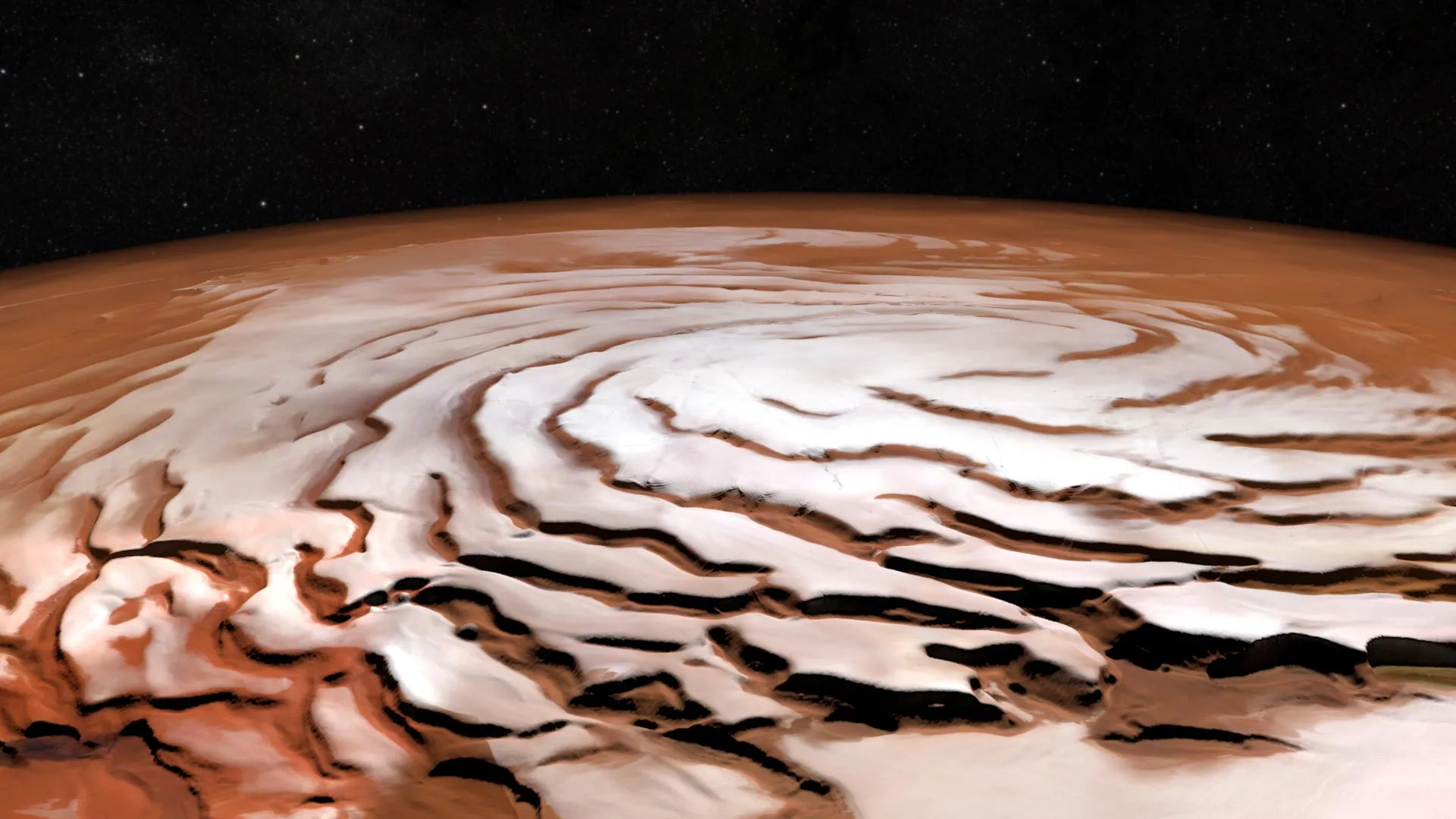
Mars may once have shared important similarities with Earth, but today its cold, dry surface appears largely inhospitable. Its frozen water deposits nevertheless preserve clues about the planet’s ancient climate and may help scientists determine whether Mars could support life now—or whether it did so in the past. A new study from the University of Washington, published in npj space exploration, suggests that Mars’ north polar ice contains substantially less dust than earlier estimates indicated.
Most Martian ice is covered by surface dust, although some is exposed near the poles. On Earth, dust can influence climate by darkening ice and reducing the amount of sunlight reflected into space. Darker ice absorbs more heat, which can accelerate melting or evaporation.
“We know there is water ice in the region surrounding Mars’s north pole, but there is wide disagreement about how dusty that ice is,” said lead researcher Aditya Kular of the University of California’s Applied Physics Laboratory. “The more dust there is, the darker the ice will be. Just like wearing a dark T-shirt in the sun will make you warmer, dusty ice will be warmer on Mars and evaporate faster.”
Reconstructing Mars’ frozen climate
Ice samples have helped scientists reconstruct thousands of years of climate history on Earth. Researchers drill into polar ice sheets and extract long, cylindrical cores whose layers preserve evidence of past atmospheric conditions. Much like tree rings, these layers allow scientists to study different periods in Earth’s history. Obtaining similar samples on Mars would be considerably more difficult.
NASA’s first mission to Mars succeeded 50 years ago. In 2008, the Mars Phoenix mission collected ice samples near the planet’s north pole, an achievement that was particularly significant after the loss of the Polar Lander near Antarctica in 1999. For the new study, the Wisconsin State University team combined data from Phoenix with observational data collected by a rover orbiting Mars.
Several years ago, Haller identified potential problems with techniques commonly used to determine the physical characteristics of Martian ice. The method had originally been developed to study lunar soil. When Kueller tested it against observations from Earth, however, the results appeared contradictory.
A different method for studying Martian ice
For the latest study, Haller worked with Pari Mohan, a University of Wisconsin graduate with a degree in geosciences, to recalculate the properties of Mars’ ice using a different approach. Their method was based on work by Steve Warren, a University of California professor emeritus of earth and space sciences who specializes in snow and ice research.
“His methods have been used successfully for decades to study snow and ice on Earth, so we thought it would be interesting to take these methods tested on Earth and apply them to Mars,” Klar said.
The results indicate that the polar ice is arranged “like an ice cream sandwich,” with relatively dusty layers between thicker sections of cleaner ice. Each Martian winter, dusty frost accumulates on the surface. During summer, that frost disappears, exposing older ice with a much lower dust concentration.
Earlier calculations estimated that dust made up as much as 25% of the mass of the uppermost polar ice. The revised analysis suggests that the proportion in exposed, older ice is closer to 3%.
“By observing how the brightness changes over time, we found that in the winter there is frost and more dust. In the Martian summer, the frost disappears, exposing cleaner, older ice,” Klar said.
The legacy of Mars’ extreme ice ages
Scientists believe the ice deposits formed from snowfall thousands of years ago and preserve evidence of the climate conditions at that time. Mars experienced a dramatic ice age that left near-surface ice deposits across approximately one-third of the planet.
Earth’s Moon helps stabilize the planet’s axial tilt. Mars, by contrast, has only two small moons, and its axial tilt varies much more widely. Kuehler said Mars is “vibrating violently,” producing extreme climate changes and triggering major ice ages.
Could Martian ice support life?
In a previous study published in communication earth, Cooler and colleagues proposed that alternating layers of ice and dust could create environments suitable for life on Mars. Dark, dusty layers absorb sunlight and may generate enough heat to form small pockets of liquid water within the ice. Minerals and other nutrients in the dust could make these pockets potential habitats for bacteria and other simple organisms.
A similar environment exists on Earth. During summer, shallow pools of meltwater within dusty ice can support abundant microbial life. When temperatures fall in winter, the water freezes and the microorganisms enter a dormant state until warmer conditions return.
“The fact that both Mars and Earth have such similar water ice and dust layers is interesting,” Klar said. “Why is there life on one planet and not the other?”
A better understanding of Mars’ climate history could bring researchers closer to answering that question, although a definitive answer may still be years away. Kuehler hopes to extend the investigation by applying improved analytical techniques to ice deposits in other regions of the Red Planet.
Source: www.sciencedaily.com