


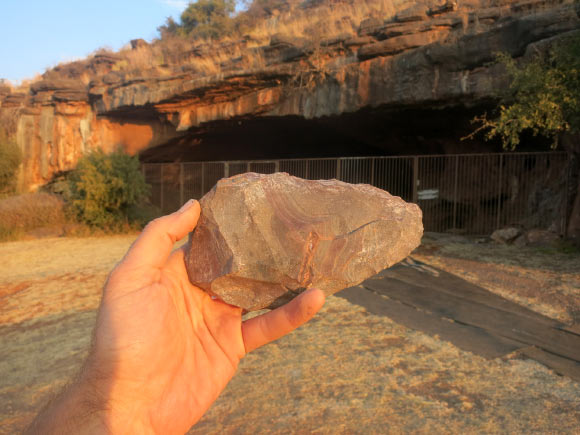
Researchers estimate that early human ancestors, particularly Homo erectus, date back approximately 1.79 million years, highlighting the intentional use of fire within South Africa’s Wonderwerk Cave.
Wonderwerk Cave, South Africa. Image credit: Michael Chazan.
Wonderwerk Cave is situated 60 km south of Kulman in South Africa’s Northern Cape Province.
This significant archaeological site has uncovered a fossil and archaeological record spanning nearly two million years of human occupation.
“The utilization of fire is crucial to understanding the evolutionary dynamics of the genus Homo. It has instigated profound changes in the relationship between humans and their natural and cultural environments,” stated Dr. Liora Korska-Horwitz from the Hebrew University of Jerusalem and colleagues.
“The pace and scale of innovations in hominin fire technology remain debated, yet early-stage innovation seems likely. Early humans may have sourced fire from natural seasonal wildfires, transporting it to their dwelling places and maintaining it until it extinguished,” she added.
“The skill to start and control fire emerged much later in human history.”
“The strongest evidence supporting early fire use currently arises from the Acheulean culture at Wonderwerk Cave, South Africa.”
Previous studies indicate that fire was employed in Wonderwerk Cave roughly one million years ago.
Dr. Korska-Horwitz and her team delved deeper into the cave’s stratigraphic layers, uncovering burnt animal bones that date from 1.07 million to 1.79 million years ago.
It is likely that Homo erectus was responsible for this fire use, suggesting they were neither mere observers of natural fires nor highly skilled fire starters.
Rather, the data indicates they actively captured fire from wildfires outdoors, carted it inside, and sustained it until it was extinguished.
“Evidence for fire from such ancient locations is often subtle and challenging to identify,” Dr. Korska-Horwitz remarked.
“Our research introduces new methodologies to pinpoint ancient fire signatures, revealing the consistent presence of fire deep within Wonderwerk Cave.”
The foundation of this study rests on a novel analytical technique developed to detect combustion in fossil bones.
“When subjected to specific light wavelengths, bones exposed to intense heat emit a distinctive glow,” the researchers explained.
“By integrating this non-destructive luminescence technology with established chemical analysis, we successfully identified burnt animal bones.”
They argue that the clear stratigraphic links between burnt remains and Acheulean tools, alongside the absence of evidence for sediment movement that could account for the bones’ presence, strongly supports the theory of intentional fire use by early humans.
“These findings confirm that early humans were not merely passive bystanders to natural fires,” Dr. Korska-Horwitz stated.
“They actively engaged with fire and woven it into their daily lives.”
For more details, refer to the study published online on June 1, 2026, in PLoS ONE.
_____
MD Marine Monfort et al. 2026. New evidence of early Pleistocene fire use at Wonderwerk Cave (South Africa). PLoS One 21 (6): e0347480; doi: 10.1371/journal.pone.0347480
Source: www.sci.news