


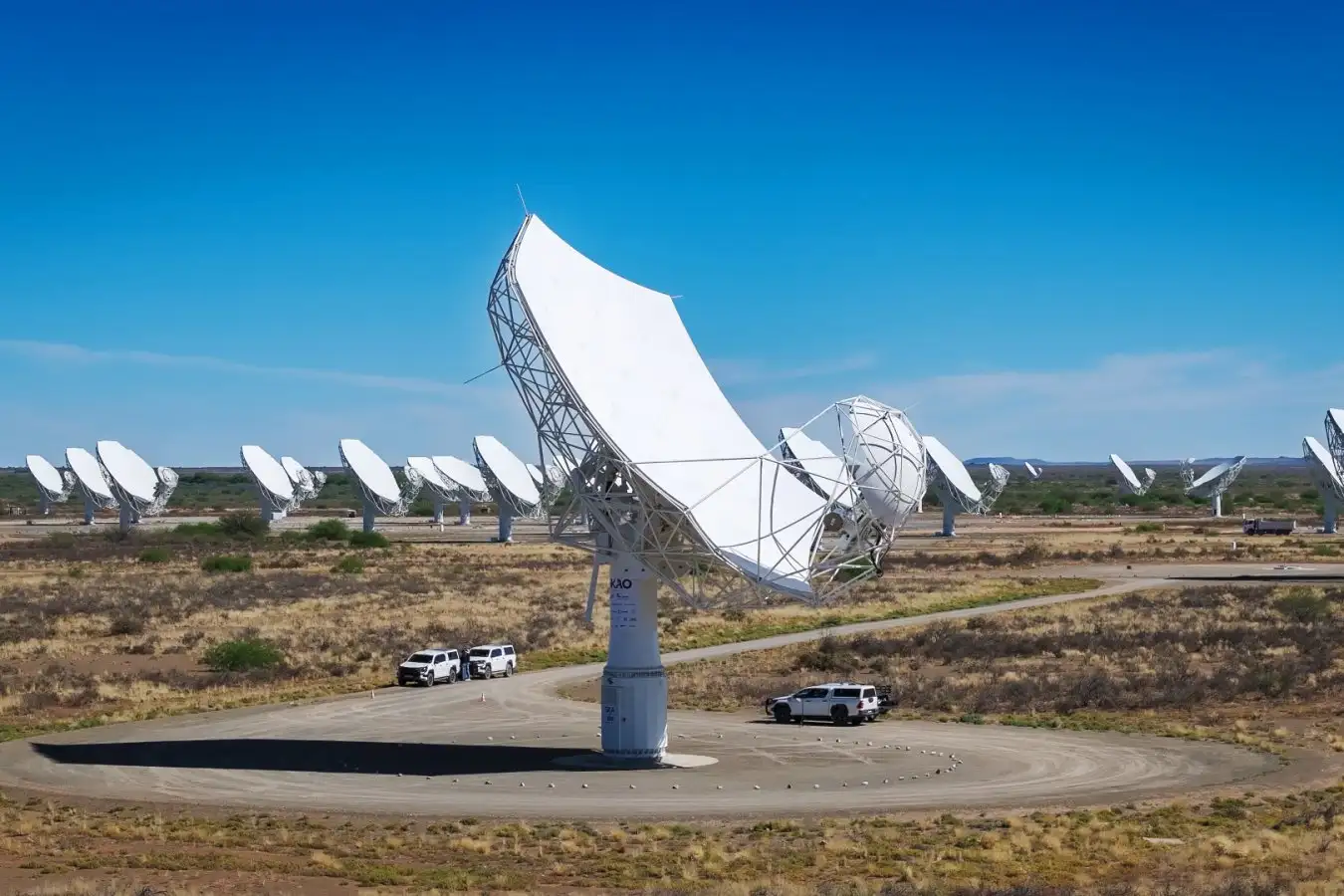
Square Kilometer Array Telescope
SKAO
Welcome to our “Lost in Time and Space” newsletter! Each month, we explore captivating concepts from around the globe. Sign up for the “Lost in Time and Space” newsletter here.
My fascination with invisible light began in childhood, reminiscent of magic. Radios echoed through my home, each room filled with static as I searched for music and conversations hidden within. It wasn’t until later that I grasped my child’s wonder at the invisible world around us, connected through the electromagnetic spectrum.
The human eye has evolved to perceive a narrow range of light, sufficient for navigating terrain and spotting threats. However, the universe radiates a vast spectrum, from gamma rays to radio waves. Each wavelength interacts differently with matter, revealing diverse aspects of our world. In our everyday lives, we regularly witness these interactions. For instance, microwaves excite water molecules, making them excellent for reheating meals, while X-rays penetrate soft tissues but are absorbed by bones, crucial for medical imaging.
Radio waves, with their long wavelengths and low energy, travel great distances with minimal interruption, effortlessly passing through Earth’s atmosphere. As experienced during my childhood, radio waves serve as vital communication tools on Earth and messengers from the cosmos. Eventually, this passion led me to cosmology and the use of radio telescopes to explore the universe’s early stars and galaxies.
The electromagnetic spectrum, as we know it today, is the culmination of centuries of scientific inquiry. It began with a prism in 1665, when Isaac Newton demonstrated that white light could be divided into a spectrum of colors from red to violet. By 1800, astronomer William Herschel discovered infrared light through a prism, noticing temperature increases beyond red light. The 19th century brought the revelation of radio waves, microwaves, X-rays, and gamma rays, forming our contemporary understanding of the spectrum.
Unveiling the Invisible
Optical astronomy is as ancient as civilization itself, emerging from humanity’s natural ability to perceive sunlight and starlight. Other wavelengths require specialized tools—antennas for radio waves and microwaves, detectors for X-rays and infrared radiation. Each wavelength can be likened to a different language. To decipher the universe, we must translate these wavelengths into forms we comprehend, whether through light for our eyes or sound for our ears, revealing a complete narrative of hidden histories.
To illuminate the universe fully, we need the entire spectrum. For example, ultraviolet light reveals water plumes erupting from Europa, one of Jupiter’s moons. The giant planet’s magnetic field interacts with the moon’s atmosphere, producing vivid auroras at ultraviolet wavelengths. Observing these changes helps astronomers deduce the presence of water ejected from an ocean beneath Europa’s icy crust.

Composite Image of a Suspected Water Plume from Europa
NASA, ESA, W. Sparks (STScI), and USGS Astrogeology Science Center
The James Webb Space Telescope (JWST), located 1.5 million kilometers from Earth, has transformed our understanding of early star and galaxy formation. With its expansive, shaded lens akin to a tennis court, it grants us the clearest view yet into the universe.
As the universe expands, light from ancient galaxies shifts to infrared wavelengths, a phenomenon known as redshift, efficiently observed by JWST. By labeling infrared wavelengths with optical colors, we can observe galaxies dating back just hundreds of millions of years post-Big Bang. However, some present with unexpected sizes, challenging prior assumptions about star formation and galaxy development.
Astronomers collect older light shifted to radio wavelengths, utilizing the Square Kilometer Array (SKA) comprising over 100,000 antennas across Western Australia. This immense radio observatory captures faint signals dating back to shortly after the Big Bang, interpreting messages from early stars and black holes. Beyond this, it facilitates diverse observations, including the mapping of the Milky Way and potential signs of extraterrestrial life.
The Search for Extraterrestrial Intelligence (SETI) particularly captivates me, showcasing how various wavelengths complement each other to deepen our understanding of the universe. Using optical telescopes, like the Transiting Exoplanet Survey Satellite (TESS), astronomers catalog thousands of exoplanets by observing changes in star brightness as these planets transit. Subsequently, IR telescopes like JWST analyze exoplanet atmospheres to gauge habitability. Finally, radio telescopes target likely life-supporting planets, listening for potential signals—be it transmissions or unintentional radio waves like television broadcasts.
While our innate language is limited to one form of light, the universe speaks many dialects. The electromagnetic spectrum serves as a Rosetta Stone, helping us interpret invisible tales penned in the cosmos. Together, we can tune into a richer universe far beyond the capabilities of our unaided sight.
Emma Chapman is an astrophysicist at the University of Nottingham, UK, and author of Radio Universe: How to Explore Space Without Leaving Earth (John Murray, 2026).
Topics:
Source: www.newscientist.com