


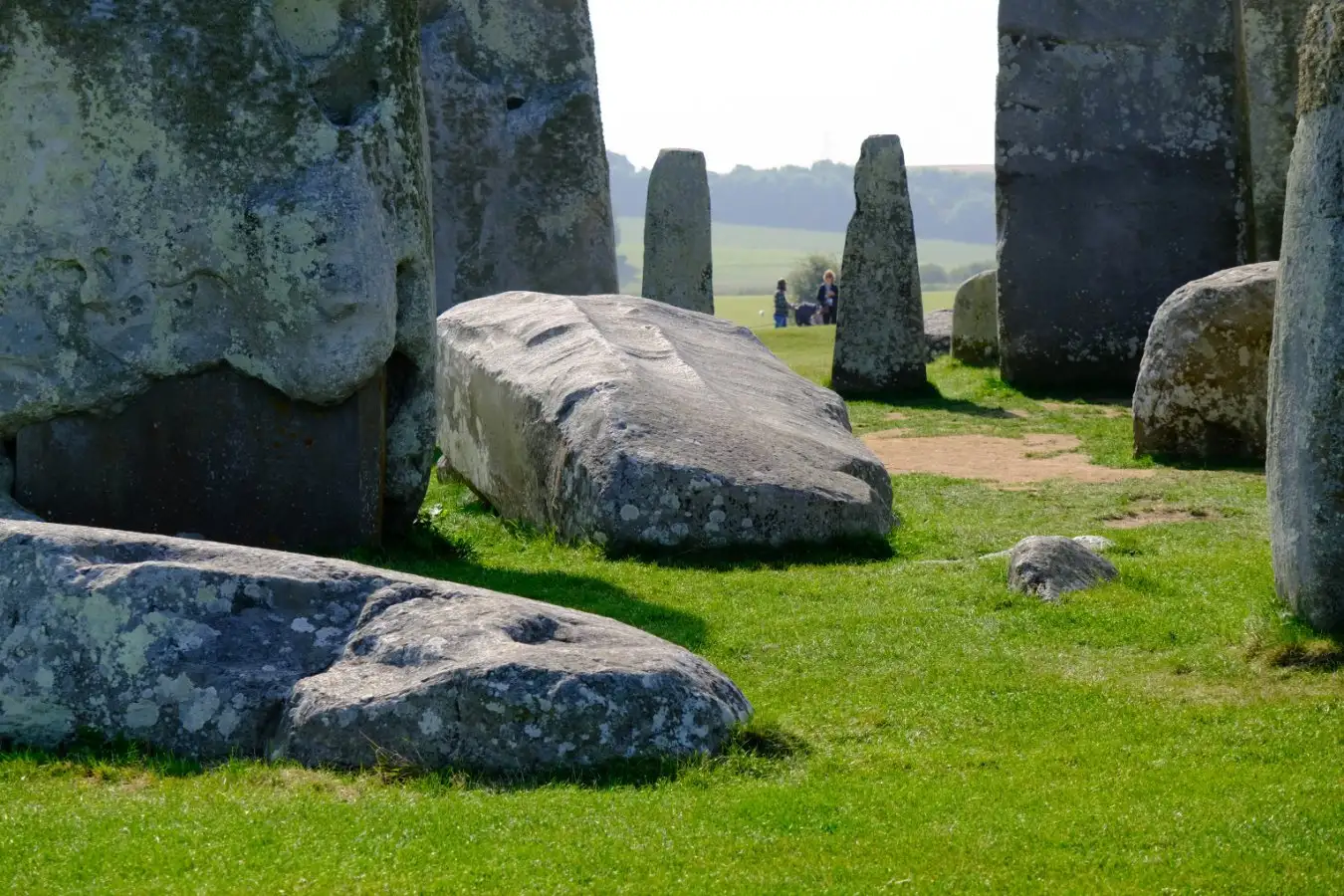

Most of the 5-meter-long altar stone is buried in the center of Stonehenge.
Laurence Berger/Getty Images
Researchers examining the origins of the enigmatic altar stone at Stonehenge suggest that this six-ton stone may have been transported south from Scotland by glaciers, although this theory depends on an improbable series of events. It is more plausible that humans moved the stone.
This impressive 5-meter monolith, partially buried and flanked by two other stones, has resided at the center of Stonehenge’s worked rock ring for approximately 4,500 years.
In 2024, Anthony Clarke and researchers from Curtin University in Perth, Australia, concluded that the altar stones originated from northeastern Scotland, based on detailed chemical analysis of the rocks.
“The altar stone is sandstone. Think of crushed grains of sand from a beach,” Clarke explains. “We can fingerprint the age and chemical composition of these particles and forensically compare them to other rocks throughout the UK and Ireland.”
The chemical analysis indicated that the stone matched an outcrop in the Orcadian Basin, a geological feature spanning parts of northeastern Scotland, implying that the stone was transported 750 kilometers south to Stonehenge in southern England.
Initially, Clarke and his team considered that the stones were likely brought in by boat. However, they also theorized that glaciers during the last ice age might have relocated the stones closer, thereby optimizing the distance humans needed to transport them.
Using geological analysis and ice flow modeling, Clarke and his colleagues reconstructed the movement of ancient glaciers. They discovered that while most ice flow from northeastern Scotland moved northward, some icy masses might have flowed southward, depositing rocks onto Dogger Bank. During the last ice age, Dogger Bank was a land bridge linking Britain to mainland Europe, now submerged beneath the North Sea off England’s eastern coast.
If glaciers did carry the altar stones to Dogger Bank, the distance humans would have needed to haul them could have been significantly reduced.
However, Dogger Bank was flooded around 8,000 years ago, while the construction of Stonehenge began approximately 5,000 years ago. Therefore, the hypothesis that glaciers transported the altar stones involves a complex array of conditions, as Clarke noted.
Notably, other stones in Stonehenge weigh between 25 and 30 tons and were moved by humans over tens of kilometers. Given sufficient time, they would have possessed the skills and determination to transport the altar stone further, according to Clarke.
“The creators of Stonehenge were not in a rush. Similar to the construction of the pyramids, this could have been a gradual endeavor lasting many years,” he explains.
Researchers aspire to conduct more sampling, aiming to identify the precise quarry or outcrop from which the altar stone originated. Yet, the motivation behind such a monumental undertaking may remain a mystery, as Clarke speculates.
“Why pick Italian marble for your kitchen?” he questions. “What drives us to choose specific pieces of jewelry? Humans have always sought suitable stones, and for some reason, British monuments seem to require sandstone from northeastern Scotland.”
Topics:
Source: www.newscientist.com