


James Webb Space Telescope Finds Closest Pair of Supermassive Black Holes in the Early Universe
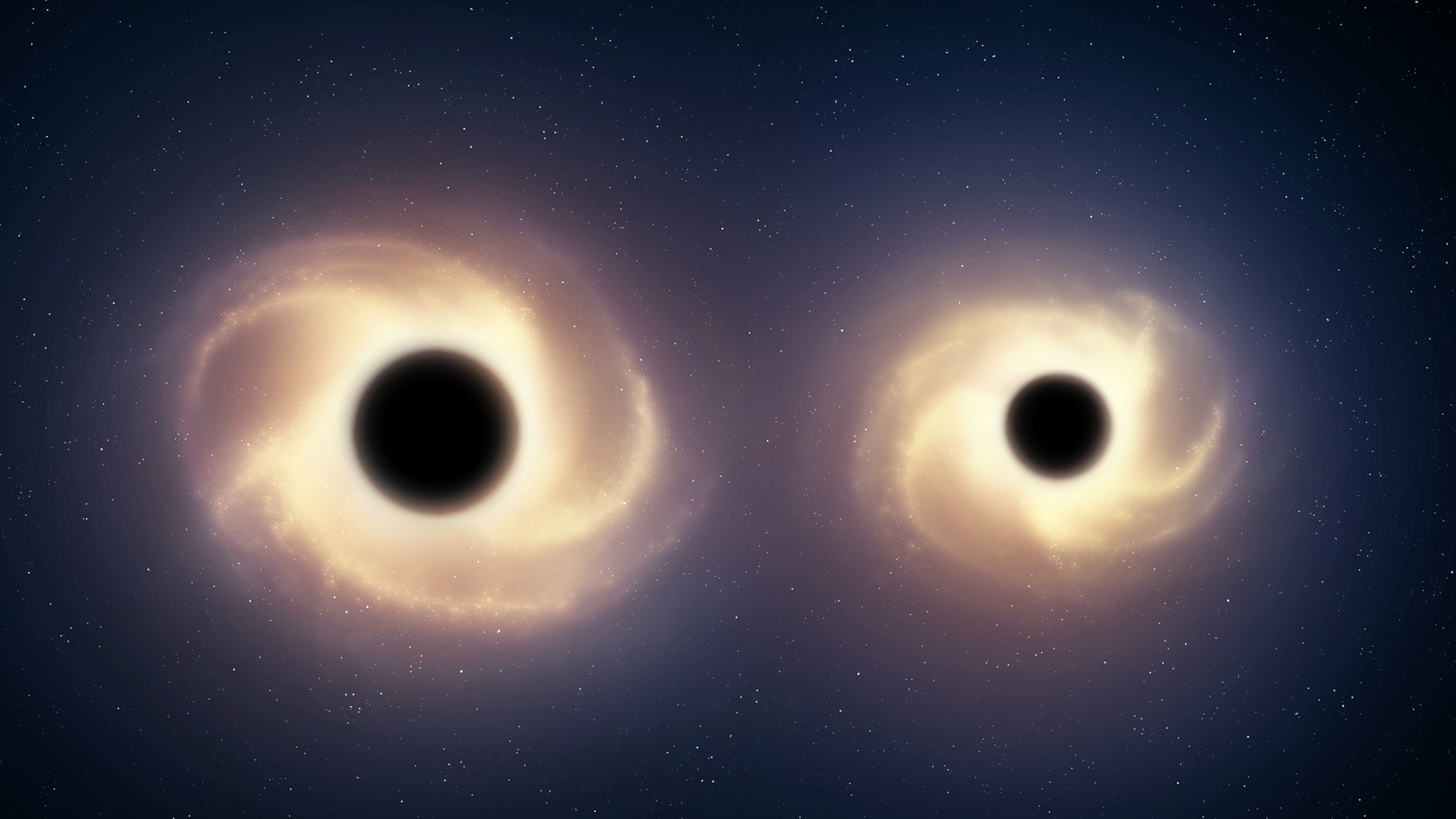
Astronomers have discovered a remarkably close pair of actively feeding supermassive black holes in the early universe. Known collectively as LID-1166, the black holes were observed when the universe was only about 1.3 billion years old.
The two black holes are separated by approximately 4,900 light-years, or 1.5 kiloparsecs, inside a galaxy merger. The discovery offers astronomers a rare look at a key stage in the evolution of supermassive black holes and the galaxies that host them.
A rare double black hole system
Most large galaxies are thought to have grown through repeated mergers with other galaxies. Because many galaxies also contain a supermassive black hole at their center, galactic mergers can create systems containing two black holes.
These binary or dual black hole systems are expected to have been common in the early universe. However, they are difficult to detect because they can be hidden within dense clouds of gas and dust. Their enormous distances and relatively small separation also make it challenging to observe the black holes individually.
In a new study uploaded to the arXiv preprint server on July 21, Seo Hye Won and colleagues reported the discovery of the closest confirmed pair of actively feeding black holes identified so early in cosmic history. The study has been accepted for publication in Nature Astronomy.
The research team used the James Webb Space Telescope (JWST) and the Atacama Large Millimeter/submillimeter Array (ALMA) in Chile to investigate LID-1166. Together, the observatories revealed evidence that both objects are active galactic nuclei, or AGNs—bright regions powered by material falling into supermassive black holes.
“What makes this discovery special is that we may be witnessing these two black holes growing and interacting in a system only about 1.3 billion years after the Big Bang,” Anna Trindade Falcão, an astrophysicist at NASA’s Goddard Space Flight Center who was not involved in the study, told Live Science.
JWST reveals two active black holes
LID-1166 originally attracted attention as an X-ray source in the Chandra COSMOS Legacy survey, although it was not detected even in the survey’s deepest observations. Strong emissions from the system suggested that intense activity could be taking place behind layers of gas and dust.
To determine the source of those emissions, astronomers used JWST’s near-infrared spectrograph, known as NIRSpec. The instrument identified two compact, luminous sources separated by roughly 4,900 light-years.
Other possible dual black hole systems have been observed at earlier points in the universe’s history, but the objects in those systems were separated by tens of thousands of light-years or more. LID-1166 is significant because its two active black holes are much closer together.
“This discovery was only possible thanks to the superior imaging and spectroscopic capabilities of JWST, especially its NIRSpec instrument,” Roberto Decarli, an astronomer at Italy’s National Institute for Astrophysics in Bologna, told Live Science. “Because Earth’s atmosphere is not very transparent at these wavelengths, similar observations from the ground would be extremely difficult.”
Evidence points to two separate black holes
Both sources displayed spectral signatures associated with rapidly rotating gas. These signals indicate that each black hole is actively consuming surrounding material and powering the merging galaxy system.
The researchers also tested multiple methods for removing light from the host galaxy. The second source remained visible after each correction, providing important evidence that it was a genuine object rather than an artifact caused by the surrounding galaxy’s light.
However, additional observations and analysis will be needed to confirm the interpretation beyond doubt. Astronomers must ensure that the signal does not instead represent a single black hole surrounded by complex structures or unevenly distributed light.
“This discovery was only possible thanks to the superior imaging and spectroscopic capabilities of JWST, especially its NIRSpec instrument.”
Roberto Decarli, astronomer at the Italian National Institute for Astrophysics
ALMA observations provided further support for the dual-AGN explanation. The radio observatory detected large reservoirs of cold gas associated with both objects. According to Decarli, this finding indicates that the system contains two active galactic nuclei at the centers of two galaxies that are in the process of merging.
The gas surrounding both black holes also helped researchers rule out alternative explanations. For example, a black hole expelled from its host galaxy during a merger—or ejected through a chaotic interaction involving three black holes—would be expected to travel rapidly without the surrounding gas and material normally associated with a galactic center.
How supermassive black holes grew so quickly
The LID-1166 system could help solve one of the biggest mysteries in astronomy: how supermassive black holes became so massive so soon after the Big Bang.
One leading explanation is that gas from the outer regions of young galaxies flowed toward their centers, providing fuel for rapid black hole growth. Galaxy mergers may have accelerated this process by funneling additional gas into the central regions.
“The cannibalization of other galaxies is also part of this process,” Decarli explained. “But what if those galaxies also have massive black holes at their centers? Studying systems such as LID-1166 will help us understand how galaxies and their central black holes grow together.”
The basic idea that early galaxies merged and brought their central black holes together has been predicted by theory for decades. What makes LID-1166 unusual is that astronomers have now resolved the process in a pair separated by only 1.5 kiloparsecs.
Future JWST and ALMA observations could reveal more about the system’s mass, structure and eventual evolution. They may also help astronomers uncover a larger population of hidden dual supermassive black holes in the early universe.
How much do you know about black holes? Take the black hole quiz.
Topics
Source: www.livescience.com