


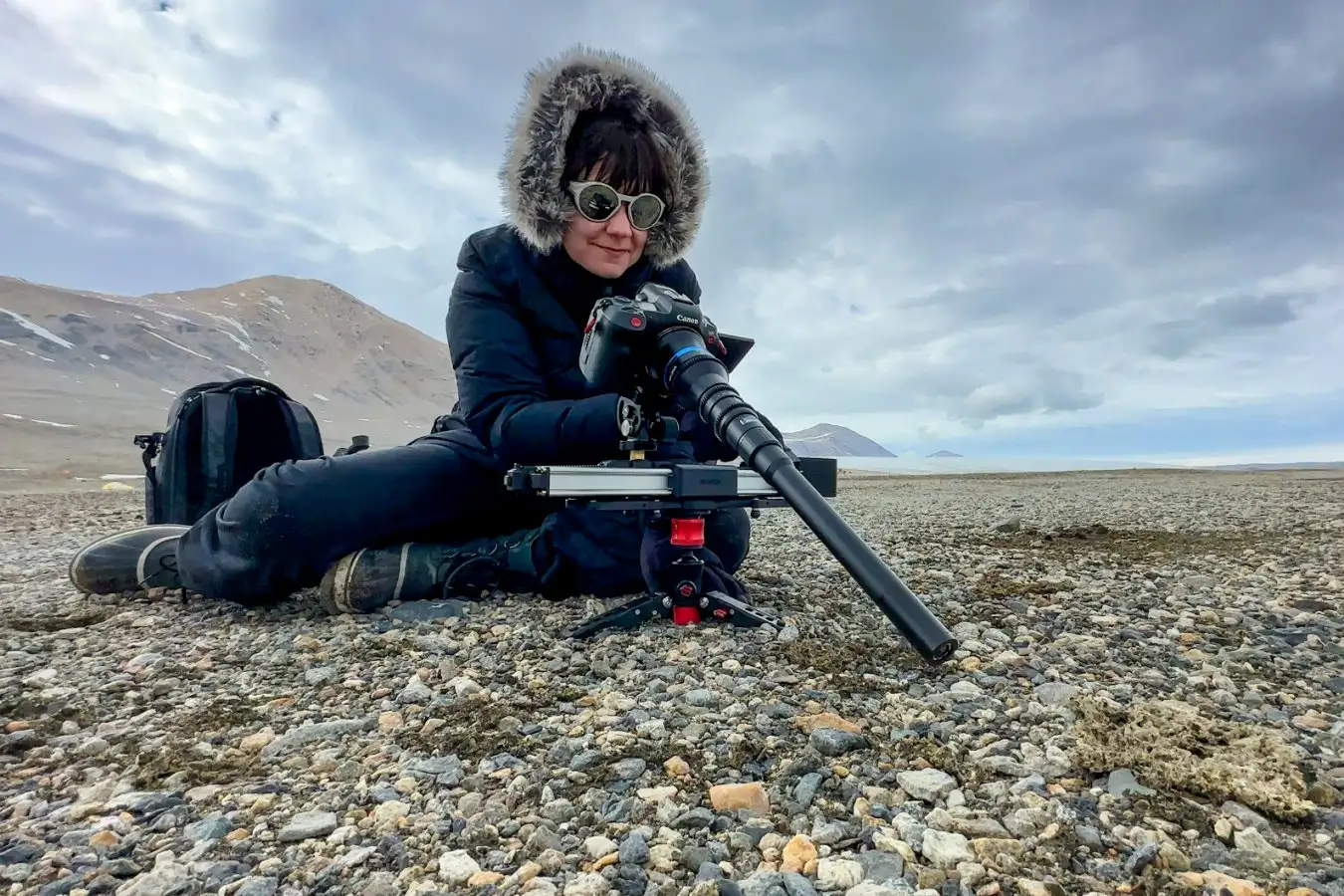

Ariel Waldman used a macro probe lens to photograph microbial mats in an Antarctic desert valley.
Credit: Ariel Waldman
Ariel Waldman stands amidst a landscape reminiscent of Mars, with rocky fragments and barren soil underfoot. Jagged mountains glisten above, dusted with ice, while a distant sun casts a hazy glow. However, she is not on another planet; instead, she’s in the stark, dry valleys of Antarctica. In her groundbreaking documentary series, Unearthed Life, she may just convince you that Earth holds secrets more alien than you realize.
Waldman’s six-episode series, available on PBS and YouTube, delves into the microscopic worlds nestled beneath our Earth’s surface. As a member of a soil science team on our planet’s southernmost continent, she brings along a macro probe lens, a drone, and complex camera mounts, capturing the obscure wildlife that thrives in these extreme conditions. Her documentary offers a compelling glimpse into ecosystems rapidly changing due to climate change.
From the seemingly desolate canyons of Antarctica to the vibrant swamps of North America, Waldman introduces us to the incredible yet tiny creatures like nematodes, rotifers, and tardigrades. These essential species, often invisible to the naked eye, play crucial roles in nourishing our ecosystems. Remarkably, she filmed her Antarctic expedition entirely solo.
In her quaint San Francisco office filled with microscopes and photographic gear, Waldman shares her motivation: documenting the fragile environments of Antarctica and the prairies before they potentially vanish. “To truly capture the essence of nature in places like Antarctica’s dry valleys, one must utilize a microscope,” she explains. “Similarly, in the prairies, most biomass is hidden deep within the moist ground.”
As the official curator of the San Francisco Microscopy Society, she aims to popularize the notion of examining dirt through a microscope, akin to how we peer at the sky with telescopes. This fascination with the microscopic world ties into her interest in finding life beyond our atmosphere. In Unearthed Life, she showcases tardigrades in action as they navigate plant cells, showcasing their ability to survive in extreme environments, including the vacuum of space.
I first encountered Waldman during her time at NASA, where she founded Space Hack, an initiative connecting citizen scientists with space exploration endeavors. She introduced me to the concept of CubeSats, DIY satellites designed for orbit insertion, and later organized Science Hack Day, fostering collaboration between scientists and hobbyists on various projects. Our friendship has flourished as I’ve tracked her eclectic career merging science, art, and community engagement.
On the eve of her departure to Antarctica, Waldman’s primary concern was efficiently packing her equipment. With a background in graphic design, she aspires not only to study the planet but to showcase its wonders, urging others to obtain inexpensive microscopes and explore. “If people witness the rich diversity of life, we can empower them to advocate for its conservation,” she emphasizes.
Inspired by Eames’ iconic 1977 short film 10 Powers, Waldman views scale as a critical perspective in understanding our universe. Thus, she incorporates aerial drones and cameras designed for exploring hard-to-reach areas, illustrating the vastness of life—often concealed without technological aid.
Ultimately, Waldman hopes Unearthed Life motivates viewers to embrace microscopy and examine the unseen wildlife beneath their feet. To truly appreciate the marvels of nature, one must first take that closer look.
Topics:
Source: www.newscientist.com