


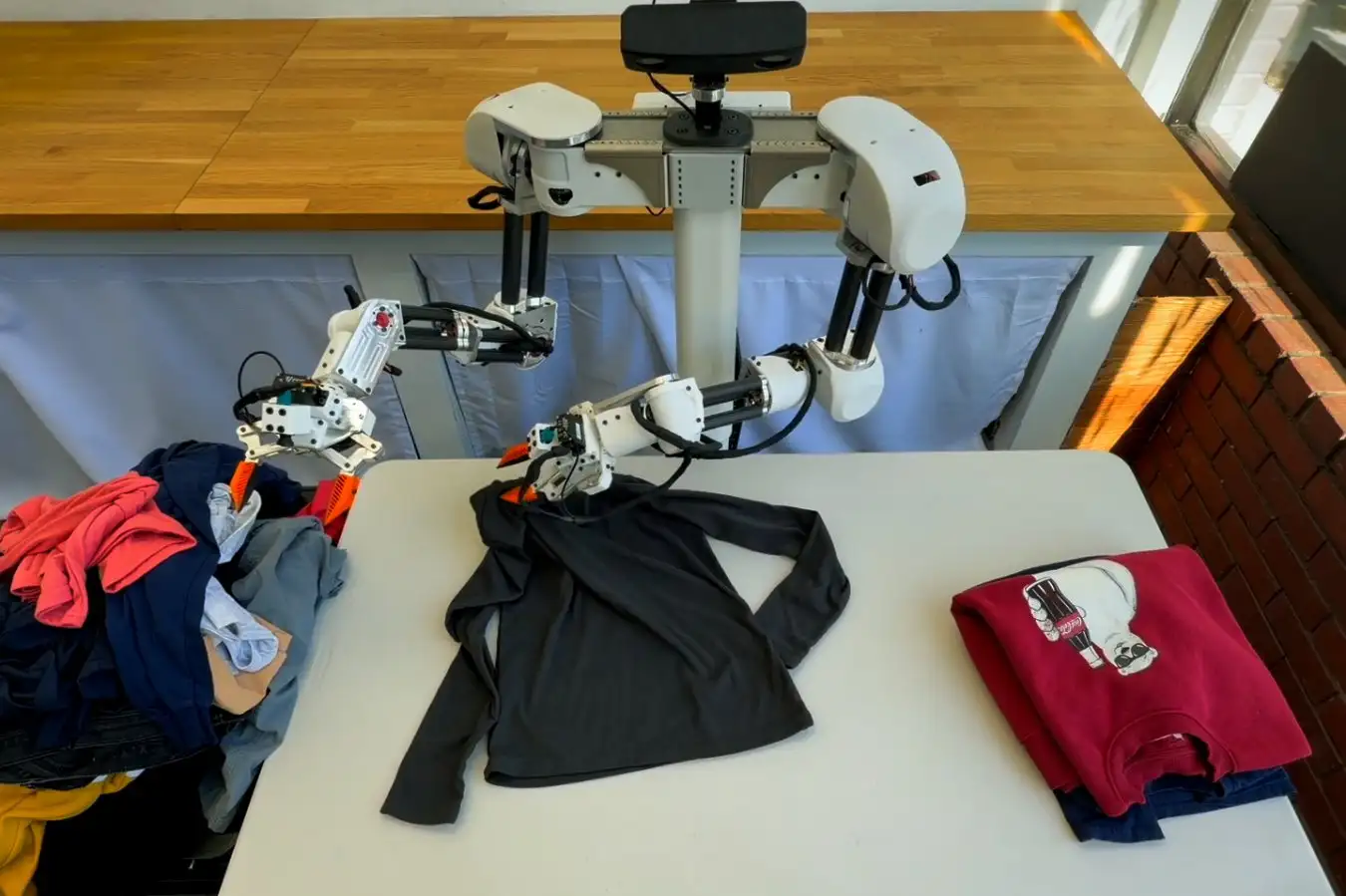

AI-Powered Laundry Folding Robot by Physical Intelligence
Physical Intelligence
In San Francisco, we encountered freshly brewed coffee prepared entirely by robots within a sleek, steel-clad warehouse. While robots have been making coffee for over a decade, the intelligence behind this coffee-making robot extends beyond just one task; it can fold laundry, peel vegetables, and clean kitchens—abilities comparable to a toddler’s developmental milestones.
Founded in 2024, Physical Intelligence envisions a future where robots seamlessly integrate into our daily lives, learning to perform diverse tasks. The startup’s goal is to create adaptive control systems capable of operating multiple tasks across various machines—much like Tesla’s humanoid robots or Amazon’s factory automation systems.
General robot intelligence is an age-old concept among robotics researchers, often viewed as a long-term aspiration. Yet, the explosive growth of large language models (LLMs) that powered AI chatbots in the early 2020s has set a precedent for potential breakthroughs in physical intelligence and robotics.
“In most fields, solving more problems often complicates things, but with AI, it simplifies because it learns from diverse knowledge sources,” says Sergei Levin from UC Berkeley, a founder of Physical Intelligence.
The emergence of Vision-Language-Action (VLA) models represents a significant advancement in robotic AI. Instead of training robots on one skill at a time, VLA leverages LLM’s broad knowledge to convert general requests into specific actions, enabling robots to follow instructions and execute various tasks. According to Ingmar Posner from Oxford University, “[VLAs] perhaps embody the excitement generated by large-scale language models” by predicting the necessary robot movement to complete tasks.
Training robots poses immense challenges; real-world tasks feature nearly infinite variations and robots operate on limited data. While automating learning might seem promising, developers have often avoided it due to data collection difficulties, as Levine notes: “In practice, the work needed to gather data exceeds that required for manual operations.”
By utilizing VLA, Levine and his team aim to minimize the data needed for robust robotic training. In an inside tour of the company’s boardroom, they were instructing robots on simple chores like folding shirts and placing pillows on shelves. The facility includes weekly-renovated spaces mimicking real-life environments, such as supermarkets and kitchens, where physically intelligent robots can learn to adapt to various scenarios. They are even experimenting with robots in genuine home settings to observe their interactions with real-world challenges.

Physical Intelligence: A Transformation in Robotics
ALEX WILKINS
This variety enables remarkable advancements such as robots learning to generalize from tasks previously unencountered. For example, a recent model called π0.7 successfully cooked sweet potatoes in an air fryer by following step-by-step human instructions, even though it had never used an air fryer before.
Levine expresses amazement at the accelerated progress of Physical Intelligence during its two-year journey: “The pace has exceeded our expectations.”
Other players in the field are taking notice. Numerous well-capitalized startups, as well as established giants like Amazon and Google DeepMind, are striving to develop their iterations of versatile robotics.
While current advancements are promising, the speed of future developments remains uncertain. Despite rapid growth from AI companies like OpenAI and Anthropic, robotics firms often encounter slower advancements. All robotics researchers are familiar with Moravec’s paradox, which highlights the disparity between a robot’s ability to master games like chess versus its challenges in acquiring fundamental perception and motor skills.
Posner notes the uncertainty surrounding the data requirements for readying Physical Intelligence robots for real-world applications. “Currently, we see early indicators of potential breakthroughs, yet it’s uncertain if this is the definitive pathway,” he remarked. He adds that real-world settings may expose robots to formidable challenges, stating, “Humans are often playful with technology, and while it is engaging, does that translate into a profitable business model? I remain skeptical.”
Topic:
Source: www.newscientist.com