


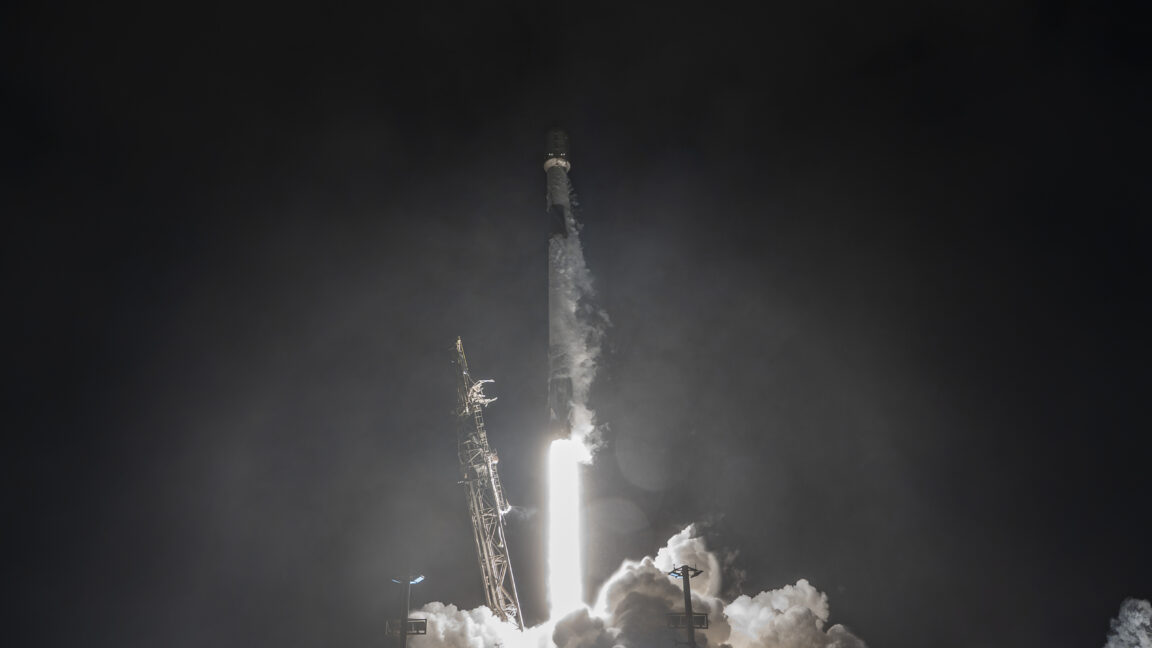
Blue Origin’s accelerating New Glenn program and rising U.S. military launch demand could reshape the outlook for the launch market, although Quilty has taken a conservative approach in its forecast. The firm expects eight New Glenn launches in 2028, 12 in 2029, and 16 in 2030, while the U.S. Space Force has sharply increased projected demand for national-security missions.
Blue Origin’s New Glenn could change the outlook
One factor that could mitigate the forecast is the rapid increase in the launch cadence of Blue Origin’s New Glenn rocket. Henry said Quilty has adopted a conservative projection of eight New Glenn launches in 2028, followed by 12 in 2029 and 16 in 2030.
“I’d be happy to be proven wrong,” he said. “And Blue has been in development for so long that they could come out of the gate with a bang.”
Henry noted that Blue Origin is developing production capacity for up to 150 upper stages per year. However, he said it will take time for the company to launch such large rockets at a consistently high rate.
Military launch demand is another wildcard
The U.S. military is another major uncertainty in the launch market. The current phase of the National Security Launch Program has two lanes. Lane 1 covers missions with a higher risk tolerance, and any company with one successful rocket launch is eligible to bid for those missions.
At present, Lane 1 includes SpaceX’s Falcon rockets, Blue Origin’s New Glenn, and United Launch Alliance’s Vulcan. A new generation of medium-sized rockets is expected to join the group within the next year or two. Lane 2 is reserved for SpaceX and United Launch Alliance.
Earlier this year, the U.S. Space Force announced a significant increase in its demand forecasts. The estimate for Lane 1 rose from 30 to 60 launches to approximately 170 launches, while the Lane 2 estimate increased from 54 launches to 79 launches. These missions are expected to be ordered between 2025 and 2029.
Henry said Quilty’s calculations do not include this surge in military launch demand because he believes the U.S. military can require SpaceX to conduct launches it considers national priorities. He also said SpaceX is already building a number of the satellites for the space-based airborne moving target beacon constellation.
“The U.S. government will force them to do this,” Henry said. “SpaceX has already built a significant number of these satellites.”
Source: arstechnica.com