


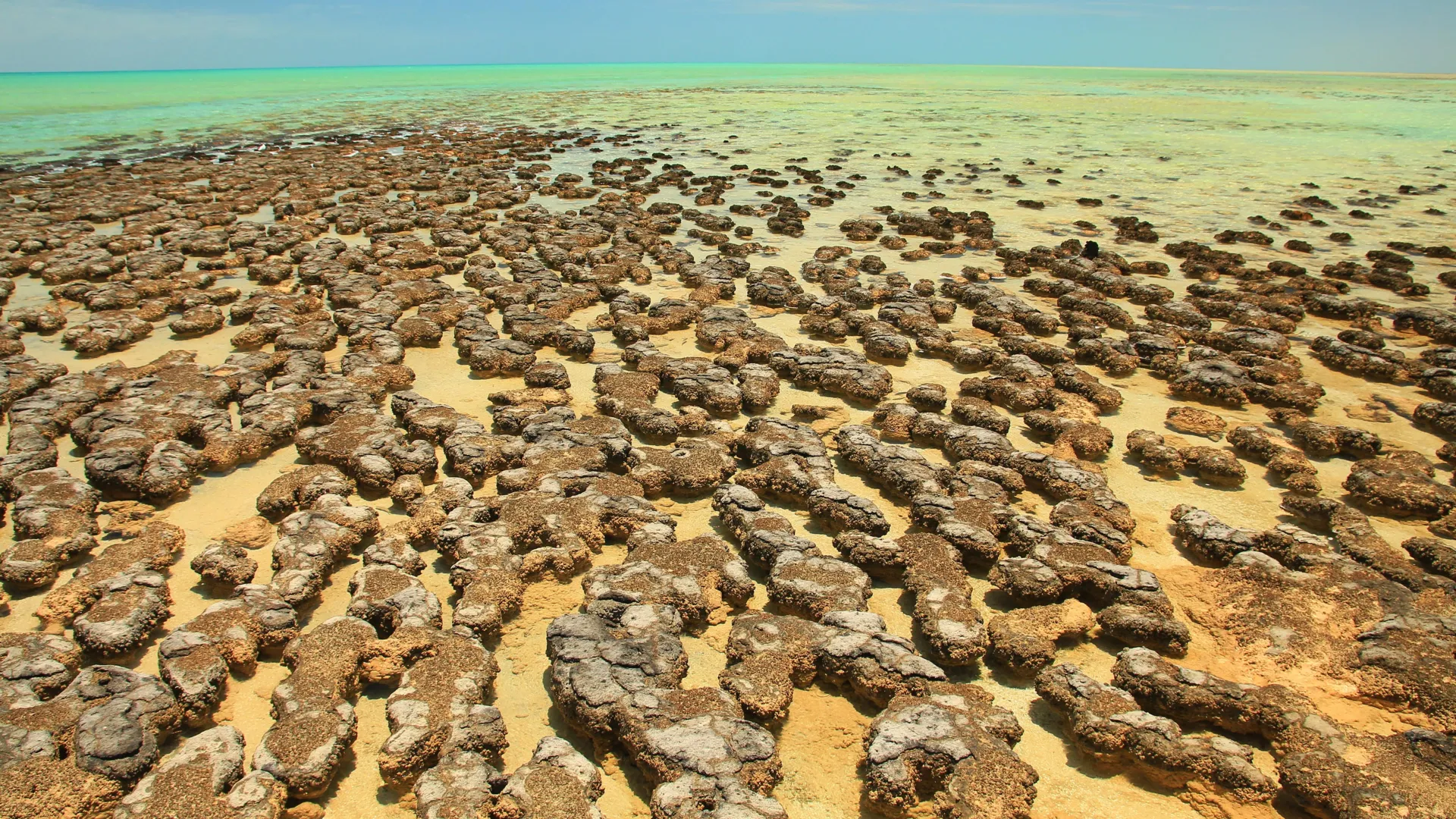
At first glance, stromatolites and their close relatives, microbial mats, may look like dark, ancient rocks. In reality, these formations are complex, layered communities built by microorganisms—and they may offer important clues about the evolution of complex life.
Billions of years ago, long before animals and plants appeared, stromatolites helped release some of the earliest oxygen into Earth’s atmosphere. Now, a study published in Current Biology suggests that these remarkable geological formations may also reveal how complex life first emerged.
Associate Professor Brendan Burns, an evolutionary microbiologist at UNSW Sydney, is part of a research team that discovered previously unknown microorganisms living in close association with other organisms inside these “living fossils.” The research, conducted with scientists from the University of Technology Sydney and the University of Melbourne, could help answer one of biology’s biggest questions: how simple cells began cooperating and eventually evolved into the complex cells that make up plants, animals, and humans.
“Stromatolites may be more than just the cradles of life where early microorganisms flourished,” says Associate Professor Brendan Burns.
“They may also provide clues about how complex life first arose.”
A microbial partnership with ancient roots
Stromatolites and microbial mats first appeared billions of years ago, but they have never completely disappeared. Today, they still form in the waters of Shark Bay in Western Australia, a World Heritage-listed site known for its ancient microbial ecosystems.
Samples collected at Shark Bay enabled Burns and his colleagues to isolate members of the Asgard archaea, a rare group of microorganisms thought to be closely related to the ancestors of eukaryotes—the cells that make up all plants, animals, and humans.
One long-standing theory in evolutionary biology proposes that the first eukaryotic cells developed through a close partnership between ancient archaea and bacteria. According to this theory, one organism eventually engulfed the other, creating a relationship that led to the development of mitochondria, the energy-producing structures found inside complex cells.
However, scientists have had little direct evidence of what these early microbial partnerships looked like. The new study provides the first visual evidence that Asgard archaea physically interact with bacteria through extremely thin, tube-like connections known as nanotubes.
“This may provide a small-scale model of how these partnerships began and eventually contributed to the formation of eukaryotic cells,” says Associate Professor Brendan Burns.
Years spent growing an elusive microorganism
Genetic sequencing confirmed the presence of microbial DNA in the Shark Bay samples. However, growing the microorganisms in the laboratory so they could be studied directly proved to be a major challenge.
“It took four or five years in the lab,” Burns says. “We spent a great deal of time optimizing the conditions and tracking different strains.”
Asgard archaea are notoriously difficult to cultivate outside their natural environment. The researchers were unable to grow the microorganism in isolation, and that challenge may reveal an important feature of its biology.
“The fact that we haven’t been able to create pure cultures of these organisms is probably because they depend on other microorganisms to survive,” Burns says.
The team ultimately advanced its research using electron cryotomography, a high-resolution 3D imaging technique capable of revealing structures at the scale of one-millionth of a millimeter.
The images showed archaea and bacteria physically connected by bacterial nanotubes. Researchers also observed that the archaea produced chains of budding vesicles and complex tubular structures. The two microorganisms appear to complement one another chemically, producing compounds—including vitamins, nutrients, and hydrogen—that can be used by other microbes.
Co-author Associate Professor Debnath Ghosal from the University of Melbourne said directly capturing interactions between Asgard archaea and bacteria was particularly important.
“This discovery brings us several steps closer to understanding how complex cells evolved from relatively simple microbial life forms,” Professor Ghosal said.
An ancient cellular machine emerges
Co-author UNSW Associate Professor Kate Mitchie said the research team also used deep learning, a form of machine learning, to analyze the microorganisms.
“We used deep learning to predict the structure of proteins in these microorganisms,” Associate Professor Mitchie says.
“That is exciting because we are beginning to see ancient versions of cellular machinery that later became central to complex life.”
Burns describes the archaea as “friends.” Life inside microbial mats can be harsh, and close cooperation between microorganisms may provide important survival advantages, even at the microscopic level.
A living window into early Earth
Co-author Associate Professor Ian Duggin from the University of Technology Sydney said it was remarkable to consider that microorganisms could have maintained partnerships like these over immense periods of time in environments resembling parts of early Earth.
“It’s like we’ve slowly risen from the bottom of the ocean,” Professor Duggin says.
The newly identified archaeon has been named Nereacium marmarmayae. Its name combines a reference to the Margana language with the name of the ancient Greek sea god Nereus. Marmarmayae means “ancient house.”
Margana is one of the traditional languages spoken by the people of central Shark Bay, whose connection to Country is recognized through Indigenous title. Margana Elders, rangers, and local residents continue to care for Shark Bay Country by protecting wildlife and restoring the land.
Shark Bay also has a long Indigenous history, with Indigenous people first settling in the region approximately 30,000 years ago.
Celebrating Shark Bay’s Margana heritage
The microbial naming process included consultation with Kimberly Oakley, a leading expert in the Margana language. The researchers also worked with Margana Elders to identify language that could be used respectfully in the organism’s scientific name. The Elders approved the inclusion of Margana language to recognize and celebrate the culture connected to Shark Bay.
For scientists, Shark Bay’s microbial communities provide a rare opportunity to study conditions that may resemble those found on early Earth. For Traditional Owners, the same environment represents a living cultural heritage that continues to be protected and valued.
Associate Professor Burns now hopes to identify additional microbial partnerships, expanding what he calls the “little primordial Asgardian soup” and providing scientists with more pieces of the puzzle surrounding the early evolution of complex life.
“But it’s not just about biology,” he says. “This is also about people. It’s a major interdisciplinary collaboration, with many graduate students helping to build this story.
“What makes this exciting is that it’s not just a discovery—it’s a connection. It connects us not only across time, but also to a present in which these fragile ecosystems face increasing threats from climate change and human activity.”
The findings also highlight how strongly survival can depend on cooperation between organisms. Burns says that lesson remains just as important today.
“These microbes remind us that even our smallest partners can leave the deepest imprints on our history.”
Source: www.sciencedaily.com