


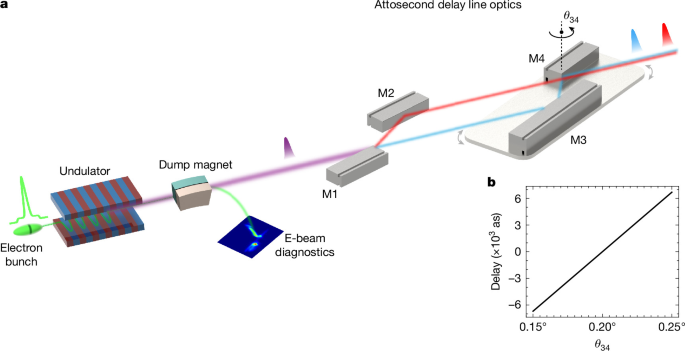
Attosecond science uses light pulses lasting less than one femtosecond to track electron motion in atoms, molecules and materials. The references provided trace the field’s development from high-harmonic generation and the first observations of attosecond pulse trains in 2001 to increasingly powerful X-ray free-electron lasers (XFELs), including isolated attosecond hard-X-ray pulses, pump–probe spectroscopy and studies of electron dynamics in water, molecules and solids. They also document advances in pulse shaping, nonlinear compression, timing, coherence, detection and high-repetition-rate operation through 2026.
From high harmonics to attosecond pulses
The theoretical foundations of attosecond physics include the study of high-harmonic generation in low-frequency laser fields by Lewenstein, Balcou, Ivanov, L’Huillier and Corkum in 1994. Antoine, L’Huillier and Lewenstein later described attosecond pulse trains produced with higher harmonics in 1996.
In 2001, Paul and colleagues reported the observation of an attosecond pulse train generated by high-harmonic generation. In the same year, Hentschel and colleagues reported attosecond metrology, establishing methods for measuring pulses on these extremely short timescales. These developments helped launch attosecond science as a way to investigate electronic motion directly.
X-ray free-electron lasers extend attosecond research
XFELs provide intense, tunable X-ray pulses that can probe atomic-scale structure and dynamics. Research cited in the source examines how to produce shorter and more controllable pulses, including single-spike hard-X-ray pulses, coherent sub-femtosecond soft-X-ray pulses and isolated attosecond pulses with gigawatt peak power.
Work published in 2020 demonstrated attosecond pulse shaping with seeded free-electron lasers, while later studies developed timing tools for coherent control of electron wave packets. Other research explored nonlinear compression, temporal shaping of photocathodes, laser-heater shaping and multiplexed XFEL operation. In 2024, Yang and colleagues reported a terawatt-attosecond hard-X-ray XFEL operating at high repetition rate, while Franz and colleagues described terawatt-scale attosecond X-ray pulses from cascaded superradiant free-electron lasers.
The references also include a 2026 report titled “Experimental demonstration of attosecond hard X-ray pulses,” as well as a 2025 study by Prat, Malyzhenkov, Orlandi, Weilbach and Reiche on generating single-spike hard-X-ray XFEL pulses with lower injector charge and a shorter electron beam.
Watching electrons and chemical processes
Attosecond measurements have been applied to electron motion in a range of systems. Studies cited here examine coherent electron motion during Auger–Meitner decay, attosecond delays in molecular ionization and electron screening in transition metals and transition-metal dichalcogenides.
In 2024, Guo and colleagues reported an experimental demonstration of attosecond pump–probe spectroscopy using an XFEL. Lee and colleagues used attosecond pump–attosecond probe X-ray spectroscopy to study liquid water, while Alexander and colleagues investigated attosecond impact-stimulated X-ray Raman scattering in liquid water. A 2025 study by Linker and colleagues reported attosecond inner-shell lasing at ångström wavelengths. In 2026, Zimmermacher and colleagues reported real-space imaging of electron-pair density holes in molecular Auger–Meitner decay, and Driver reported on the attosecond response of molecules to impact ionization.
Measurement challenges and future directions
Because XFEL pulses fluctuate in time, energy and intensity, attosecond experiments require precise characterization and synchronization. The cited work covers the time–energy structure of XFEL pulses, angular streaking for isolated-pulse characterization, X-ray correlation spectroscopy, single-shot transmission spectrometers and detector technology such as the JUNGFRAU readout ASIC.
Other references address direct two-photon absorption, intensity autocorrelation and X-ray nonlinear spectroscopy. These techniques support measurements of pulse duration and temporal structure without relying solely on conventional optical diagnostics. The bibliography also includes work on ultrastable hard-X-ray attosecond split-delay lines and a 2026 roadmap for attosecond science.
References
- Krausz, F. & Ivanov, M. “Attosecond physics.” Reviews of Modern Physics 81, 163–234 (2009). Article
- Lewenstein, M., Balcou, Ph., Ivanov, M. Yu., L’Huillier, A. & Corkum, P. B. “Theory of harmonic generation by low-frequency laser fields.” Physical Review A 49, 2117–2132 (1994). Article
- Antoine, P., L’Huillier, A. & Lewenstein, M. “Attosecond pulse trains with higher harmonics.” Physical Review Letters 77, 1234–1237 (1996). Article
- Paul, P. M. et al. “Observation of a train of attosecond pulses from high harmonic generation.” Science 292, 1689–1692 (2001). Article
- Hentschel, M. et al. “Attosecond metrology.” Nature 414, 509–513 (2001). Article
- Maroju, P. K. et al. “Attosecond pulse shaping using seeded free-electron lasers.” Nature 578, 386–391 (2020). Article
- “Attosecond coherent control of electron wave packets in two-color photoionization using a new timing tool for seeded free-electron lasers.” Nature Photonics 17, 200–207 (2023). Article
- Huang, S. et al. “Generation of single-spike hard X-ray pulses by nonlinear bunch compression in free-electron lasers.” Physical Review Letters 119, 154801 (2017). Article
- Marinelli, A. et al. “Experimental demonstration of a single-spike hard X-ray free-electron laser starting from noise.” Applied Physics Letters 111, 151101 (2017). Article
- Marizhenkov, A. et al. “Monochromatic and bichromatic attosecond hard X-ray free-electron laser pulses with nonlinear compression.” Physical Review Research 2, 042018(R) (2020). Article
- Zhang, Z. et al. “Experimental demonstration of enhancement of self-amplified spontaneous emission by temporal shaping and self-compression of the photocathode in a magnetic wiggler.” New Journal of Physics 22, 083030 (2020). Article
- Duris, J. et al. “Tunable isolated attosecond X-ray pulses with gigawatt peak power from free-electron lasers.” Nature Photonics 14, 30–36 (2020). Article
- Pratt, E. et al. “Coherent sub-femtosecond soft X-ray free-electron laser pulses with nonlinear compression.” APL Photonics 8, 111302 (2023). Article
- Lee, S. et al. “Beam à la carte: Laser heater shaping of attosecond pulses in multiplex X-ray free-electron lasers.” Applied Physics Letters 125, 191101 (2024). Article
- Yang, J. et al. “High repetition rate terawatt attosecond hard X-ray free-electron laser.” Nature Photonics 18, 1293–1298 (2024). Article
- “Experimental demonstration of attosecond hard X-ray pulses.” (2026).
- Prat, E., Malyzhenkov, A., Orlandi, G. L., Weilbach, T. & Reiche, S. “Enhanced generation of single-spike hard X-ray free-electron laser pulses with lower charge in the injector and shorter electron beam.” Physical Review Research 7, L042060 (2025). Article
- Lee, S. et al. “Attosecond coherent electron motion in Auger–Meitner decay.” Science 375, 285–290 (2022). Article
- Driver, T. et al. “Attosecond delays in X-ray molecular ionization.” Nature 632, 762–767 (2024). Article
- Guo, Z. et al. “Experimental demonstration of attosecond pump–probe spectroscopy using an X-ray free-electron laser.” Nature Photonics 18, 691–697 (2024). Article
- Lee, S. et al. “Attosecond pump–attosecond probe X-ray spectroscopy of liquid water.” Science 383, 1118–1122 (2024). Article
- Hartmann, N. et al. “Attosecond time–energy structure of an X-ray free-electron laser pulse.” Nature Photonics 12, 215–220 (2018). Article
- Lee, S. et al. “Characterization of isolated attosecond pulses with angular streaking.” Optics Express 26, 4531–4547 (2018). Article
- Franz, P. et al. “Terawatt-scale attosecond X-ray pulses from cascaded superradiant free-electron lasers.” Nature Photonics 18, 698–703 (2024). Article
- Rohringer, N. et al. “1.46 nanometer subatomic X-ray laser excited by an X-ray free-electron laser.” Nature 481, 488–491 (2012). Article
- Yoneda, H. et al. “Inner-shell laser with a wavelength of 1.5 angstroms excited by an X-ray free-electron laser.” Nature 524, 446–449 (2015). Article
- Driver, T. “Attosecond response of molecules to impactive ionization.” Nature Physics 22, 1459–1466 (2026).
- Mukamel, S. Principles of Nonlinear Optical Spectroscopy, Vol. 6. Oxford University Press (1995).
- Sun, Y., Li, H., Ichii, Y. & Zhu, D. “Ultrastable hard X-ray attosecond split delay lines.” Preprint, arxiv.org/abs/2505.06865 (2025).
- Ding, Y., Huang, Z. & Ocko, S. A. “Lateral coherence properties of FELs in LCLS.” In Proceedings of FEL2010, 151–154. JACoW Publishing (2010).
- Gatto, C. et al. “Single-shot spatial and temporal coherence properties of a SLAC linac coherent light source in the hard X-ray region.” Physical Review Letters 108, 024801 (2012). Article
- Ghimire, S. et al. “Nonsequential two-photon absorption from the K shell in solid zirconium.” Physical Review A 94, 043418 (2016). Article
- Tamasaku, K. et al. “Nonlinear spectroscopy using X-ray two-photon absorption in metallic copper.” Physical Review Letters 121, 083901 (2018). Article
- Osaka, S. et al. “Autocorrelation of hard X-ray intensity using direct two-photon absorption.” Physical Review Research 4, L012035 (2022). Article
- Göppert-Mayer, M. “Über Elementarakte mit zwei Quantensprüngen.” Annalen der Physik 401, 273–294 (1931). Article
- Zhu, D. et al. “Single-shot transmission spectrometer for hard X-ray free-electron lasers.” Applied Physics Letters 101, 034103 (2012). Article
- Bonifacio, R., De Salvo, L., Pierini, P., Piovella, N. & Pellegrini, C. “Spectral, temporal structure, and noise-initiated variations in high-gain free-electron lasers.” Physical Review Letters 73, 70–73 (1994). Article
- Pellegrini, C., Marinelli, A. & Reiche, S. “Physics of X-ray free-electron lasers.” Reviews of Modern Physics 88, 015006 (2016). Article
- Baxevanis, P., Duris, J., Huang, Z. & Marinelli, A. “Time-domain analysis of attosecond pulse generation in X-ray free-electron lasers.” Physical Review Accelerators and Beams 21, 110702 (2018). Article
- Schwartz, S. et al. “X-ray second harmonic generation.” Physical Review Letters 112, 163901 (2014). Article
- Osaka, S. et al. “Background-free intensity autocorrelation of femtosecond X-ray pulses.” Physical Review Letters 136, 195002 (2026). Article
- Zhu, D. & Reis, D. A. “Attosecond X-ray laser vision.” Nature Photonics 18, 1232–1233 (2024). Article
- Alexander, O. et al. “Attosecond impact-stimulated X-ray Raman scattering in liquid water.” Science Advances 10, eadp0841 (2024). Article
- Linker, T. M. et al. “Attosecond inner-shell lasing at ångström wavelengths.” Nature 642, 934–940 (2025). Article
- Zimmermacher, M. et al. “Real-space imaging of electron pair density holes in molecular Auger–Meitner decay.” Nature Physics 22, 1473–1478 (2026). Article
- Volkov, M. et al. “Attosecond screening dynamics via electron localization in transition metals.” Nature Physics 15, 1145–1149 (2019). Article
- Schumacher, Z. et al. “Ultrafast electron localization and screening in transition-metal dichalcogenides.” Proceedings of the National Academy of Sciences of the United States of America 120, e2221725120 (2023). Article
- Barillas, R. B. et al. “A roadmap for attosecond science.” Preprint, arxiv.org/abs/2604.15085 (2026).
- Alonso-Mori, R. et al. “X-ray correlation spectroscopy in a linac coherent light source.” Journal of Synchrotron Radiation 22, 508–513 (2015). Article
- Mozzanica, A. et al. “Characterization results for the JUNGFRAU full-scale readout ASIC.” Journal of Instrumentation 11, C02047 (2016). Article
Source: www.nature.com