


Ancient Meteorite Reveals Magnetic Fields May Have Shaped the Early Solar System
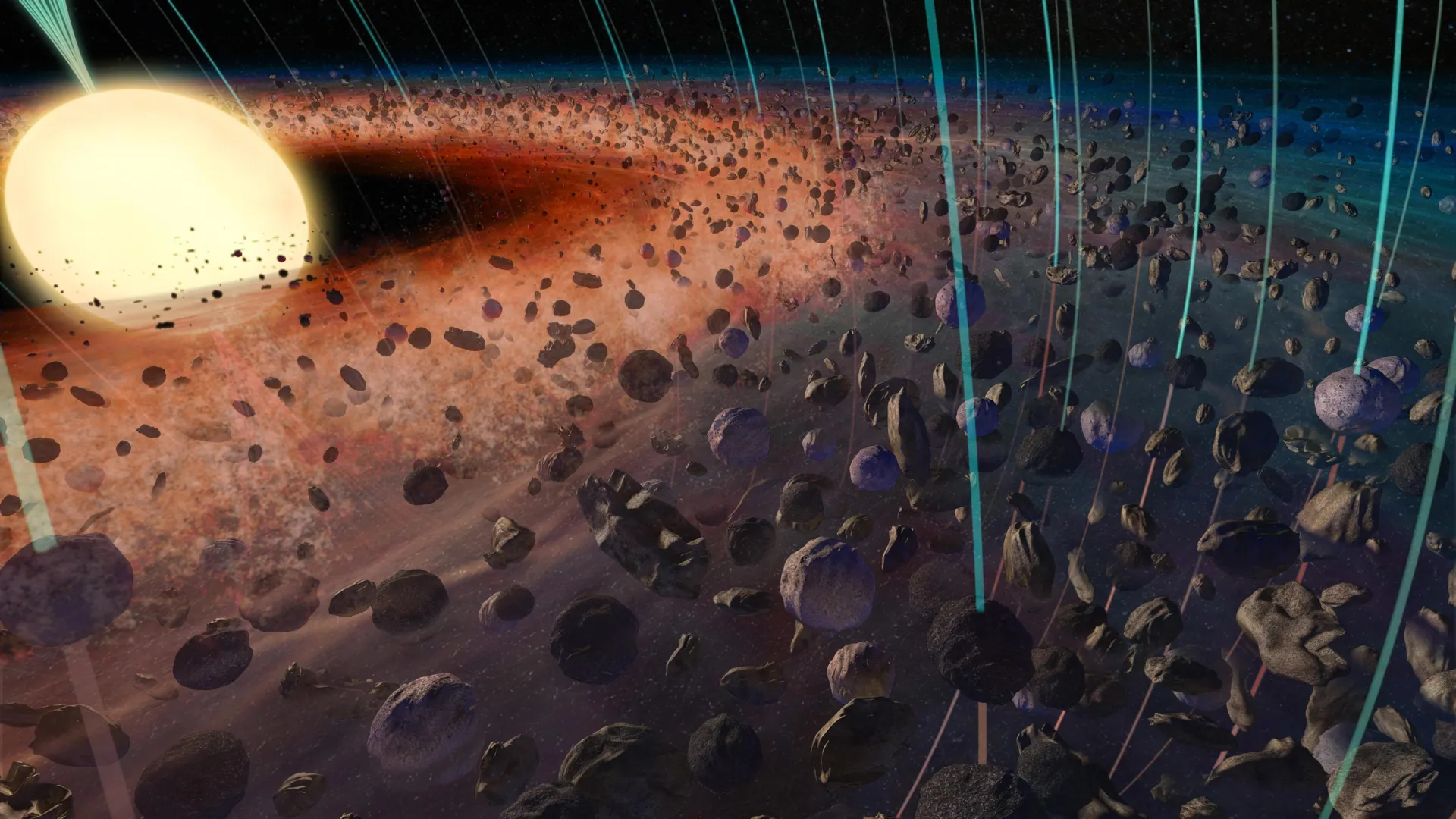
About 4.6 billion years ago, the solar system began as a vast cloud of gas and dust. Over the next several million years, the solar nebula collapsed and flattened into a disk, with the Sun forming at its center and planets developing around it.
Gravity has long been considered the primary force behind this transformation. However, new research from MIT suggests that magnetism may also have played an important role in shaping the early solar system.
Scientists found evidence of ancient magnetic fields preserved in some of the oldest meteorite material ever identified. The researchers studied tiny particles inside a meteorite discovered in Antarctica in 2008. These particles, known as calcium-aluminum-rich inclusions (CAIs), formed during the solar system’s first 200,000 years and are among the oldest known materials from that period.
Their magnetic signatures indicate that a significant magnetic field already existed during the solar nebula stage. Researchers estimate that the field was 150 to 600 microteslas—about 3 to 12 times stronger than Earth’s current magnetic field. It may have helped move primordial material inward as the young Sun formed.
“This transition from a spherical cloud to a protoplanetary disk is one of the most important events in the entire history of the solar system,” says Benjamin Weiss, Robert R. Schrock Professor of Earth and Planetary Sciences at MIT. “This has long been theorized to be caused by gravity, but our measurements show that magnetism is likely involved.”
The findings were published in Proceedings of the National Academy of Sciences. MIT co-authors include first authors Cauê Borlina PhD ’22, Elias Mansbach PhD ’24, and Nilanjan Chatterjee. Other collaborators include Xue-Ning Bai of Tsinghua University; Po-Yen Tung and Richard Harrison of the University of Cambridge; François Tissot of the California Institute of Technology; and Kevin McKeegan of the University of California, Los Angeles.
How Did Magnetism Affect the Early Solar System?
Magnetic fields are created when electrically charged particles move. During the early stages of solar system formation, collapsing clouds of gas and dust may have generated plasma containing charged particles. As those particles circulated through the developing disk, they may have produced and maintained a magnetic field.
If a magnetic field existed, Weiss and his colleagues reasoned, it could have left a permanent imprint on material forming within the disk. When that material condensed, tiny magnetic minerals may have recorded the strength of the surrounding field. If the minerals survived billions of years and eventually reached Earth inside a meteorite, their “remanent magnetization” could provide evidence that magnetism influenced the young solar system.
Researchers had already discovered evidence of magnetism about 2 million years after the solar system began forming. Scientists believe that by then, the Sun had formed and the planets had started to assemble. That earlier research suggested that magnetic fields may contribute to planet formation.
“Nowadays, people don’t debate whether magnetism is present when planets form, but the debate revolves around the very early solar system, before the planets formed, when there was only a disk,” said Borlina, who led the new study as an MIT graduate student and is now an assistant professor at Purdue University. “That’s where the debate still remains, and that’s where we’re operating right now.”
An Unusually Well-Preserved Meteorite
The latest study looked even further back in time, examining whether magnetism existed while the Sun itself was still forming.
The researchers tested samples from the meteorite DOM 08006, discovered in 2008 in the Dominion Mountains, a range along the East Antarctic Ice Sheet. Scientists have extensively studied the meteorite because of its unusually primitive composition.
DOM 08006 contains mineral grains from the earliest stages of solar system formation, likely dating to before the Sun was fully formed. Remarkably, the meteorite retains much of its original mineral composition despite surviving billions of years of solar system history.
“Other meteorites have gone through different processes over their 4.5 billion year history,” Weiss says. “They formed in the solar nebula, were then added to a celestial body with water, then were destroyed, moved to the asteroid belt, and then landed here. But somehow DOM is less altered than any other meteorite.”
This unusual preservation makes DOM 08006 an especially promising source for evidence of magnetic fields in the oldest solar system.
That evidence may be preserved in part of the meteorite’s CAIs.
“We know that they are the oldest we know of from the early solar system,” Borlina says. “But CAI is very complex, and not all meteorite fragments are the same, even one millimeter in size. Therefore, we need to carefully identify what type of CAI it is.”
Early Solar System Magnetic Field Was Stronger Than Earth’s
The research team used small pieces of the meteorite to isolate mineral particles. They identified several CAIs containing naturally occurring magnetic minerals, including iron, and conducted a series of tests to determine whether the particles still preserved their ancient magnetism.
The tests revealed traces of magnetic fields recorded inside the minerals. Based on these measurements, the researchers estimate that the early solar system had a magnetic field of approximately 150 to 600 microteslas—roughly 3 to 12 times stronger than Earth’s magnetic field today.
The results suggest that magnetism may have helped control how material moved through the protoplanetary disk during the formation of the Sun.
“This kind of magnetic field would have helped move gas from the protoplanetary disk toward this central star, the Sun,” Borlina said. “Gravity plays a role, too. But we now have proof that if we want to fully understand how the Sun and planets form, we should include magnetic fields among the components that make them.”
This research was supported in part by NASA.
Source: www.sciencedaily.com