


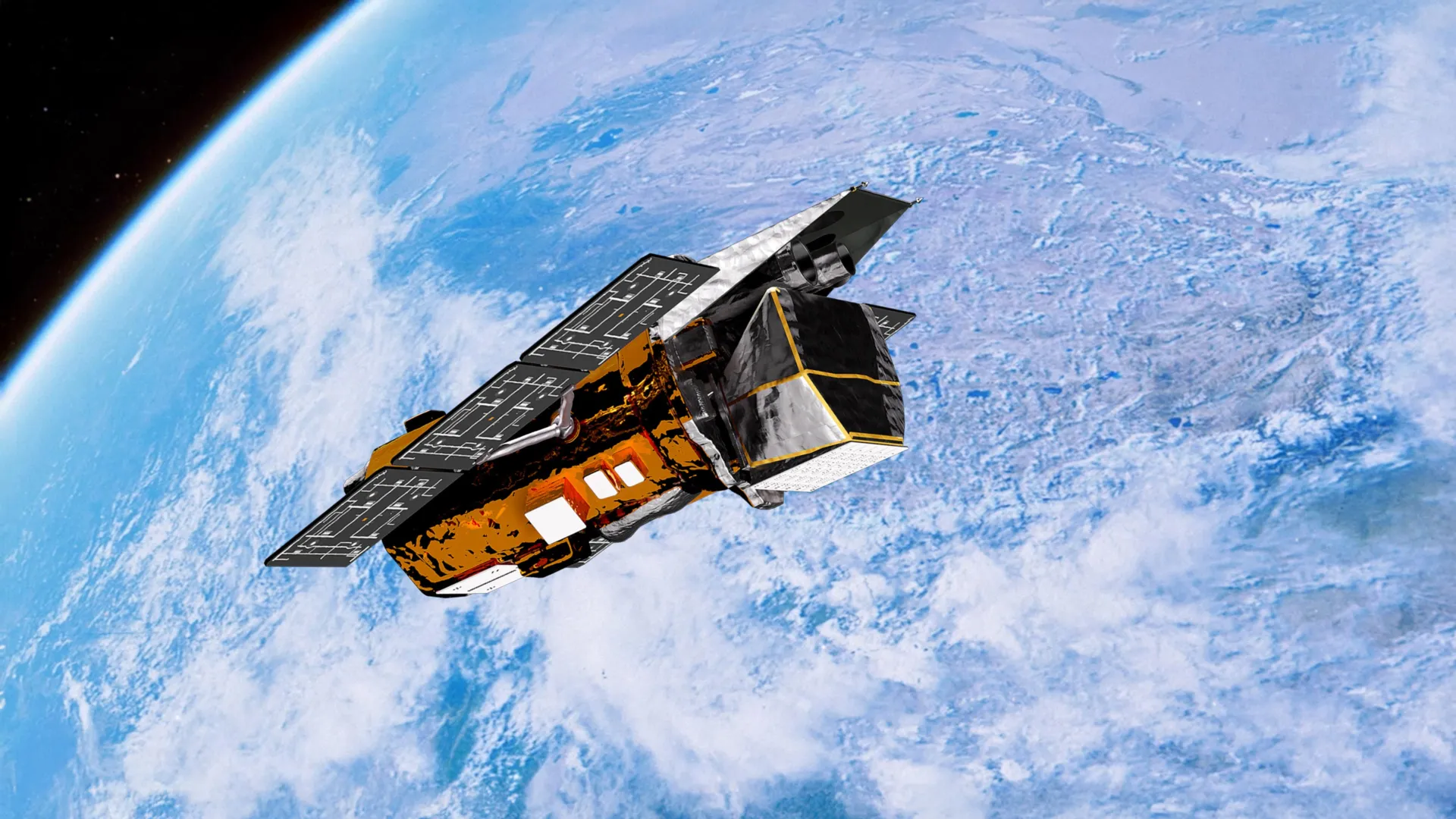
NASA’s Neil Gehrels Swift Observatory re-entered Earth’s atmosphere on Wednesday after nearly 22 years in space, bringing to an end a mission that lasted more than 10 times longer than originally planned. Launched in 2004 to study gamma-ray bursts, Swift became a versatile observatory that helped scientists investigate powerful cosmic explosions, black holes, stellar flares, supernovae, comets and asteroids.
Swift re-enters Earth’s atmosphere
The U.S. Space Command confirmed that Swift entered the atmosphere at 7:39 a.m. ET on Wednesday over North Sumatra, Indonesia. The reported location was approximately 3.4 degrees north latitude and 98.6 degrees east longitude.
NASA expected most of the spacecraft to burn up during atmospheric reentry, although officials acknowledged that some components may have survived the intense heat.
A two-year mission that lasted nearly 22 years
Swift was originally designed to study gamma-ray bursts, extremely powerful flashes of high-energy radiation associated with some of the universe’s most extreme events. These bursts can occur when massive stars collapse or when compact objects such as neutron stars merge.
NASA initially planned to operate the observatory for only two years. Instead, Swift continued making scientific contributions for more than 20 years.
One of its most important capabilities was its ability to respond rapidly to sudden cosmic events. When Swift detected a burst of energy, it could quickly redirect its telescopes toward the source and alert observatories around the world. This allowed astronomers to study short-lived events before they disappeared from view.
Swift also observed multiple wavelengths of light, giving researchers different ways to examine the same event and improve their understanding of the physical processes involved.
From black holes to exploding stars
Over its unusually long lifespan, Swift’s scientific work expanded well beyond its original focus on gamma-ray bursts.
The observatory helped astronomers study active galaxies powered by supermassive black holes, stars that produce powerful X-ray flares, and supernovae—giant explosions marking the deaths of certain stars.
Its observations also extended closer to home, supporting the study of comets and asteroids in our solar system.
Swift’s combination of rapid-response observations and the ability to detect different forms of radiation made it a valuable tool for studying both distant cosmic explosions and nearby objects. Its reentry marked the end of a mission that far exceeded its planned lifetime and contributed to scientists’ understanding of some of the universe’s most energetic phenomena.
Source: www.sciencedaily.com