


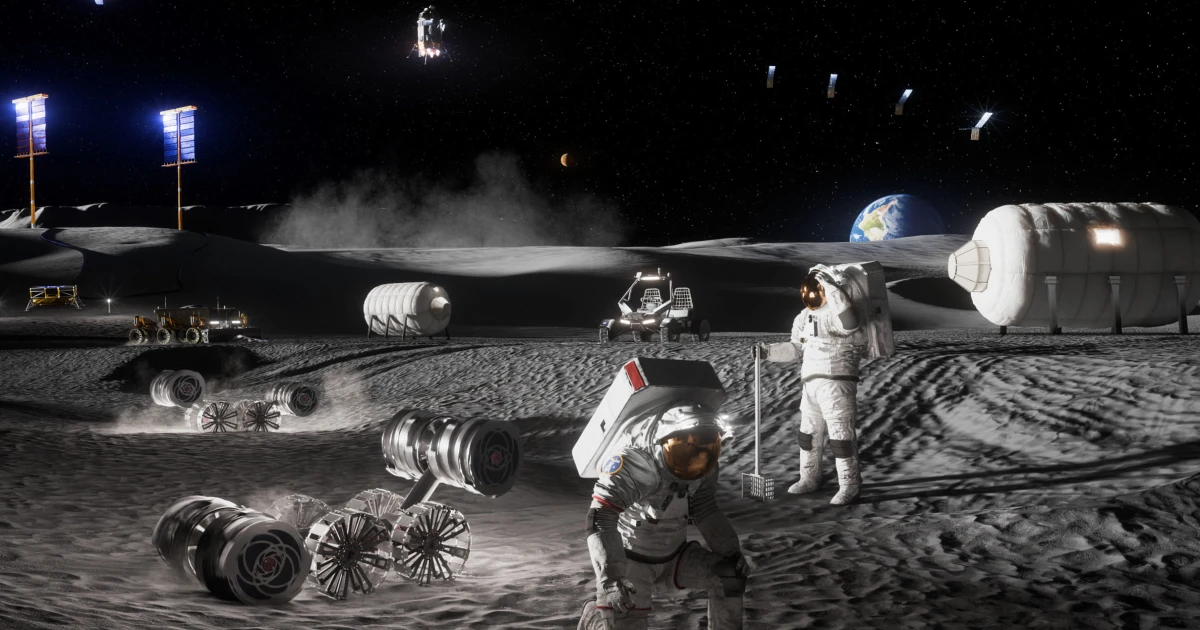
NASA has unveiled exciting plans for three unmanned lunar flights set for later this year, marking a significant step towards establishing a permanent moon base.
Subscribe to read this story without ads
Gain unlimited access to ad-free articles and exclusive content.

These robotic missions aim to explore the lunar south pole, gather scientific data, test groundbreaking technologies, and pave the way for future astronaut missions to the moon.
“We won’t immediately leap into a dome-shaped moon base,” NASA Administrator Jared Isaacman stated during a press conference. “Our strategy involves a gradual approach, signaling to industry the need for various landers, rovers, technology demonstrations, and scientific payloads that these missions will carry.”

Photo: Kevin Dietch/Getty Images
The upcoming missions will be branded as Moonbase 1, Moonbase 2, and Moonbase 3, all slated for launch before the year’s end. Isaacman noted that the first mission is anticipated for this fall.
Blue Origin, Jeff Bezos’s aerospace company, will have a pivotal role in the inaugural mission, having been awarded a contract to transport two science and technology payloads to the moon using their Lunar Lander.
“Moonbase 1 will mark the first privately funded lunar module mission in history,” Isaacman stated.
For the Lunar Base 2 mission, a lander from Pennsylvania’s Astrobotic will carry over 1,000 pounds of cargo and a lunar rover to the moon’s surface.
Moonbase 3’s mission will focus on scientific exploration, particularly studying lunar swirls—unusual formations that appear brighter than their surroundings. It will also deliver payloads from the European and South Korean space agencies, underscoring the international collaboration in lunar exploration,” Isaacman added.
These three missions represent the initial phase of NASA’s broader strategy to establish a permanent lunar base, a phase expected to last until 2029 and comprising a series of unmanned missions.
“The first phase will involve 25 launches and 21 landings, with around 4 tons of cargo scheduled for delivery to the moon’s surface,” stated Carlos García Galán, NASA’s lunar base program manager, during the briefing.
The second phase, spanning 2029 to 2032, will see NASA begin constructing a semi-permanent base that enables early human habitation on the moon.

Artist rendering by NASA
NASA envisions achieving a sustained lunar presence by the third phase, commencing in 2032. García Galán noted that the lunar base could span “hundreds of square miles.” Regular crew missions to and from the lunar surface are anticipated to begin by then, with ongoing activities on the moon.
In an NBC interview, Isaacman articulated that the moon base is crucial for NASA to cultivate the necessary skills for future Mars missions.
“We’re looking at a $20 billion investment over the next seven years aimed at establishing a lasting presence on the moon,” he explained, emphasizing the importance of base-building experience for future Mars endeavors.
NASA also announced substantial funding for commercial aerospace ventures. California’s Astrolab and Colorado’s Lunar Outpost each secured a $220 million contract for the development of the Lunar Rover, which will operate autonomously and be utilized by astronauts on the lunar surface.
Additionally, Texas’s Firefly Aerospace obtained a $75 million contract to create four drones for exploring intriguing areas on the moon’s south pole. Firefly successfully landed its Blue Ghost lander on the moon last year, conducting scientific experiments for NASA.
NASA’s lunar base aspirations will proceed alongside the Artemis lunar return initiative. The Artemis II mission recently sent four astronauts on a ten-day orbit of Earth and the moon, marking NASA’s first moon mission in over 50 years.
The next target is the Artemis III mission planned for 2027 to showcase technology in low Earth orbit, utilizing one or both lunar landers being developed by Blue Origin and SpaceX. Success in this endeavor will pave the way for Artemis IV, which aims to land astronauts on the lunar surface in 2028.
“For those who have waited patiently, the grand homecoming is nearing, and we are committed to pressing forward,” Isaacman concluded.
Source: www.nbcnews.com