


Bat Origins Traced to Europe in Major Genomic Study
Europe was the birthplace of bats, according to an analysis of 103 bat genomes and the fossil record. The findings challenge earlier theories that bats originated in Africa, Asia or North America and provide new insights into the evolution of powered flight, echolocation and global bat diversity.
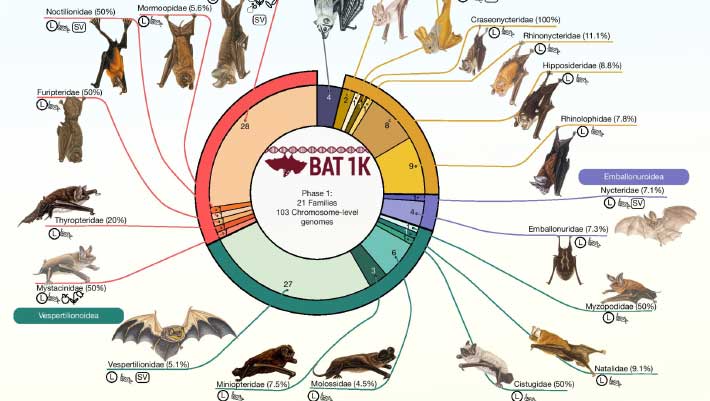
Phase 1 of the Bat1K project: 103 chromosome-level genome assemblies and annotations representing at least one species from each of the 21 currently recognized bat families. Image credit: Morales et al., doi: 10.1038/s41586-026-11007-3.
Genomic evidence points to a European origin
Bats account for more than one-fifth of all living mammal species. Yet, despite decades of research, scientists have continued to debate where and when the first bats evolved.
The new study was conducted during the first phase of the Bat1K consortium, an international effort to sequence the genomes of every living bat species. Researchers analyzed high-quality, chromosome-level genome assemblies from 103 bat species, including 42 genomes generated specifically for the project.
They combined the genomic data with 699 anatomical traits from 65 species. The dataset included 44 fossil species from the Quaternary period and earlier, allowing the team to compare living bats with their extinct relatives.
Using statistical models that accounted for the ages of the fossils, the researchers concluded that the ancestors of all bats lived in Europe during the late Paleocene. Their analysis assigned a 99.2% probability to a European origin, rejecting previous proposals that bats originated in Africa, Asia or North America.
“Bats never cease to amaze us,” said Professor Sonja Vernes, director of Bat1K and a researcher at the University of St Andrews.
“They are one of evolution’s greatest experiments. With this extraordinary genomic resource, we can finally understand how their amazing biology evolved.”
Professor Suzanne Hand of the University of New South Wales said bats have “dominated the night sky for about 65 million years,” while noting that determining where they first flew has been more difficult.
“Advances in genome sequencing and computing now allow us to compare and combine living bat DNA data with the fossil record in ways that were not possible before,” Hand said. “This gives us a clearer picture of the family tree of early bats, and shows us that Europe was where bats first took flight.”
Bat diversity expanded about 56 million years ago
The major bat lineages appear to have diversified within a relatively narrow period during the early Eocene, approximately 56 million years ago. This interval coincided with the Paleocene-Eocene Thermal Maximum, an abrupt episode of global warming.
“The approach we used to model the evolution of fossil and extant species together allows us to do something that would otherwise be impossible,” said Professor Liliana Dávalos, a researcher at Stony Brook University.
“It allows us to identify the oldest groups of fossil bats while accounting for genomic data, and reveal when and where bats originated.”
Did flight or echolocation evolve first?
The Bat1K team also investigated one of the longest-running questions in bat evolution: whether laryngeal echolocation evolved before or after bats began to diversify.
The researchers placed the fossil species Vielasia on the oldest branch of the bat family tree. This suggests that echolocation using sounds produced in the larynx predates the diversification of modern bats and may have evolved in close association with powered flight.
“For decades, the question has been whether flight or echolocation comes first in bats, because bats cannot fly at night without some kind of perceptual change to enable flight in the dark,” Dávalos said.
“Our analysis shows that the oldest lineages of bats already included distinct echolocating species.”
“Thus, based on these fossil trees, we believe that bat echolocation evolved shortly after mammalian flight.”
New insights into the bat family tree
The genomic data also helped researchers reconstruct relationships among bat groups. The study places Myzopodidae, a family found in Madagascar, as the earliest branch of the superfamily Vespertilionoidea.
The analysis also identifies Emballonuroidea and Vespertilionoidea as sister groups.
Professor Emma Teeling, a researcher at University College Dublin and co-founder and director of the Bat1K consortium, said the research resolves decades of contradictory findings.
“After decades of research and contradictory findings, it is amazing that we finally have a robust phylogenetic tree that can be used to properly understand how the unique traits of bats have evolved,” Teeling said.
“We also have the genome to reveal the molecular basis of these amazing adaptations and to see where bat fossils fall in this tree.”
How bats spread across the oceans
The researchers also used the combined genomic and fossil evidence to investigate how bats crossed oceans and reached new continents.
For the major group Noctilionoidea, the analysis favors a route across the North Atlantic from Europe to North America approximately 54 million years ago, rather than a route through the Bering region.
The study also rejects the idea that noctilionid bats reached South America by migrating from Africa through the islands.
Instead, the timing and route of their arrival coincided with the expansion of mid-latitude tropical regions in the Americas and Europe and the beginning of the uplift of the islands of the Isthmus of Panama. These changes provided habitat and a North American route for the group’s diversification, the researchers said.
The findings are published in the journal Nature.
_____
A. E. Morales et al. “Reference genomes and fossils correct the phylogeny and biogeography of bats.” Nature, published online September 23, 2026. doi: 10.1038/s41586-026-11007-3.
Source: www.sci.news