


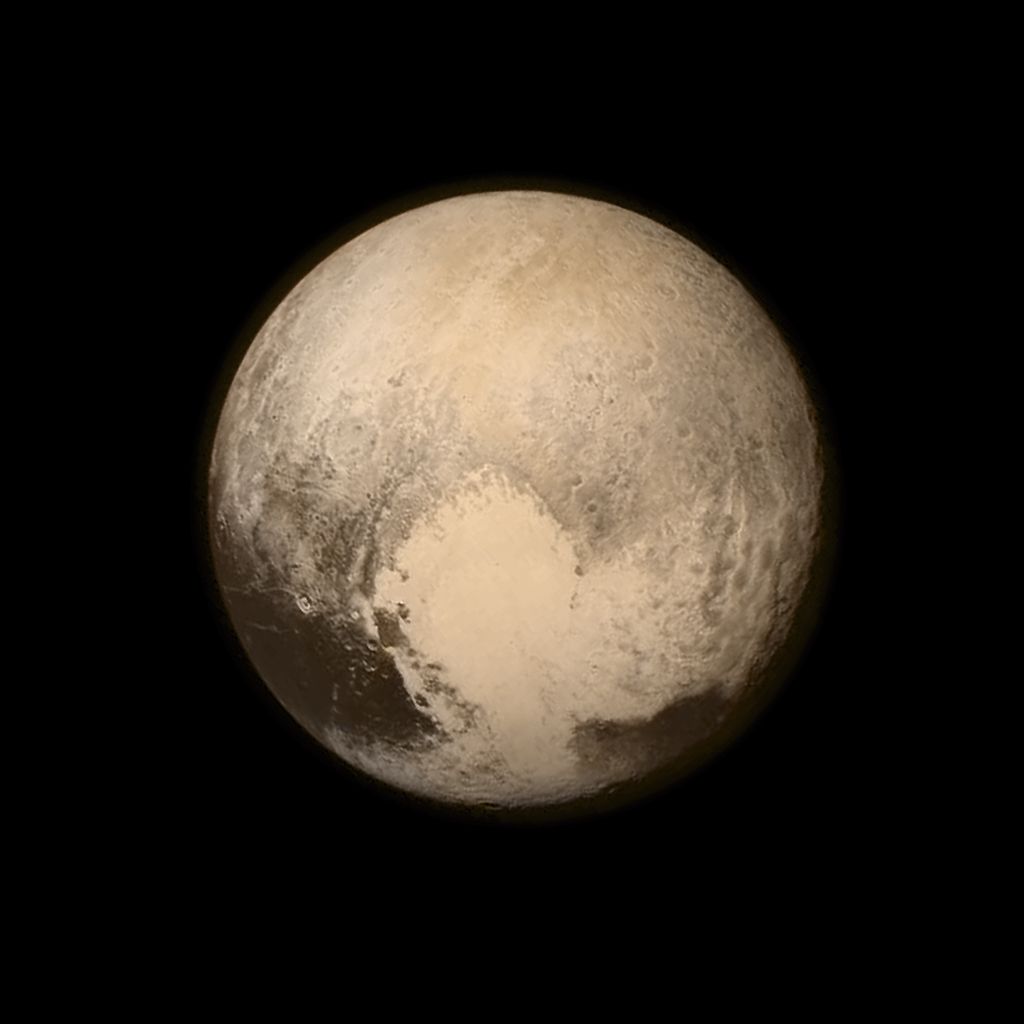
Pluto is the best-known dwarf planet beyond Neptune—and one of the solar system’s most beloved worlds
NASA / APL / SwRI via Getty Images
Pluto was discovered by a 24-year-old observatory assistant from the American Midwest. Clyde Tombaugh, born in 1906 in Streator, Illinois, developed a passion for astronomy at an early age. The self-taught astronomer built his own telescopes and used them to study Mars, Jupiter and other objects in the night sky.
Tombaugh eventually wrote to the Lowell Observatory in Flagstaff, Arizona, seeking feedback on his astronomical drawings. Instead of simply receiving an expert opinion, he was offered a job as an assistant. His assignment was to search for a theorized ninth planet beyond Neptune.
On February 18, 1930, Tombaugh examined photographic glass plates taken several days apart. Using a blink comparator, he rapidly switched between the images and noticed a tiny point of light shifting position against the background stars.
That moving dot was Pluto, a small, icy world in the outer solar system. Tombaugh had found the object that Lowell Observatory leaders had been seeking for decades.
“It took the right person with the right amount of focus, because it was a needle in a haystack looking at dots—a dot that moved against the background of hundreds of thousands of dots,” says Kevin Schindler, longtime historian and public information officer at Lowell Observatory.
After additional observations, the observatory publicly announced Pluto’s discovery on March 13, 1930. The announcement coincided with what would have been the 75th birthday of astronomer Percival Lowell, who founded the observatory in 1894.
/https://tf-cmsv2-smithsonianmag-media.s3.amazonaws.com/filer_public/35/04/3504c9fb-d748-4400-8a8f-da0953b5100d/ezgif-362247de9926abb2.jpg)
Bettmann via Getty Images
/https://tf-cmsv2-smithsonianmag-media.s3.amazonaws.com/filer_public/2f/12/2f120f16-d2f4-4322-88d8-968a27472ea1/gettyimages-515132042.jpg)
Bettmann via Getty Images
Lowell had predicted that a ninth planet, which he called Planet X, might exist beyond Neptune. He began a formal search in 1905, but died in 1916 after spending much of the previous 11 years looking for the unseen world. Although Lowell never witnessed Pluto’s discovery, the find fulfilled a dream he had pursued at his own observatory.
The newly discovered world was named Pluto after the Roman god of the underworld. The name also suited an object located so far from the sun, Schindler explains.
Quick facts: Pluto and its moons
Lowell and Tombaugh’s connection to Pluto remains central to Flagstaff’s identity. Each February, Lowell Observatory hosts the I Heart Pluto Festival, an event that combines astronomy, history and public programs. Observatory staff are also preparing for the centennial of Pluto’s discovery in 2030.
“Flagstaff is Plutotown, USA,” Schindler says.
Pluto’s popularity has only grown since August 24, 2006, when the International Astronomical Union voted to redefine the solar system’s planets and classify Pluto as a dwarf planet. Rather than ending public interest, the decision made Pluto an even more recognizable and controversial object, Schindler says.
“It keeps people interested,” he says. “It keeps people really fired up about it.”
The debate over Pluto’s status intensified after the 2005 discovery of Eris, a distant dwarf planet that is similar in size to Pluto but more massive. The discovery raised a fundamental question: If Pluto remained a planet, should Eris and other newly identified worlds also be added to the list?
“They have rightfully called into question whether or not they should be considered as new ‘planets,’” Ron Ekers, then-president of the IAU, said in 2006. The organization had spent roughly two years developing a formal definition of the word “planet.”
One proposal debated at the IAU’s August 2006 general assembly would have expanded the solar system to 12 planets. The proposed additions included Ceres, Charon, Pluto’s largest moon, and Eris. Members ultimately rejected that plan and instead established a solar system with eight major planets.
Under the final resolution, Pluto became a “dwarf planet,” a category distinct from the eight planets. “It was agreed that ‘planets’ and ‘dwarf planets’ are two distinct classes of objects,” the IAU noted at the time.
/https://tf-cmsv2-smithsonianmag-media.s3.amazonaws.com/filer_public/c5/f3/c5f3a976-00e3-47c6-b10d-16039055d5ee/dwarf-planets.webp)
NASA / JPL-Caltech
The IAU defines a planet as a celestial body that orbits the sun, has enough mass for its gravity to make it nearly round and has cleared most other objects from its orbital neighborhood.
Pluto meets the first two conditions but not the third. Its orbit lies within the Kuiper Belt, an icy region beyond Neptune filled with smaller bodies. Pluto’s gravity has not cleared those objects from its path, so the IAU classified it as a dwarf planet.
Planetary scientist Alan Stern, principal investigator of NASA’s New Horizons mission, disagreed with the decision. He has described the vote as a failure of the IAU’s planetary definition. In his view, dwarf planets are still planets, just as dwarf stars are still stars.
Schindler also questions whether voting was the right way to settle the issue. “Science is done based on research; you do papers, you share at conferences, and you come up with sort of a consensus, but you don’t sit around a table and vote on it,” he says.
The makeup of the voting group became another source of controversy. Astronomers from many specialties participated, rather than only planetary scientists, says Samantha Thompson, astronomy curator at the Smithsonian’s National Air and Space Museum.
Public protests followed Pluto’s reclassification. Many people asked what makes an object a planet and viewed Pluto as a beloved world that had been unfairly singled out. “I think about all the T-shirts that were made that were like, ‘RIP Pluto,’” Thompson says.
Schindler recalls a visitor at Lowell Observatory asking whether the staff was all right after “they took your planet away.” His response was simple: Pluto was still there.
Although news headlines often described Pluto as having been “demoted,” Thompson emphasizes that a dwarf planet is not an inferior object. “A ‘planet’ is not better than a ‘dwarf planet,’” she says.
/https://tf-cmsv2-smithsonianmag-media.s3.amazonaws.com/filer_public/9d/58/9d582578-b388-4a55-931c-1d1f800557f7/2338706385_b08449aee2_k.jpg)
javacolleen via Flickr under CC BY-NC-ND 2.0
Two decades after the IAU vote, planetary scientists continue to discuss Pluto as a planet in scientific research, even while recognizing its official classification as a dwarf planet.
“Scientific papers call the dwarf planets ‘planets’ on a routine basis, because that’s what they are in terms of classification, they’re just smaller,” Stern says. “I like to say, ‘A chihuahua is still a dog.’”
When the IAU changed Pluto’s classification, NASA’s New Horizons spacecraft was already traveling toward the distant world. The probe launched on January 19, 2006, about seven months before the vote.
The controversy ultimately helped increase public interest in the mission. “They couldn’t have done us a bigger favor,” says Fran Bagenal, a planetary scientist and New Horizons co-investigator. The debate encouraged more people to follow the spacecraft’s journey and learn about Pluto.
Located roughly 3.7 billion miles from the sun, Pluto is a guide to the many icy worlds beyond Neptune. “It’s the biggest, the brightest and the best known of all the dwarf planets in the Kuiper Belt,” Stern says.
New Horizons reached Pluto in July 2015 after a journey of nearly nine and a half years. For the first time, scientists could study the former planet up close rather than as a moving point of light on a photographic plate.
The spacecraft revealed a surprisingly complex world. “We thought that it was going to be a lump of ice and rock, covered with impact craters and just an old surface,” Bagenal says. Instead, New Horizons found active geological processes, including rifts, glacial flows and enormous blocks of ice.
/https://tf-cmsv2-smithsonianmag-media.s3.amazonaws.com/filer_public/b1/a5/b1a50557-1994-4e4b-83f4-74cc5d929faf/gettyimages-480799068.jpg)
NASA / APL / SwRI via Getty Images
/https://tf-cmsv2-smithsonianmag-media.s3.amazonaws.com/filer_public/d5/5d/d55d1f79-d8d1-4007-aec5-a1c6c7ae564a/pia21590_800w.jpg)
NASA / Johns Hopkins University Applied Physics Laboratory / Southwest Research Institute
Some regions of Pluto remain geologically active. Fresh ice rises to the surface, creating bright white areas, while atmospheric aerosols settle over other locations and give the terrain a smooth, “gooey” appearance, Bagenal says.
Scientists were particularly surprised by the scarcity of craters in some regions. “We knew it probably had some active geological processes on it, but we didn’t expect to see large swaths of the planet that had, for instance, no craters on it,” says geologist Jeff Moore, a New Horizons co-investigator and imaging node leader.
One such region, Sputnik Planitia, is a vast plain covered with frozen nitrogen. The glacial basin is approximately the size of Oklahoma and Texas combined and contains virtually no impact craters, suggesting that it continues to evolve today.
Sputnik Planitia makes up part of Pluto’s most recognizable feature: its enormous heart-shaped region.
“By good luck, the hemisphere we decided to fly over with New Horizons had this great heart-shaped feature on it, which we didn’t know was there at the time,” Moore says. In honor of Tombaugh’s discovery, the heart-shaped area is officially called Tombaugh Regio.
New Horizons returned a vast amount of data about Pluto and its moons. The spacecraft showed that Pluto rivals Earth and Mars in geological complexity, challenging earlier assumptions about how active small worlds can be.
/https://tf-cmsv2-smithsonianmag-media.s3.amazonaws.com/filer_public/40/46/40467c6d-6011-4848-ba3f-d595b1248de5/gettyimages-480658764.jpg)
Brendan Smialowski / AFP via Getty Images
/https://tf-cmsv2-smithsonianmag-media.s3.amazonaws.com/filer_public/99/e7/99e71ed9-4abf-4551-b8ff-60788b92be4a/gettyimages-481812416.jpg)
Win McNamee / Getty Images
/https://tf-cmsv2-smithsonianmag-media.s3.amazonaws.com/filer_public/0b/f2/0bf22792-2230-4fbf-962f-6197c6a49fa7/gettyimages-480661418.jpg)
Bill Ingalls / NASA via Getty Images
Pluto’s scientific importance is matched by its cultural appeal. For people who grew up during the 20th century, Pluto was the only mysterious planet in the solar system that had not yet been explored, Stern says. The 2006 IAU decision also transformed Pluto into an underdog with a devoted following.
“It’s small and cute,” Stern says children often tell him. “It’s like a puppy.”
“Kids just love Pluto,” Bagenal says.
After Pluto’s reclassification, Canadian Broadcasting Corporation reporter Karl Wells interviewed two children, Nathan and Megan Ridley, about the decision. Nathan said Pluto should not be downgraded because it was one of his favorite planets. When asked why he liked Pluto, he pointed to another famous Pluto—the beloved Disney dog.
The debate also gave teachers an opportunity to explain how science changes with new evidence. “It’s exciting,” fourth-grade teacher Rich Hogen told CNN in 2006. “It’s a chance to teach kids that this is the nature of science. Things are always changing.”
Other educators wished the decision had expanded the list of planets instead. Florida teacher Becky Peltonen said she hoped additional planets would inspire students to imagine what else might be waiting to be discovered.
/https://tf-cmsv2-smithsonianmag-media.s3.amazonaws.com/filer_public/c0/55/c0557446-f0ce-4908-a4ac-4983fb247722/gettyimages-480810266.jpg)
Mark Wilson / Getty Images
Pluto may have held special meaning for many American children because it was the only planet discovered in the United States by an American astronomer, Thompson suggests.
The IAU is scheduled to meet in 2027, and Thompson will be watching to see whether members revisit the definition of a planet. In April 2026, NASA administrator Jared Isaacman said he was looking into the possibility of restoring Pluto’s status as the ninth planet and repeated that position during a Senate hearing later that month.
Whatever scientists ultimately call it, Pluto remains one of the solar system’s most fascinating worlds. Its classification may change again, but its scientific value and public appeal are unlikely to fade.
“I just love that people love it so much,” Thompson says.
Stern recalls several encounters that demonstrated Pluto’s emotional power. One man told him that seeing Pluto had inspired him to keep living so he could witness more discoveries. Stern also heard from a mother whose son became interested in science after the New Horizons flyby. “She said to me, ‘You saved my son’s life,’” he recalls.
Pluto changed Tombaugh’s life, too. After his discovery, he received a scholarship to study astronomy at the University of Kansas. There he met Patricia Edson, the sister of fellow student James Edson. Clyde and Patricia married in 1934 and had two children, Annette and Alden.
In the foreword to Schindler and Will Grundy’s book, Pluto and Lowell Observatory: A History of Discovery at Flagstaff, Annette writes, “My brother and I exist because of Pluto.”
Source: www.smithsonianmag.com